
Why does the order matter?
Debt advisers sort debts by what the creditor can do to you, not by how much you owe or who shouts loudest. A small council tax debt can lead to bailiffs within weeks. A large credit card debt can only lead to court action, and that usually takes months.
| Priority debts | Non-priority debts | |
|---|---|---|
| Worst outcome | Losing your home, energy supply or liberty, or bailiffs | A CCJ and damage to your credit file |
| Bailiffs? | Often without a court case, after a liability order or warrant | Only after a CCJ you haven't paid as ordered |
| Deductions from wages or benefits? | Often, without going to court | Only after a court order |
| How much to pay | An affordable amount towards arrears, plus your ongoing bill | What's left after priorities and essentials, even a token amount |
Priority debts
| Debt | What can happen if you don't pay |
|---|---|
| Mortgage or secured loan arrears | Your home could be repossessed |
| Rent arrears | Eviction |
| Council tax | Bailiffs, deductions from wages or benefits, and in rare cases prison |
| Gas and electricity (utility bills) | A prepayment meter, or in rare cases disconnection |
| Magistrates' court fines | Bailiffs, deductions from wages or benefits, and in serious cases prison |
| Council parking fines | Bailiffs |
| Income tax, VAT and National Insurance (HMRC debt) | Taking control of goods, or court action |
| Child maintenance | Deductions from wages or bank accounts, and other enforcement |
| Business rates | Bailiffs, bankruptcy or winding up, and in rare cases prison |
| TV licence | Watching live TV without a licence is a criminal offence, which can lead to prosecution and a fine |
| Hire purchase on essential goods, such as a car you need for work | The goods can be taken back |
Non-priority debts
These include credit cards, personal loans and overdrafts, payday loans, catalogues, buy now pay later, store cards, money owed to friends and family, and most unsecured debts. Student loans are repaid through your wages, so they rarely need a separate plan. Water bills are usually treated as non-priority, because domestic water can't be cut off, but keep paying for your current use.
If you don't pay non-priority debts, creditors can add charges, record defaults on your credit file and take you to court for a CCJ. Only after a CCJ can they use bailiffs.
Which debts can be either priority or non-priority?
- CCJ debts: the debt itself is non-priority, but if you break the court order, the creditor can send bailiffs or take money from your wages. Keep up the payments the court ordered, or ask to change them.
- Hire purchase and car finance: a priority if you need the car, for example for work or a disability, because it can be taken back.
- Benefit overpayments: usually taken from your benefits, so there's often no separate payment to make. If you're not on benefits, the DWP can now take money from your bank account, so treat them seriously.
- Phone, broadband and mobile: non-priority, but you may need them. Ask about a cheaper social tariff instead of falling further behind.
- Debts to friends and family: non-priority in law, though you may feel differently about them.
How to deal with them
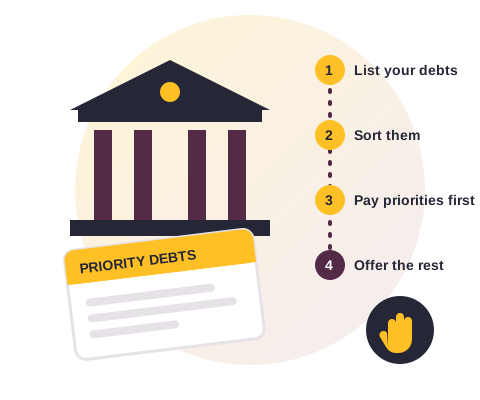
- List every debt and what you pay each month.
- Do a budget covering essentials first.
- Agree affordable plans for priority debts, starting with the most urgent.
- Offer what's left to non-priority creditors through an informal arrangement or a Debt Management Plan.
Don't let a non-priority creditor pressure you into paying them before rent, council tax or energy, and don't borrow to pay priority bills.
How do I do a budget for my debts?
- Add up your income: wages, benefits, pensions, child maintenance and any other money coming in each month.
- List essential spending: rent or mortgage, council tax, energy, water, food, travel, childcare, phone and insurance.
- Take essentials away from income. What's left is what you can put towards debts.
- Pay priority arrears first, then share anything left between non-priority creditors, in proportion to what each is owed.
Creditors and bailiffs often accept the Standard Financial Statement, the budget format used by free debt advisers. Free tools from MoneyHelper, National Debtline and StepChange produce one for you. If there's nothing left, tell non-priority creditors in writing and ask them to hold or freeze the account.
What if a non-priority creditor pressures me to pay?
Lenders and debt collectors must follow FCA rules: they should treat you fairly, consider your budget and not pressure you to pay more than you can afford. If they do:
- explain in writing that you have to pay priority bills first, and send your budget
- offer what you can afford, even a token payment of £1 a month for a while
- ask them to freeze interest and charges
- if they keep pressuring you, complain to them, then to the Financial Ombudsman Service. See debt collection agencies.
What if I can't afford my priority debts?
- Check your benefits and discounts, such as Council Tax Reduction, the single person discount, and any benefits you're missing out on.
- Ask for help with housing costs: Crisis and Resilience Fund Housing Payments from your council in England, or Discretionary Housing Payments in Wales.
- Ask your energy supplier about hardship funds, payment plans and the Warm Home Discount.
- Tell priority creditors early, before action escalates. Councils, landlords and suppliers have to consider affordable plans.
- Get Debt Breathing Space to pause most action for 60 days while you get advice.
Can priority debts go into a debt solution?
| Solution | Priority debts |
|---|---|
| Debt Management Plan | Usually not. Pay priority bills alongside it |
| IVA | Arrears of council tax and some others can be included. Ongoing bills must still be paid |
| Debt Relief Order | Rent, council tax and energy arrears can be included. Fines, child maintenance and student loans can't |
| Bankruptcy | Most arrears can be included. Fines and child maintenance can't |
Getting help
If you can't keep up with priority debts, get advice quickly. Debt Breathing Space can pause most creditor action for 60 days, and formal options like a DRO, IVA or bankruptcy can deal with non-priority debts. See all your debt options.
Behind on priority bills?
Tell us about your debts and a licensed insolvency practitioner will call you back to talk through your options. It's free, with no obligation.
Questions about priority debts
What is a priority debt?
A debt where not paying could lead to serious consequences, such as losing your home, having your energy supply affected, bailiffs or prison. Examples are rent, mortgage, council tax, energy bills and court fines.
Is a credit card a priority debt?
No. Credit cards are non-priority debts. You should still deal with them, but only after your priority debts and essential bills.
Is water a priority debt?
Usually not, because water companies can't disconnect a domestic supply. But keep paying for your current water use, and deal with arrears once priority debts are covered.
Is a CCJ a priority debt?
The debt itself is non-priority, but if you break the court order, the creditor can enforce it with bailiffs or wage deductions. Keep up the ordered payments or ask the court to change them.
Is car finance a priority debt?
It can be, if you need the car for work, health or caring, because the finance company can take it back.
Should I pay my credit card or council tax first?
Council tax. It's a priority debt, and the council can use bailiffs without going back to court once it has a liability order.
Can non-priority creditors send bailiffs?
Only after they've taken you to court and got a County Court Judgment that you haven't paid as ordered.
