
When can a creditor use High Court enforcement officers?
Most creditors collect debts through the County Court. But a creditor can transfer a County Court judgment to the High Court for enforcement if:
- you haven't paid the judgment as the court ordered,
- the debt is more than £600, and
- the debt isn't regulated by the Consumer Credit Act 1974.
That means credit cards, overdrafts, payday loans and most personal loans can't be enforced by HCEOs. They're more often used for business debts, utility arrears, old rent arrears and tribunal awards. Very large claims, generally over £100,000, can also be started in the High Court.
What happens when a High Court enforcement officer is involved?
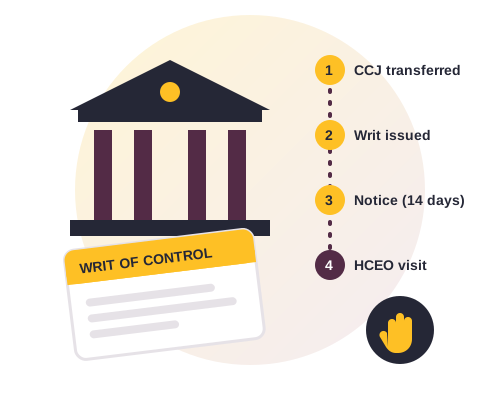
- The creditor gets a writ of control. This lets an HCEO visit you and take control of goods.
- You get a Notice of Enforcement. It must give you at least 14 clear days before the first visit. A debt adviser can ask for this to be extended to 28 days.
- The HCEO visits. They'll usually ask for payment in full. If you can't pay, they'll list goods that could be sold.
- A controlled goods agreement. You can usually keep the goods while you pay in instalments. Miss a payment and they can return to remove them.
- Goods taken straight away. Sometimes, for example with a valuable car, or if they think goods might disappear, items are removed or clamped at the first visit.
How much do High Court enforcement officers charge?
HCEOs use a higher fee scale than other bailiffs. The fees are fixed by law.
| Stage | Fixed fee | Plus |
|---|---|---|
| Compliance (Notice of Enforcement) | £79 | None |
| First enforcement (first visit) | £200 | 7.5% of the debt over £1,200 |
| Second enforcement (refusing or breaking an arrangement) | £520 | None |
| Sale or disposal | £550 | 7.5% of the debt over £1,200 |
VAT can be added, along with costs such as storage and auction fees. Since 1 May 2026, if you pay in full or agree an arrangement and keep to it, only the first enforcement fee can be charged. Compare these with other bailiff fees.
Can High Court bailiffs force entry?
Not into your home on a first visit. They can't push past you, put a foot in the door or climb through a window or skylight. Keep doors locked and don't leave valuables, including your car, where they can be reached.
If they've already been inside and listed goods in a controlled goods agreement, they can use reasonable force to re-enter if you don't keep to it. The rules for business premises are different, and HCEOs may be able to force entry there in some circumstances. Our guide can bailiffs force entry? explains the rules for every type of debt.
How can I stop High Court enforcement officers?
Pay before the visit
If you can pay in full before the first visit, do it. This keeps the fees to the £79 compliance fee.
Offer instalments
Write to the HCEO with your offer and budget, copy in the creditor and start paying at that rate, even if they don't reply.
Apply for a stay of execution
If they won't agree, apply to the court on the N244 form with your offer and budget. A fee applies, but you may get Help with Fees.
Vary the judgment
You can also ask the County Court to change the payments on the original CCJ. If it agrees and you keep paying, most other action stops.
A debt adviser can also apply for Debt Breathing Space, which pauses enforcement, interest and charges for 60 days. If you think you've been overcharged, you can complain to the firm and then the Enforcement Conduct Board.
Had a letter from a High Court enforcement officer?
Tell us about your debts and a licensed insolvency practitioner will call you back to talk through your options. It's free, with no obligation.
Questions about High Court enforcement
Can High Court enforcement officers force entry?
Not into your home on a first visit. They can't push past you, put a foot in the door or climb through a window. They can only use force to re-enter if they've already listed goods in a controlled goods agreement and you've broken it. Business premises have different rules.
Can a credit card debt be passed to High Court enforcement officers?
No. Debts regulated by the Consumer Credit Act, such as credit cards, overdrafts, personal loans and payday loans, can only be enforced in the County Court. HCEOs usually collect business debts, old utility or rent arrears and other unregulated debts over £600.
How much can High Court enforcement officers charge?
£79 for the Notice of Enforcement, £200 plus 7.5% of the debt over £1,200 for the first visit, £520 for a second visit if you refuse or break an arrangement, and £550 plus 7.5% over £1,200 for a sale. VAT and some costs can be added on top.
What is a stay of execution?
It's a court order that pauses High Court enforcement. You apply on the N244 form, explaining why you can't pay and making an offer. The court will look at your budget and decide whether to pause enforcement while you pay.
Do HCEOs add interest to the debt?
Often, yes. Once a non-regulated judgment is enforced in the High Court, statutory interest of 8% a year can usually be added until it's paid.
