
Debt Advice
Debt advice: compare your options for getting out of debt
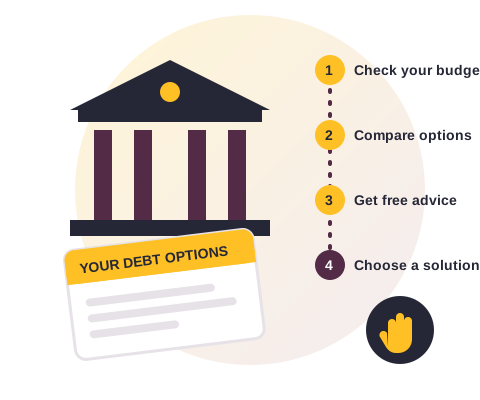
There are nine main ways to deal with problem debt in England and Wales. Some give you breathing room, some help you repay in full at an affordable rate, and some write off what you can't afford. Compare them side by side, then get free debt help to choose.
What types of debt can we help with?
From high street lenders to payday loans, most types of debt can be dealt with through a debt solution. Some, like court fines and student loans, need to be handled separately. If bailiffs are already involved, our free bailiff help explains your rights and how to stop enforcement.
- Credit cards
- Personal loans
- Overdrafts
- Store cards
- Catalogues and BNPL
- Payday loans
- Utility bill arrears
- Council tax arrears
- Business debts
- HMRC tax debts
- Bailiff and debt collector debts
- County Court judgments (CCJs)
The 9 main debt solutions
Tap any option for a full guide, including who it suits, how it works and a worked example.
Debt Breathing Space
60 days' legal protection from most interest, charges and enforcement while you get advice.
Informal payment arrangement
Agree lower payments directly with each creditor. Flexible, free and quick to set up.
Debt Management Plan (DMP)
One affordable monthly payment shared between your non-priority creditors until the debt is repaid.
Fixed end dateIndividual Voluntary Arrangement (IVA)
A legally binding plan for a fixed term. Interest is frozen and qualifying debt left at the end is written off.
Fixed end dateSelf-employed IVA
An IVA built around your business, so you can keep trading. Tax arrears can usually be included.
Debt Relief Order (DRO)
For low income and few assets. Qualifying debts up to £50,000 are written off after 12 months, with no fee.
Bankruptcy
A fresh start when you can't repay. Usually lasts 12 months but can affect your home, assets and some jobs.
Debt consolidation loan
One new loan to pay off several debts. Only helps if the new loan is cheaper and affordable.
Administration Order
One payment to the court if you have a County Court judgment and total debts of £5,000 or less.
8 ways debt help could benefit you
What you get depends on the solution you choose. Every option also has downsides, which will be explained before you decide.
Freeze interest and charges
Formal solutions like an IVA stop interest and charges being added to the debts included.
One affordable payment
Replace lots of separate payments with one monthly amount based on what you can afford.
Legal protection
Once an IVA, DRO or bankruptcy is in place, the creditors included can't take further action.
Fewer calls and letters
Creditors deal with your plan provider, so the pressure from calls and letters eases.
Write off part of your debt
Some solutions write off qualifying debt you can't afford to repay at the end.
Less stress and worry
A clear plan with an end in sight can make debt much easier to live with.
No need to borrow from family
Deal with your debts without asking friends or family for money.
A fresh start
Get back in control of your money and plan for the future.
How do the debt solutions compare?
A quick comparison of the key features. Swipe sideways on a phone to see the whole table.
| Solution | Legally binding? | Writes off debt? | Usual length | Cost | Credit file | Your home |
|---|---|---|---|---|---|---|
| Breathing Space | Legal protection | No | 60 days | Free | Not shown | Not affected |
| Informal arrangement | No | Rarely | Until repaid | Free | Arrears may show | Not affected |
| Debt Management Plan | No | No | Until repaid | Free from charities | Usually 6 years | Not affected |
| IVA | Yes | Yes | 5 or 6 years | Fees come from payments | 6 years | Excluded under the IVA Protocol |
| Self-employed IVA | Yes | Yes | 5 or 6 years | Fees come from payments | 6 years | Excluded under the IVA Protocol |
| Debt Relief Order | Yes | Yes | 12 months | No fee | 6 years | Not usually for homeowners |
| Bankruptcy | Yes | Yes | Usually 12 months | £680 | 6 years | Can be at risk |
| Consolidation loan | No | No | Loan term | Interest | New loan shows | At risk if secured |
| Administration Order | Court order | Sometimes | Until repaid | Up to 10% of payments | 6 years | Not affected |
Figures checked November 2026 for England and Wales. Every option has eligibility rules and downsides, which are explained on each guide.
Which debt solution might suit me?
A starting point only. Your full circumstances decide what's right, so always get advice before you choose.
| If this sounds like you | Look at |
|---|---|
| You need time to get advice and stop things getting worse | Debt Breathing Space |
| You can afford something and your problems are short term | Informal payment arrangement |
| You can repay in full, just not at the current rate | Debt Management Plan |
| You owe £8,000+, have regular spare income and want a fixed end date | IVA |
| You're a sole trader or partner with business and personal debts | Self-employed IVA |
| You have £75 a month or less spare, few assets and owe £50,000 or less | Debt Relief Order |
| You can't realistically repay and a DRO or IVA isn't right | Bankruptcy |
| Your credit is good and a new loan would cost less overall | Debt consolidation loan |
| You have a CCJ and owe £5,000 or less in total | Administration Order |
Getting debt help in 3 simple steps
- Answer a few questionsFill in our short call-back form to tell us a little about your debts. It takes about a minute.
- Talk it throughA licensed insolvency practitioner calls you at a time that suits you. They'll listen, without judgement, and explain the options that could fit.
- You decideTake your time. There's no pressure and no obligation, and nothing happens unless you choose to go ahead.
Things to check first
- Deal with priority debts first. Rent or mortgage, council tax, energy and court fines come before credit cards and loans. See our guide to priority and non-priority debts.
- Work out a realistic budget. Every solution is based on what you can genuinely afford after essential bills.
- Check you're getting everything you're entitled to, such as benefits, Council Tax Reduction and grants. Our extra support page lists free services that can help.
- Avoid firms that charge upfront fees. Free, impartial debt advice is always available.
Free, impartial debt advice is available from MoneyHelper, a free service backed by the government. Bailiff Helpline isn't connected to MoneyHelper.
Important things to know before choosing a debt solution
- Fees may apply. Some solutions, such as an IVA or bankruptcy, have fees. They'll be explained in full before you agree to anything.
- Your credit rating will usually be affected. Most solutions stay on your credit file for 6 years.
- Some solutions are public. IVAs, Debt Relief Orders and bankruptcies are recorded on the public Individual Insolvency Register.
- Your home and assets. Some solutions can affect your home, car or other assets. Homeowners in an IVA are protected by the IVA Protocol, but other solutions differ.
- Not every solution suits everyone. Eligibility rules apply, and an IVA can fail if you can't keep up the payments.
- Think carefully before borrowing to repay debts or securing debts against your home.
- How we're paid. If you ask for a call back, we pass your details, with your consent, to a licensed insolvency practitioner who may pay us a fee. This doesn't cost you anything. How we're paid.
Bailiffs already involved?
Tell us about your debts and a licensed insolvency practitioner will call you back to talk through your options. It's free, with no obligation.
Questions about debt advice and debt solutions
Can I write off some or all of my debt?
Possibly. An IVA, a Debt Relief Order or bankruptcy can write off qualifying unsecured debts, such as credit cards, loans, overdrafts and catalogues, once the solution ends successfully. How much is written off depends on what you can afford and the solution you choose. Some debts can't be written off, including court fines and most student loans.
What debt solutions are available to me?
In England and Wales the main options are Breathing Space, informal payment arrangements, Debt Management Plans, IVAs (including self-employed IVAs), Debt Relief Orders, bankruptcy, debt consolidation loans and Administration Orders. Which ones are open to you depends on how much you owe, your income and spending, and what you own.
How do I know which debt solution is right for me?
It depends on your full circumstances: whether you can repay in full, how much you have left each month after essential bills, whether you own your home and the types of debt you have. A licensed insolvency practitioner or free debt adviser can look at your budget and explain the pros and cons of each option before you decide.
Can I get help with my debts if I have a low income?
Yes. If you have little spare money each month, options such as a Debt Relief Order (for £75 a month or less spare and debts up to £50,000), Breathing Space or reduced payment arrangements may help. It's also worth checking you're getting all the benefits and discounts you're entitled to.
Can I get debt advice if I am unemployed?
Yes. Being out of work doesn't stop you getting help. Creditors must treat you fairly if you can't pay, and options like Breathing Space, token payments or a Debt Relief Order may suit you. Free charities can also help you check your benefit entitlement.
Is debt advice free and confidential?
Yes. Requesting a call back through Bailiff Helpline is free, confidential and there's no obligation. Free, impartial debt advice is also available from charities such as MoneyHelper, StepChange, National Debtline and Citizens Advice. Some formal debt solutions, such as an IVA or bankruptcy, have fees, which are explained before you agree to anything.
How quickly can I get help with my debts?
Our call-back form takes about a minute, and a licensed insolvency practitioner will usually call you back within one working day, at a time you choose. If bailiffs are involved, act quickly. A debt adviser can ask for more time or apply for Breathing Space to pause most enforcement.
Will getting debt advice affect my credit score?
No. Asking for advice or a call back doesn't affect your credit file. Some debt solutions do. An IVA, Debt Relief Order, bankruptcy or Debt Management Plan will usually show on your credit file for 6 years, and this will be explained before you choose.
Can I get debt help if I have multiple creditors?
Yes. Most debt solutions are designed for people with several creditors. A DMP or IVA, for example, replaces lots of separate payments with one affordable monthly payment shared between your creditors.
What happens when I speak to a debt adviser?
They'll ask about your debts, income, outgoings and what you own, so they understand your situation. Then they'll explain the options that could suit you, including the costs, risks and effect on your credit file. There's no pressure to decide on the call, and you choose what happens next.

Page last updated:
By Wes, Site Admin at Bailiff Helpline · Covers England and Wales