
Why do benefit overpayments happen?
- a change in your circumstances, such as income, work, savings or who lives with you, wasn't reported or was reported late
- a mistake by the DWP, HMRC or the council
- tax credit awards that were finalised at the end of the year and found to be too high
- Housing Benefit paid after you moved, or after your income or household changed
- Carer's Allowance paid while your earnings were over the limit
Overpayments can go back years and run into thousands of pounds. Always check the figures before you agree to anything.
Who will ask me to repay?
| Benefit | Who recovers it |
|---|---|
| Universal Credit, ESA, JSA, PIP, Pension Credit, Carer's Allowance and most DWP benefits | DWP Debt Management |
| Tax credits | HMRC, or the DWP if you've moved to Universal Credit. Tax credits ended in April 2025, so most of these debts are now collected by the DWP |
| Housing Benefit | Your local council. It may also ask your landlord to repay, if the landlord caused the overpayment |
| Child Benefit | HMRC |
| Council Tax Reduction | Your council, by adding it to your council tax bill |
Do I have to pay back an overpayment?
- Universal Credit: usually yes, whatever caused it, including the DWP's own mistakes.
- Older DWP benefits such as ESA, JSA, Income Support and Pension Credit: only if the overpayment was caused by you giving wrong information or not reporting something you should have. If it was purely the DWP's mistake, it may not be recoverable.
- Housing Benefit: usually recoverable, unless it was caused by an official error and you couldn't reasonably have realised you were being overpaid.
- Tax credits: usually recoverable, but HMRC may write off an overpayment if it made a mistake and you'd told it about changes on time.
The rules are technical, so get advice before accepting an overpayment from an official mistake.
Can I challenge a benefit overpayment?
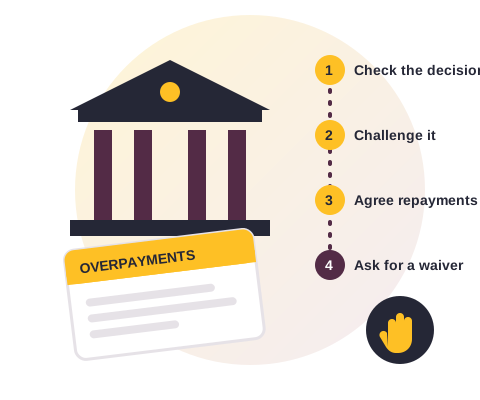
- Ask for a full explanation in writing: how the overpayment was worked out, the dates it covers and why it's said to be recoverable.
- Check it. Is the amount right? Did you report the change, and when? Was it an official mistake? Did they deduct anything you'd already repaid?
- Ask for a mandatory reconsideration, usually within one month of the decision letter. For Housing Benefit, ask the council to reconsider. For tax credits, you can dispute the overpayment with HMRC.
- Appeal to a tribunal if you're not happy with the reconsideration. It's free and independent.
Ask for recovery to be paused while you challenge, and keep copies of everything. If you've missed the deadline, you can sometimes still ask for a late reconsideration with a good reason.
How will I have to repay?
| Method | How it works |
|---|---|
| Deductions from benefits | Taken from your ongoing benefits. Since April 2025, total debt deductions from Universal Credit are capped at 15% of your standard allowance, with some exceptions such as fraud penalties |
| Repayment plan | Regular payments to DWP Debt Management, HMRC or the council, if you're not on benefits |
| Direct Earnings Attachment | Your employer takes a percentage of your wages, based on your earnings, without a court order |
| Direct deduction order | New: regular or lump-sum deductions from your bank account, if you're not on benefits or in PAYE work |
| Court action | A County Court claim and judgment, then the usual enforcement, including bailiffs |
The DWP can keep taking deductions from benefits for many years. The six-year time limit for court action doesn't stop that: see statute-barred debt.
What are the new DWP debt recovery powers?
The Public Authorities (Fraud, Error and Recovery) Act 2025 gave the DWP new powers, which came into force on 24 June 2026 and are being rolled out from October 2026. They're aimed at people who owe the DWP money but aren't on benefits or in PAYE work, and haven't agreed to repay.
- Direct deduction orders: the DWP can tell your bank to take regular or lump-sum payments from your account, without going to court. First it must try to contact you, check about three months of your bank statements to see what you can afford, and write giving you at least a month to respond or object.
- Driving bans: for persistent non-payers owing at least £1,000, the DWP can ask a court to disqualify you from driving. It can't do this if you need your licence for work or caring, and any ban is suspended at first if you keep to repayment terms.
If you get a letter about these powers, contact the DWP within four months to agree an affordable plan and you can avoid them.
Can I reduce my repayments or get the overpayment written off?
- Ask for a lower rate. If deductions leave you unable to afford food, rent or energy, contact the team recovering the debt with your budget and ask for less to be taken, or a temporary pause.
- Ask for a waiver. The DWP, HMRC and councils can write off an overpayment in exceptional circumstances, such as severe hardship, serious ill health, or where recovery would harm your health or your family. Explain why, with evidence such as medical letters.
- Complain if an official mistake caused the overpayment or made it worse. You may be able to get compensation for the distress or costs caused.
- Pause other debt collection while you get advice, with Debt Breathing Space.
What if I'm accused of benefit fraud?
An overpayment isn't the same as fraud. Fraud means you deliberately gave false information or didn't report a change, knowing you should. If the DWP or council suspects fraud:
- you may be invited to an interview under caution. Get legal advice before you go: you're entitled to have a solicitor, and legal aid may be available
- you may be offered an administrative penalty instead of prosecution. Don't accept one without advice, because it means accepting you committed fraud
- fraud overpayments are recovered at higher rates and usually can't be written off in bankruptcy or a Debt Relief Order
What happens to an overpayment when someone dies?
If someone was overpaid before they died, the DWP can recover the money from their estate, usually through the executor or administrator. It can't make family members pay from their own money, unless they also caused the overpayment. If you're dealing with an estate, don't share out the money until any overpayment has been sorted out.
Can benefit overpayments go into a debt solution?
| Debt solution | Can it include this debt? |
|---|---|
| Debt Breathing Space | Yes, it can pause recovery for 60 days, though benefit deductions may continue |
| Debt Management Plan | Can include overpayments, but the DWP may still deduct from benefits |
| IVA | Some overpayments can be included |
| Debt Relief Order | Yes, but not if caused by fraud |
| Bankruptcy | Yes, but not if caused by fraud |
Overpayments caused by fraud usually can't be written off, and the DWP may still be able to take deductions from benefits. Get advice before including an overpayment in a solution.
Compare your debt options, or read which debts to pay first.
Overpayment deductions leaving you short?
Tell us about your debts and a licensed insolvency practitioner will call you back to talk through your options. It's free, with no obligation.
Questions about benefit overpayments
How much can the DWP take from my Universal Credit for an overpayment?
Since April 2025, total debt deductions from Universal Credit are capped at 15% of your standard allowance, with some exceptions such as fraud penalties.
Can I challenge a benefit overpayment?
Yes. Ask for a mandatory reconsideration, usually within one month of the decision, then appeal to a tribunal if needed.
Do I have to repay an overpayment caused by the DWP's mistake?
For Universal Credit, usually yes, whatever the cause. For some older benefits and Housing Benefit, an overpayment caused only by official error may not be recoverable. Get advice.
Can the DWP take money from my bank account?
Since 2026, yes, through a direct deduction order, if you're not on benefits or in PAYE work and haven't agreed to repay. You get at least a month's notice to respond.
Can the DWP take away my driving licence?
For persistent non-payers owing at least £1,000, the DWP can ask a court for a driving ban. Not if you need your licence for work or caring.
Can the DWP take money from my wages?
Yes, through a Direct Earnings Attachment, if you're working and not on benefits.
Can a benefit overpayment be written off?
The DWP, HMRC and councils can waive an overpayment in exceptional circumstances, such as severe hardship. Overpayments can also go into some debt solutions, unless caused by fraud.
Is there a time limit for benefit overpayments?
The DWP has six years to take court action, but it can keep taking deductions from benefits after that.
Sources
- GOV.UK: Benefit overpayments
- GOV.UK: Driving bans for those who refuse to repay benefit debts as new DWP powers come into force
- GOV.UK: DWP Direct Deduction and Disqualification from Driving Orders: Code of Practice
- Public Authorities (Fraud, Error and Recovery) Act 2025
- GOV.UK: Challenge a benefit decision (mandatory reconsideration)
- National Debtline
