
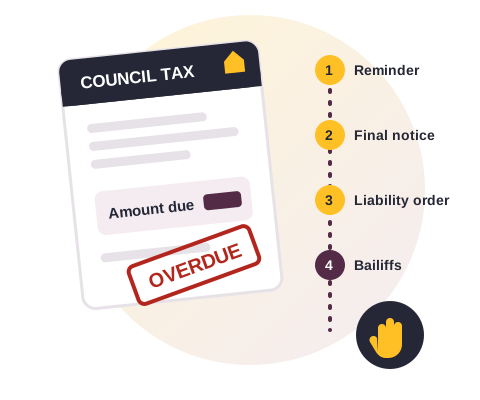
Why is council tax a priority debt?
Council tax is charged on your home and depends on its valuation band and who lives there. You can be responsible for it even if you don't live in the property, for example if you own an empty home.
Councils have stronger collection powers than most lenders. They don't need to take you to the County Court, and they can use bailiffs, take money from your wages or benefits and, in England, ask a court to send you to prison as a last resort. That's why council tax arrears are a priority debt: you should deal with them before credit cards, loans and other non-priority debts.
Can I reduce my council tax bill?
Before you work out a repayment offer, check you're not paying more than you should. Reductions can sometimes be backdated, which may cut the arrears too.
Council Tax Reduction
If you're on a low income or claim benefits, you may get help with your bill. Each council runs its own scheme, so the rules vary.
Single person discount
If you're the only adult counted at your address, you get 25% off. Full-time students and some carers and apprentices aren't counted.
Disability reduction
If your home has extra space or features because someone who lives there is disabled, your bill can drop by one band.
Hardship relief
Councils can reduce or cancel a bill, including arrears, if you're in severe financial hardship. Ask for a discretionary reduction.
Exemptions
Some homes pay nothing, for example where everyone living there is a full-time student, or the home is empty after someone has died.
Pay over 12 months
You can ask to spread the bill over 12 monthly payments instead of 10, which lowers each payment.
Tell the council if you've applied for any reduction. It may hold off on further action until your claim has been decided.
What happens if I miss a council tax payment?
The process is different in England and Wales. Here's how it works now.
In England
- Reminder noticeYou have 7 days to pay the missed instalment.
- Whole year becomes dueIf you don't pay, you lose the right to pay in instalments and the rest of the year's bill is due 7 days later.
- Two reminders a yearAfter two reminders in the same year, a third missed payment can make the whole year due straight away.
- Court summonsThe council can then apply to the magistrates' court for a liability order.
In Wales (since 1 April 2026)
- Reminder noticeA reminder no longer takes away your right to pay in instalments.
- Final noticeCan only be sent once the debt is at least 41 days overdue and 14 days after the last reminder.
- 21 days to payIf you don't pay within 21 days of the final notice, the whole year's bill becomes due.
- Court summonsThe council can then apply for a liability order.
Changes announced for England
In April 2026 the government announced that England will follow Wales. Councils will have to wait at least 63 days after a missed payment before you lose the right to pay in instalments, liability order costs will be capped at £100, and bills will be spread over 12 months by default. These changes are expected from April 2027 but aren't in force yet. We'll update this page when they start.
What is a council tax liability order?
A liability order is a court order from the magistrates' court confirming that you owe the council tax. You'll get a summons with a hearing date. Councils usually apply for many liability orders at once, so the hearing is mostly a formality, but you can go and explain why you haven't paid, for example if you dispute the bill.
- Costs are added. The council can add its court costs to what you owe. The amount varies between councils.
- You must answer the information request. The council can write asking about your job, earnings and other income. You have 14 days to reply, and not replying or giving false information is a criminal offence.
- The 6-year rule. The council should apply for a liability order within 6 years of the debt becoming due. Once it has one, there's no time limit for enforcing it.
- You can still pay. Paying the arrears and costs before the hearing stops the order being made. An agreed payment plan often stops further action.
What can the council do after a liability order?
The council chooses how to collect the debt, but it can only use one method at a time for each liability order.
Attachment of earnings
Your employer takes a fixed percentage of your net pay. In England it's nothing on £300 a month or less, rising to 17% and then 50% on higher earnings. Not used if you're self-employed.
Deductions from benefits
Money can be taken from Universal Credit, Pension Credit, income-based JSA, income-related ESA or Income Support.
Bailiffs (enforcement agents)
The most common action. Bailiffs add fees and can take control of goods to sell. Your rights are explained below.
Charging order
If you own your home and owe £1,000 or more, the debt can be secured against your property.
Bankruptcy
The council can apply to make you bankrupt if you owe £5,000 or more. This is rare, and usually a last resort.
Prison (England only)
Very rare. Only if a court decides you could pay and refused. The maximum is 3 months. This can't happen in Wales.
Council tax bailiffs: what are your rights?
Council tax bailiffs (also called enforcement agents) must be certificated by the County Court. You can check a bailiff's name on the official Certificated Enforcement Agents Register on GOV.UK.
Council tax bailiffs at a glance
- Notice before a visit
- At least 14 clear days (since 1 May 2026). A debt adviser can ask for more time.
- Forced entry
- Not on a first visit. Only to re-enter after you've broken a controlled goods agreement, with 2 clear days' notice. See can bailiffs force entry?
- Visiting hours
- Between 6am and 9pm.
- Whose goods
- Only goods belonging to the person named on the liability order.
- Protected goods
- Basic household items, and work tools or a work vehicle worth up to £1,350 in total. See what can bailiffs take?
- Vehicles
- Cars on the road or your drive can be clamped, even if bailiffs can't get into your home.
How much can bailiffs charge?
| Stage | Fixed fee | Plus |
|---|---|---|
| Compliance (letter and Notice of Enforcement) | £79 | None |
| Enforcement (first visit) | £247 | 7.5% of the debt over £1,900 |
| Sale or disposal | £116 | 7.5% of the debt over £1,900 |
If you pay or agree a plan during the compliance stage, only the £79 fee can be added. That's why acting as soon as the Notice of Enforcement arrives makes such a difference. See our full guide to bailiff fees.
What to do if bailiffs are coming
- Don't let them in if they haven't been inside before. Keep doors locked and talk through a window, by phone or by letter.
- Contact the bailiff firm and the council straight away with an affordable offer and your budget.
- Tell them if you're vulnerable, for example if you have a serious illness, a disability, a mental health problem or young children. Ask the council to take the debt back from the bailiffs.
- Ask about Breathing Space. A debt adviser can apply for 60 days' protection from most enforcement.
- Check the fees. If a bailiff breaks the rules or overcharges you, you can complain.
How do I make an offer to the council?
- Work out your budget. List your income and essential spending, including your current council tax, rent or mortgage and energy.
- Decide what you can afford. Your offer should cover this year's bill plus a realistic amount towards the arrears.
- Contact the council in writing (or phone, then follow up in writing). Include your offer, your budget and any reductions you've applied for.
- Start paying straight away, even if the council hasn't replied or refuses. It shows your offer is genuine and affordable.
- Keep copies of everything you send and receive, and note the date and name of anyone you speak to.
Not sure what you can afford?
Tell us about your debts and a licensed insolvency practitioner will call you back to talk through your options. It's free, with no obligation.
Which debt solutions can include council tax arrears?
If you owe council tax alongside other debts, a formal debt solution may help. You'll still need to keep paying your current council tax.
- Debt Breathing SpacePauses most enforcement, interest and charges for 60 days while you get advice.
- Individual Voluntary Arrangement (IVA)Council tax arrears can be included alongside your other unsecured debts.
- Debt Relief Order (DRO)For lower incomes and debts up to £50,000. Arrears can be written off after 12 months.
- BankruptcyCan include council tax arrears, but has serious effects on your home and finances.
Compare every option on our debt help solutions page.
Questions about council tax bailiffs
Can council tax bailiffs force entry to my home?
No, not on a first visit. Council tax bailiffs can only use reasonable force to re-enter if they've already taken control of goods inside your home, you've broken a controlled goods agreement by missing a payment, and they've given you 2 clear days' notice. They can come in through an unlocked door, so keep doors locked.
How long does the council have to chase council tax arrears?
The council should apply for a liability order within 6 years of the debt becoming due. Once it has a liability order, there's no time limit for enforcing it.
Can I still pay my council tax in instalments after falling behind?
If you've lost the right to pay by instalments, the council doesn't have to agree a new plan, but most will if your offer is realistic. Send a budget with your offer and start paying straight away, even before they reply.
Can I go to prison for not paying council tax?
In England, it's possible but rare. A magistrates' court can send you to prison for up to 3 months only if it decides you could pay and chose not to. In Wales, prison for council tax debt was abolished in 2019.
Can council tax arrears go into a debt solution?
Yes. Council tax arrears can be included in a Debt Relief Order, an IVA or bankruptcy, as long as you keep paying your current year's bill. Breathing Space can also pause enforcement for 60 days while you get advice.
What should I do if a council tax bailiff letter arrives?
Don't ignore it. Since 1 May 2026, bailiffs must give you at least 14 clear days' notice before visiting. Use that time to contact the council or the bailiff firm, offer an affordable payment and get free debt advice.
