What counts as HMRC debt?
HMRC debt is any money you owe to HM Revenue and Customs, such as:
- Self Assessment income tax, including payments on account
- National Insurance, including Class 2 and Class 4 if you're self-employed
- VAT, if you're VAT registered
- PAYE underpayments, and PAYE or NIC owed as an employer
- Capital Gains Tax and other personal taxes
Tax arrears are a priority debt, because HMRC has stronger collection powers than almost any other creditor and often doesn't need a court order to use them. Deal with them before credit cards and loans. See priority and non-priority debts.
How is tax normally paid?
If you're employed, tax comes out of your wages through PAYE, based on your tax code. If you're self-employed, you file a Self Assessment return online by 31 January after the tax year (6 April to 5 April), and HMRC tells you what you owe. Most HMRC debt problems affect the self-employed and small business owners.
Tax credit overpayments work differently. They're usually treated as non-priority and are often collected through deductions from benefits. Get advice if that's your debt.
5 steps to deal with tax arrears
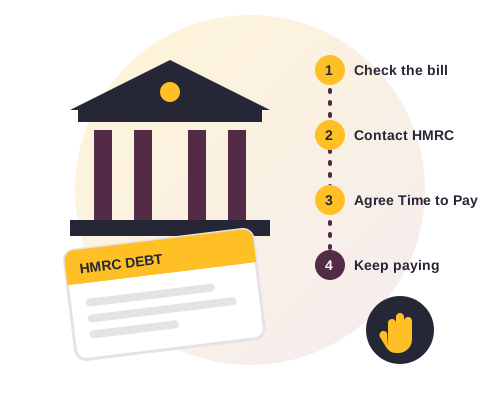
- Check the bill is right. Tax is based on your profit after allowable business expenses, not your takings. If you haven't filed a return, HMRC may have estimated your tax, and filing the return replaces the estimate. If you're employed, check your tax code and payslips. If you've overpaid in the last four years, you can claim it back.
- Work out what you can afford. Keep business and household money separate, do a personal budget, and see what's left after essential bills and your ongoing tax.
- Contact HMRC early. Don't ignore letters. Ask for a Time to Pay arrangement, and show your budget to explain your offer.
- Start paying something. Pay what you've offered, even if HMRC hasn't accepted yet. It shows you're not avoiding the debt.
- Keep HMRC updated. Tell them straight away if things change or you're struggling to keep up.
What is a Time to Pay arrangement?
Time to Pay is HMRC's own instalment plan for tax you can't pay in full. You may be able to set one up online through your HMRC account, without speaking to anyone, if:
- it's a Self Assessment debt of £30,000 or less
- you've filed all your tax returns
- the debt is no more than 60 days overdue
- you can clear it within 12 months
For bigger debts, older debts, longer plans or other taxes such as VAT and PAYE, call HMRC's Payment Support Service. Expect to be asked about your income, spending and assets. HMRC usually wants the arrears cleared before your next tax bill, but may agree longer if you show you can't afford that and can keep up with ongoing tax.
Interest is still charged on tax paid late, at the Bank of England base rate plus 4%.
What happens if I don't pay HMRC?
Penalties and interest are added automatically. Missing the Self Assessment filing deadline alone means a £100 penalty, with more if it's later still. If you don't pay or agree a plan, HMRC can:
| Action | How it works |
|---|---|
| Collect through your tax code | If you're employed or get a pension, HMRC can add the debt to your tax code. It can collect up to £3,000 a year if you earn under £30,000, rising on a sliding scale to £17,000 if you earn over £90,000. |
| Direct recovery from your bank | For debts over £1,000, after warnings, HMRC can take money from your bank or building society accounts without a court order. It must leave you at least £5,000 across your accounts, and only half of a joint account counts as yours. |
| Debt collection agency | HMRC may pass the debt to a private collector. Collectors have no special powers. |
| Take control of goods | HMRC officers or bailiffs can take control of your goods, without a court order. See below. |
| Magistrates' court | For debts under £2,000 that are less than a year old. |
| County Court | For larger debts, HMRC can get a County Court Judgment. |
| Bankruptcy | HMRC can petition for your bankruptcy if you owe £5,000 or more. It's one of the most common bankruptcy petitioners, especially against self-employed people. |
Not being able to pay tax isn't a crime. Prison only comes into it for tax fraud or deliberate evasion, not for genuine arrears.
Can HMRC send bailiffs to my home?
Yes. In England and Wales, HMRC can take control of goods from your home or business without first going to court. Its officers (sometimes called the Field Force) or private bailiffs must follow the same rules as other bailiffs:
- a Notice of Enforcement and at least 14 clear days before a visit
- visits only between 6am and 9pm, and only the fees set by law
- no taking essential or exempt goods
- no forcing entry to your home without a court warrant, although business premises can be entered by force
In practice, HMRC uses bailiffs less often than tax code deductions, bank recovery or bankruptcy. If bailiffs are involved, see how to stop bailiffs.
How long can HMRC chase tax debt?
Tax debts don't become "statute barred" after six years like credit card debts. HMRC has time limits for working out extra tax you owe:
- 4 years after the end of the tax year normally
- 6 years if you were careless
- 20 years if the underpayment was deliberate
Once tax has been assessed and is owed, HMRC can generally keep collecting it. Waiting it out is rarely an option.
Your rights when you owe HMRC
- Appeal a decision you think is wrong, usually within 30 days. You can ask for a review and then appeal to the First-tier Tribunal (Tax), which is free.
- Fair treatment under the HMRC Charter, including extra support if you need it because of your health or circumstances.
- Complain to HMRC, then the Adjudicator's Office if you're not happy.
- Use Debt Breathing Space for tax you owe personally, including as a sole trader. It pauses most enforcement and stops interest and penalties for 60 days.
- Get free tax help. TaxAid helps people on low incomes, and Tax Help for Older People supports those over 60. Business Debtline helps the self-employed.
Debt solutions that can help with HMRC debt
| Debt solution | Can it include this debt? |
|---|---|
| Debt Breathing Space | Yes, for tax you owe personally |
| Debt Management Plan | Can include tax arrears, but HMRC doesn't have to accept and may carry on collecting |
| IVA | Yes. HMRC votes on self-employed IVAs and accepts many |
| Debt Relief Order | Yes, if you meet the rules |
| Bankruptcy | Yes, for tax owed before the bankruptcy |
HMRC rarely agrees to accept less than the full amount outside a formal solution such as an IVA or bankruptcy. Any tax on income you earn during a solution still has to be paid. Compare all your debt options.
Struggling with tax debts?
Tell us about your debts and a licensed insolvency practitioner will call you back to talk through your options. It's free, with no obligation.
Questions about HMRC debt
Is HMRC debt a priority debt?
Yes. Income tax, National Insurance and VAT arrears are priority debts because HMRC can take money from your wages or bank account, use bailiffs and petition for bankruptcy, often without going to court first.
What is a Time to Pay arrangement with HMRC?
An agreement to pay tax arrears in instalments. You may be able to set one up online for Self Assessment debts of £30,000 or less if you've filed your returns and can pay within 12 months.
Can HMRC take money from my bank account?
Yes, for debts over £1,000 and after warning you. It must leave at least £5,000 across your accounts.
Can HMRC send bailiffs without a court order?
Yes. HMRC can take control of goods without going to court, but must follow the same rules on notice, fees and protected goods. It needs a court warrant to force entry to your home.
Can HMRC make me bankrupt?
Yes, if you owe £5,000 or more. HMRC usually tries other collection methods first.
Can I go to prison for not paying tax?
Not for genuinely being unable to pay. Prison only applies to tax fraud or deliberate evasion.
How long does HMRC have to chase tax debt?
Tax debts don't become statute barred like credit card debts. HMRC has 4, 6 or 20 years to assess extra tax, depending on the reason, and can usually keep collecting tax once it's owed.
Can HMRC debt be included in an IVA or DRO?
Yes. HMRC debts can be included in an IVA, a Debt Relief Order or bankruptcy, as long as you meet the rules for that solution.