
What is a Debt Management Plan?
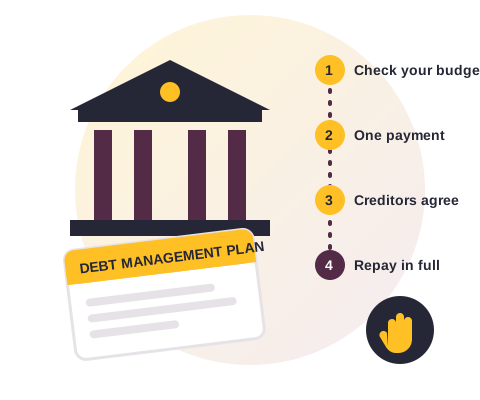
A Debt Management Plan (DMP) is an informal agreement with your creditors to repay your debts at a rate you can afford. Instead of paying lots of creditors separately, you make one monthly payment to a DMP provider, who shares it between them.
A DMP isn't legally binding and it doesn't write off any debt. You repay everything you owe, just more slowly. It's often used when you can afford something towards your debts, but not the full contractual payments.
Who is a DMP suitable for?
- You have non-priority debts, such as credit cards, loans and overdrafts.
- You can afford a regular payment after your essential bills, but not your full payments.
- You'd rather repay in full than use a formal option like an IVA or bankruptcy.
- You expect your situation to improve, or you want something flexible you can change later.
Free DMP providers usually need you to be able to pay at least £5 a month to each debt. GOV.UK says DMPs are usually used when you can only afford small payments for now, or when you expect to be able to pay more in a few months.
A DMP may not suit you if your debts would take a very long time to clear (as a rough guide, 10 years or more), if creditors are already taking court action, or if you could qualify for an option that writes debt off. Compare all your options on our debt advice page.
Which debts can go into a DMP?
| Can be included (non-priority) | Can't be included (priority or secured) |
|---|---|
| Credit cards and store cards | Council tax arrears |
| Personal loans and overdrafts | Rent and mortgage arrears |
| Payday loans | Energy arrears |
| Catalogues and buy now, pay later | Magistrates' court fines |
| Debts with debt collection agencies | Income tax and VAT owed to HMRC |
| Most County Court judgment (CCJ) debts | Secured loans, and hire purchase for essential items |
| Home credit and in-store credit | TV Licence arrears |
| Money borrowed from friends or family | Child support and maintenance |
| Overpayments owed to DWP or HMRC |
Priority debts have to be dealt with separately, because the consequences of not paying them are more serious, such as bailiffs, losing your home or having your energy cut off. Your DMP payment is worked out only after allowing for them.
How does a DMP work?
- Get advice. A debt adviser looks at your income, spending and debts, and checks that a DMP is the right option.
- Work out your budget. Your essential costs and priority debts come first. What's left is your DMP payment.
- Your provider contacts your creditors. They send your offer and ask creditors to accept it and freeze interest and charges. Creditors don't have to agree, but many do.
- You make one monthly payment. You pay your provider, who shares the money between your creditors.
- The plan is reviewed. Usually once a year, or sooner if your circumstances change. You can increase, reduce or pause your payments.
- The plan ends when your debts are paid in full, or earlier if you switch to another option.
An example of a DMP
This is an illustration only.
| Non-priority debts | £12,000 across 6 credit cards and loans |
|---|---|
| Paying now | About £400 a month in minimum payments |
| Affordable DMP payment | £200 a month |
| Time to clear | About 5 years, if every creditor freezes interest and charges |
If some creditors keep adding interest, it will take longer. With a fee-charging provider, part of each payment goes on fees, which also adds time.
How much does a DMP cost?
You don't have to pay for a DMP. Debt charities such as StepChange and PayPlan run DMPs free of charge, so all your money goes to your creditors.
Is it better to pay for a DMP? No. A paid DMP doesn't give you any extra protection or benefits. It works the same way, but part of your money goes on fees, so it takes longer to clear your debts.
Some companies charge a set-up fee and a monthly fee. Any DMP provider must be authorised by the Financial Conduct Authority (FCA), which you can check on the FCA register. Before you agree, ask for the total cost and how much longer the fees will make your plan.
Fee-charging companies must follow FCA rules. They must tell you the total cost and how long the plan will last before you sign, can't promise that debts will be written off or that interest will be stopped, and must tell you what your creditors say or do. Money you pay into a DMP while a provider holds it is usually protected by the Financial Services Compensation Scheme (FSCS).
Already paying for a DMP? You can switch to a free provider. Ask your current company to close the plan and refund anything owed to you. Some keep your first payment as a deposit, so check your agreement. Let your creditors know you're moving.
You can also set up a DMP yourself by writing to your creditors, although a provider will usually deal with them for you. If you're self-employed, Business Debtline can help with a DMP that includes business debts.
Will a DMP stop bailiffs?
Not on its own. Because a DMP is informal, creditors can still go to court, get a County Court judgment and, in some cases, send bailiffs, even if you keep paying. In practice, most creditors don't take action while you're keeping to a reasonable plan, because it shows you're trying to pay.
- Council tax arrears can't go into a DMP, so you'll need a separate arrangement with the council or bailiffs. See our council tax bailiffs guide.
- If bailiffs are already involved, read how to stop bailiffs, or ask for more time.
- A debt adviser can apply for Breathing Space, which gives 60 days' legal protection while a plan is set up.
Living with a DMP
- Some letters will still arrive. By law, lenders often still send annual statements, arrears notices and default notices. That doesn't mean your plan has gone wrong. Pass anything else to your provider.
- Creditors may still contact you and ask you to pay more. Your provider can deal with them for you.
- Joint debts: couples can usually have a joint DMP. You're both responsible for joint debts, so a creditor can chase either of you for the whole amount.
- If your income changes, tell your provider so your payment can be reviewed.
- Pensions: if you're 55 or over, creditors shouldn't pressure you to use your pension to pay debts. Taking money early can affect your tax and benefits, so get advice first.
How a DMP affects your credit file
Paying less than the agreed amount usually means your creditors record arrears or defaults on your credit file. A default stays on your file for 6 years from the date it's recorded, even if you pay the debt off sooner. Some creditors add an "arrangement to pay" marker instead.
A DMP isn't a formal insolvency, so it doesn't go on a public register. Avoid taking on new credit during your plan, as this can make creditors less willing to help.
Advantages and disadvantages of a DMP
| Advantages | Disadvantages |
|---|---|
| One affordable monthly payment instead of many | You repay the full amount, so nothing is written off |
| Free DMPs are available from debt charities | Creditors don't have to agree or freeze interest and charges |
| Flexible: you can change, pause or stop it | It can take many years to clear your debts |
| It isn't a formal insolvency and isn't on a public register | Your credit file will usually show defaults or arrears |
| Your home isn't at risk because of the plan | Creditors can still take court action, even if you keep paying |
| The provider deals with your creditors for you | Priority debts, such as council tax, can't be included |
DMP or IVA: what's the difference?
| Debt Management Plan | IVA | |
|---|---|---|
| Type | Informal, not legally binding | Formal and legally binding |
| Debt written off? | No, you repay it all | Yes, what's left at the end |
| How long? | Until the debts are paid | Usually 5 to 6 years |
| Interest frozen? | Only if each creditor agrees | Yes, for debts included |
| Creditor action | Creditors can still take action | Creditors in the IVA can't take action |
| Cost | Free from charities, or fees from some companies | Fees taken from your payments |
| Public register | No | Yes, the Individual Insolvency Register |
Read more about an IVA. In Scotland, the Debt Arrangement Scheme (DAS) is a legally binding alternative to a DMP.
Things to check before you start a DMP
- Are your priority debts covered? Rent, mortgage, council tax and energy must come first.
- Is the payment affordable, with some money left for emergencies?
- How long will it take? If it's many years, an option that writes off debt may be better.
- Is it free? If not, what are the total fees, and is the provider FCA authorised?
- Have you compared other options, such as a Debt Relief Order, an IVA or bankruptcy?
How Bailiff Helpline works: if you ask us to, we pass your details to a licensed insolvency practitioner from our panel, who may pay us a fee. They can talk you through all your options, including whether a DMP would suit you better than a formal solution. Free DMPs and free debt advice are also available from debt charities and MoneyHelper.
Not sure if a DMP is right for you?
Tell us about your debts and a licensed insolvency practitioner will call you back to talk through your options. It's free, with no obligation.
Questions about Debt Management Plans
What is a Debt Management Plan?
A Debt Management Plan (DMP) is an informal agreement to repay your non-priority debts at a rate you can afford. You make one monthly payment to a provider, who shares it between your creditors. You repay the full amount, just more slowly.
Does a DMP write off debt?
No. A DMP doesn't write off any debt. You repay everything you owe. If you need debt written off, an IVA, a Debt Relief Order or bankruptcy may be more suitable.
Is a DMP free?
It can be. Debt charities such as StepChange and PayPlan offer DMPs free of charge. Some companies charge fees, which means less of your money goes to your creditors and the plan takes longer.
Will creditors freeze interest and charges?
Many do, but they don't have to. Your provider will ask every creditor to freeze interest and charges. If some don't, your debts will take longer to clear.
Can creditors still take action during a DMP?
Yes. A DMP isn't legally binding, so creditors can still go to court even if you're paying. Most don't while you keep to a reasonable plan.
Can council tax go into a DMP?
No. Council tax arrears are a priority debt and must be dealt with separately, usually through an arrangement with the council or the bailiffs.
Will a DMP stop bailiffs?
Not on its own. It can make court action less likely for the debts included, but it doesn't legally stop it. Priority debts like council tax aren't covered at all.
How long does a DMP last?
As long as it takes to repay your debts in full. That depends on how much you owe and what you can afford. Your plan is reviewed regularly.
Will a DMP affect my credit rating?
Usually, yes. Creditors are likely to record arrears or defaults. A default stays on your credit file for 6 years from the date it's recorded. A DMP doesn't go on a public register.
Can I stop a DMP?
Yes. A DMP is flexible, so you can stop it at any time, or switch to another option if your circumstances change. Your creditors can then ask for the full contractual payments again.
Is it better to pay for a DMP?
No. A paid DMP doesn't give you any extra protection. It works the same as a free one, but part of your money goes on fees, so it takes longer to repay your debts.
Can I switch from a paid DMP to a free one?
Yes. Ask your current provider to close the plan and refund anything owed, set up a new plan with a free provider, and let your creditors know you're moving.
Can couples have a joint DMP?
Yes. Joint debts and debts in each partner's name can usually be included in one joint DMP. You're both responsible for joint debts, so creditors can chase either of you.
Who can get a free DMP?
Free providers usually need you to be able to pay at least £5 a month to each of your debts. If the plan would take 10 years or more, they may suggest a different option.
Can I set up a DMP myself?
Yes, you can write to your creditors yourself with a budget and an offer. Most people use a free provider, who deals with creditors for them.
