
What is an IVA?
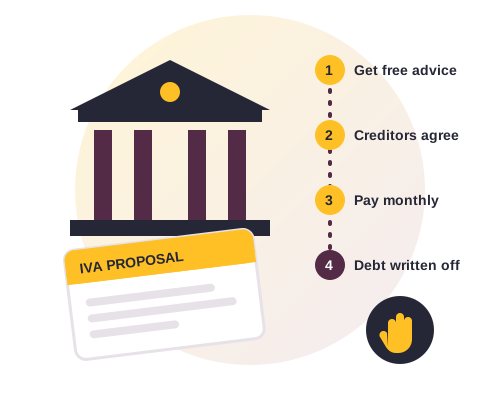
An Individual Voluntary Arrangement (IVA) is a formal, legally binding agreement with the people you owe money to (your creditors). You make one regular payment to a licensed insolvency practitioner, who shares the money between your creditors. When the IVA ends successfully, the rest of the debts it includes are written off.
An IVA is a type of personal insolvency, but it's an alternative to bankruptcy that lets you keep more control of your assets. IVAs are available in England, Wales and Northern Ireland. In Scotland, a similar option is called a Protected Trust Deed.
Who is an IVA suitable for?
An IVA may suit you if:
- you owe several thousand pounds in unsecured debts, usually to two or more creditors
- you have a regular income and can afford a monthly payment after your essential bills
- you can't clear your debts in a reasonable time with an informal plan
- you want to avoid bankruptcy, for example to protect your job or business
There's no legal minimum debt, but many IVA providers look for around £6,000 to £8,000 or more owed to at least two creditors, and a monthly payment of about £70 to £100 or more. There's no upper limit on how much debt an IVA can include. IVAs are open to:
- single people, and couples (you can each have an IVA, and they can be linked)
- homeowners and tenants
- employed and self-employed people, including business owners
An IVA isn't right for everyone. If you qualify for a Debt Relief Order, which is cheaper and shorter, an IVA usually isn't appropriate. If you can only afford a very small payment, or your income may drop soon, another option may be safer. Compare all the options on our debt advice page.
Which debts can go into an IVA?
| Can usually be included | Can't be included |
|---|---|
| Credit cards and store cards | Magistrates' court fines |
| Personal loans, overdrafts and payday loans | Child maintenance |
| Catalogue and buy now, pay later debts | Student loans |
| Council tax arrears | Mortgages and other secured debts |
| Energy and water arrears | Goods on hire purchase (they're secured on the goods) |
| County Court judgment (CCJ) debts | Ongoing bills, such as this year's council tax |
| Income tax and National Insurance arrears | TV Licence arrears |
| Tax credit and benefit overpayments | Social Fund loans |
| Money owed to family and friends | Child support arrears |
| Other bills, such as solicitors', builders' or vets' invoices | New debts taken out after the IVA starts |
| A shortfall left after a home was repossessed |
- County Court judgments should be included. Any separate CCJ payments stop, and the debt is added to your IVA.
- Rent arrears: arrears from a past home can often be included. Arrears on the home you rent now are harder, and including them could put your tenancy at risk, so get advice first.
- Joint debts can be included, but the other person still owes the full amount and will have to pay anything written off for you. There are no joint IVAs, but couples can have two linked (interlocking) IVAs.
Your insolvency practitioner will confirm which of your debts are included. Self-employed? A self-employed IVA can let you keep trading.
Can an IVA stop bailiffs?
Yes, for the debts it includes. Once your IVA is approved, the creditors in it can't take further action against you, so bailiff action for those debts, such as council tax arrears or a CCJ, has to stop.
- Before the IVA is agreed, bailiffs can still act. A debt adviser can apply for Breathing Space to give you 60 days' protection while you get advice. You can also ask bailiffs to give you more time.
- Court fines can't go into an IVA, so bailiffs collecting magistrates' court fines can carry on. See our court fines guide.
- Keep paying your current council tax. New arrears built up during the IVA aren't covered.
For other ways to deal with enforcement, see how to stop bailiffs.
How does an IVA work?
- Get advice. An adviser looks at your income, spending, debts and assets, and checks whether an IVA is the right option or whether something else would suit you better.
- The proposal is prepared. A licensed insolvency practitioner (the nominee) writes a proposal setting out what you can afford and how long it will last. Before you agree, you must be given a key facts document explaining the fees, how your payment was worked out, the effect on your home and on your credit score.
- Your creditors vote. The IVA is approved if creditors who are owed 75% of your debt (by value) agree. It then binds all the creditors included, even those who voted against it.
- You make monthly payments. You pay the insolvency practitioner (now called the supervisor), who shares the money between your creditors. Your circumstances are reviewed, usually once a year.
- If your creditors say no, you can change the proposal and try again, or look at another option such as a Debt Management Plan or Debt Relief Order.
- The IVA ends. When you've made all the payments, you get a completion certificate and the rest of the debts in the IVA are written off.
Setting up an IVA usually takes a few weeks from your first call to the creditors' vote. If you can raise a lump sum, for example from family, an IVA can sometimes be shorter.
Your budget during an IVA
Your monthly payment is worked out from an agreed budget. It should cover your essential living costs, such as rent or mortgage, council tax, energy, water, food, travel, phone and internet, childcare and insurance.
Creditors can question costs they think are too high, such as an expensive phone contract or subscription TV, so be realistic and honest. Your budget is reviewed each year. If you leave too little for emergencies, the IVA is more likely to fail, so make sure the payment leaves you enough to live on.
An example of how an IVA might work
This is an illustration only. Your own payment, term and write-off depend on your income, spending and creditors.
| Unsecured debts | £20,000 (credit cards, a loan, an overdraft and council tax arrears) owed to 5 creditors |
|---|---|
| Paying now | About £450 a month in minimum payments, with interest still being added |
| Affordable IVA payment | £150 a month for 60 months |
| Total paid into the IVA | £9,000, including the IVA fees |
| Written off at the end | £11,000, if every payment is made |
The fees come out of the £9,000, so your creditors receive less than that. If your income rises, your payment may go up, which would reduce the amount written off.
Can an IVA really write off 80% of my debt?
You may have seen adverts promising to write off a set percentage of your debt. Be careful. No one can tell you how much will be written off until they've looked at your budget, and the figure isn't guaranteed.
The amount written off is simply whatever is left once you've made all your agreed payments. It depends on how much you owe, what you can afford, how long the IVA lasts and whether your circumstances change. If the IVA fails, nothing is written off.
For context, some IVA providers publish the average write-off their own clients achieve, and these figures are usually around 60% to 70%. These are averages across many people, not a promise for you.
Ask any provider to show you, in writing, what you'll pay in total, what the fees are and how much is likely to be written off in your case.
How much does an IVA cost?
There are usually two fees: one for setting up the IVA and one for running it, taken from each payment you make. You don't normally pay anything upfront. The fees come out of your monthly payments, so less of your money goes to your creditors.
Fees vary between providers. As an example, one IVA provider publishes total fees of £3,650: £1,900 for setting up the IVA and £1,750 for running it.
Whatever the provider, you must be told the fees in writing before you agree to anything. Ask for the total cost over the whole IVA, and compare it with other options.
What happens to my home, car and credit file?
- Your home: under the IVA Protocol, which has applied since 1 July 2025, your family home no longer forms part of your IVA where the protocol is followed. If your share of the equity in your home is more than £10,000, your IVA will usually last 6 years instead of 5, and remortgaging later may cost more. Keep paying your mortgage or rent as normal.
- Your car: you can usually keep a reasonably priced car you need, for example for work. A high-value car may need to be sold or swapped.
- Your credit file: an IVA usually stays on your credit file for 6 years from the date it starts, so it will be harder to borrow during that time. During the IVA you usually can't borrow more than a small amount without your supervisor's permission.
- The public register: your IVA is listed on the Individual Insolvency Register and removed 3 months after it ends.
- Windfalls and pay rises: if your income goes up or you receive money, such as an inheritance, you may need to pay some of it into the IVA.
Advantages and disadvantages of an IVA
| Advantages | Disadvantages |
|---|---|
| One affordable monthly payment instead of many | It usually lasts 5 to 6 years, which is a long commitment |
| Interest and charges on the debts included are frozen | There are fees, taken from your monthly payments |
| Creditors included can't take further action, including sending bailiffs | It's recorded on the public Individual Insolvency Register |
| Any debt left at the end is written off | It stays on your credit file for 6 years, making credit harder to get |
| Under the IVA Protocol, your family home is no longer part of the IVA | If you can't keep up the payments, it can fail, and you could be made bankrupt |
| You keep more control of your assets than in bankruptcy | Some debts can't be included, such as court fines and student loans |
What if I can't keep up the payments?
Tell your insolvency practitioner straight away. If your income drops, it may be possible to reduce your payments, take a short payment break, or change the IVA with your creditors' agreement.
If the payments stop and nothing is agreed, the practitioner can end (terminate) the IVA. Your creditors can then chase you again, and you could be made bankrupt, although not every failed IVA leads to bankruptcy. Anything you've already paid stays paid, but the rest of the debt is no longer written off, and creditors may add back interest and charges. If your IVA ends early, the supervisor must direct you to free, regulated debt advice.
Things to check before you agree to an IVA
- Have you compared every option? Including a Debt Relief Order, a Debt Management Plan and bankruptcy.
- Is the monthly payment affordable for 5 to 6 years, leaving enough for your essential bills?
- Do you understand the fees and the key facts document?
- Is the practitioner licensed? You can check on the Insolvency Service's list of insolvency practitioners.
- Has anyone pressured you? You should never feel rushed into an IVA. Free, independent advice is available from MoneyHelper.
How Bailiff Helpline works: we don't arrange IVAs ourselves. If you ask us to, we pass your details to a licensed insolvency practitioner from our panel, who may pay us a fee. They must check whether an IVA is right for you and explain the other options. Free, independent debt advice is also available from MoneyHelper.
An IVA may not be suitable in all circumstances. Fees apply, and your credit rating will be affected.
Want to know if an IVA could help?
Tell us about your debts and a licensed insolvency practitioner will call you back to talk through your options. It's free, with no obligation.
Questions about IVAs
What is an IVA and how does it work?
An IVA (Individual Voluntary Arrangement) is a formal, legally binding agreement with your creditors. A licensed insolvency practitioner works out what you can afford and puts a proposal to your creditors. If creditors owed 75% of your debt agree, you make one monthly payment, usually for 5 to 6 years, and whatever is left of the debts included is written off at the end.
How much debt do I need to qualify for an IVA?
There's no legal minimum, but many providers look for around £6,000 to £8,000 or more of unsecured debt owed to at least two creditors. If your debts are smaller, a cheaper option such as a Debt Relief Order or an informal plan may suit you better.
How much of my debt can I write off with an IVA?
It depends on your circumstances. The amount written off is whatever is left after you've made all your agreed payments. Some providers publish average write-offs of around 60% to 70% for their clients, but that's an average, not a promise, and nothing is written off if the IVA fails.
How much will I have to pay each month?
Your payment is based on what's left from your income after your essential living costs, such as rent or mortgage, council tax, energy, food and travel. Many providers look for at least £70 to £100 a month. Your payment is reviewed each year and can go up or down if your income changes.
Will I lose my home if I enter an IVA?
Under the IVA Protocol that has applied since 1 July 2025, your family home no longer forms part of your IVA where the protocol is followed. If your share of the equity is more than £10,000, your IVA will usually last 6 years instead of 5. You must keep paying your mortgage or rent.
Can I keep my car if I have an IVA?
Usually, yes, if it's a reasonably priced car you need, for example for work, school runs or a disability. If the car is worth a lot, you may be asked to sell it and buy a cheaper one. Car finance payments can usually be included in your budget if the car is essential.
Will an IVA affect my credit rating?
Yes. An IVA stays on your credit file for 6 years from the date it starts, so borrowing will be harder and more expensive during that time. It's also listed on the public Individual Insolvency Register until 3 months after it ends.
How long does an IVA last?
Most IVAs last 5 years, or 6 years if you own your home with more than £10,000 of equity. An IVA can be shorter if you can offer a lump sum.
Can I get an IVA if I am unemployed?
It's difficult, because an IVA needs a regular income to pay from. You may still qualify if you have other regular income, such as a pension, or can offer a lump sum, for example from family. Otherwise, a Debt Relief Order or bankruptcy is usually more suitable.
Can I get an IVA if I am on benefits?
Possibly, if your income, including benefits, leaves enough to make a monthly payment after your essential costs. But if your only income is benefits and you have little spare money, you may qualify for a Debt Relief Order, which is cheaper and shorter. In that case, an IVA usually isn't appropriate.
Will creditors stop contacting me once I enter an IVA?
Yes, for the debts included. Once the IVA is approved, those creditors must stop chasing you and deal with your insolvency practitioner instead. You may still get the odd statement. Creditors can keep contacting you before the IVA is approved, and about any debts that aren't included.
Can an IVA stop bailiffs from visiting my home?
Yes, for the debts included in the IVA, such as council tax arrears or a CCJ. Once it's approved, those creditors can't take further action, so bailiff action for them must stop. Bailiffs collecting debts that can't be included, such as magistrates' court fines, can carry on.
Can I include all my debts in an IVA?
No. Most unsecured debts can be included, such as credit cards, loans, overdrafts, council tax arrears and CCJs. You can't include magistrates' court fines, child maintenance, student loans, TV Licence arrears, Social Fund loans, mortgages, secured loans or hire purchase.
What happens if I cannot afford my IVA payments?
Tell your insolvency practitioner straight away. They may be able to lower your payments, arrange a short payment break or ask your creditors to change the terms. If payments stop and nothing can be agreed, the IVA can be ended, the rest of your debt is no longer written off, and you could be made bankrupt.
What happens when my IVA finishes?
Once you've made all your payments, you get a completion certificate and the rest of the debts in the IVA are written off. Your IVA is removed from the Insolvency Register 3 months later, and it stays on your credit file until 6 years after it started.
How much does an IVA cost?
There's usually a set-up fee and a fee for running the IVA, both taken from your monthly payments rather than paid upfront. You must be told the fees in writing before you agree.
Can council tax arrears go into an IVA?
Yes, council tax arrears can usually be included. You must keep paying your current council tax during the IVA.
Can a CCJ be included in an IVA?
Yes. County Court judgment debts should be included. Any separate payments you're making towards a CCJ stop, and the debt is dealt with in the IVA.
What happens to joint debts in an IVA?
Your share can be included, but the other person is still responsible for the whole debt. If part is written off for you, the creditor can ask them to pay it.
Can couples get an IVA?
There are no joint IVAs, but each partner can have their own IVA and the two can be linked (interlocking IVAs) so you make one combined payment.
How long does it take to set up an IVA?
Usually a few weeks, from your first conversation to the creditors' vote. Most providers don't charge anything upfront.
Is an IVA the same as bankruptcy?
No. Both are formal insolvency, but in an IVA you agree a repayment plan with your creditors and usually keep more control of your assets. Bankruptcy is usually shorter but can have a bigger effect on your home and some jobs.
