
The key rules on bailiffs entering your home
Bailiff entry at a glance
- Opening the door
- You don't have to open the door or let a bailiff in.
- Peaceful entry
- For most debts, bailiffs can only come in through a door that's unlocked or if you let them in.
- Not allowed
- Pushing past you, putting a foot in the door, breaking a lock, or climbing through a window.
- Visiting hours
- Only between 6am and 9pm, on any day of the week.
- Who's at home
- They can't come in if the only people there are children under 16 or vulnerable adults.
- Outside your home
- Even with the door locked, they can clamp or take a car parked outside, unless it's exempt. See what can bailiffs take?
Can bailiffs force entry? It depends on the debt
The type of debt decides whether bailiffs can ever use force. For the debts most people have, they can't.
| Debt | Force entry to your home? | What it means |
|---|---|---|
| Council tax arrears | No | Peaceful entry only, on any visit, unless you break a controlled goods agreement. |
| Credit cards, loans and overdrafts (County Court judgments) | No | A CCJ or warrant of control gives no extra right to break in. |
| Parking fines (penalty charge notices) | No | Peaceful entry only. |
| Gas, electricity and water arrears | No | Peaceful entry only for bailiffs collecting the debt. |
| High Court writs at your home | No | High Court enforcement officers need peaceful entry to your home on a first visit. |
| Magistrates' court fines | Last resort | Bailiffs collecting criminal fines can use reasonable force, but only as a last resort and usually with the court's permission. |
| HMRC tax debts (such as Income Tax) | Last resort | HMRC can apply to the court for a warrant to force entry, as a last resort. |
| Business premises (CCJs and High Court writs) | Last resort | Force can sometimes be used at trade premises, not your home. |
| After you break a controlled goods agreement | Yes | Bailiffs can re-enter by force to take goods they listed, usually after giving you 2 clear days' notice. |
Evictions and home repossessions are different. County Court bailiffs can use a locksmith to carry out a warrant of possession. If you're facing eviction, see our N244 form guide on asking the court to suspend it.
What counts as peaceful entry?
Peaceful entry means coming in through a normal entrance without using force. A bailiff can do this if:
- you, or someone else at home, lets them in, even if you didn't realise who they were;
- a door is unlocked, including a back door, side door or porch, whether or not you're at home.
They can't climb through a window, even an open one, or come in through anything other than a door. Once a bailiff has entered peacefully and listed your goods, the rules change, so keep every outer door locked and make sure everyone you live with knows not to let them in.
Can bailiffs force entry after a controlled goods agreement?
Yes. This is the most common situation where bailiffs can break in. If you've already let a bailiff in, they've listed your goods, you've signed a controlled goods agreement and then you miss the agreed payments, they can come back and use reasonable force to take the listed goods.
They must usually give you 2 clear days' notice first. If this happens, contact the bailiff firm straight away to get the arrangement back on track, or get free advice about other options, such as applying to the court or Breathing Space.
Are the rules different for business premises?
Yes. The strong protection for your home doesn't apply in the same way to premises used only for business, such as a shop, workshop, warehouse or office with nobody living there. If you're self-employed, bailiffs enforcing County Court or High Court judgments against your business may be able to use force to enter your trade premises, usually with the court's permission.
- Mixed-use premises: if someone lives there, such as a flat above a shop, the protections for a home still apply to the living space.
- Commercial rent arrears: landlords of business premises can use a separate process (Commercial Rent Arrears Recovery), which has its own notice rules.
- Business debts: Business Debtline gives free advice to self-employed people and small businesses.
What if I'm vulnerable?
Bailiffs must take extra care if you're vulnerable, for example because of serious illness, disability, a mental health condition, pregnancy, age or bereavement. They can't enter if only children under 16 or vulnerable people are at home, and they should consider pausing enforcement or passing the debt back to your creditor.
Tell the bailiff firm and your creditor in writing. Use our free letter telling a bailiff you're vulnerable.
What to do if a bailiff threatens to force entry
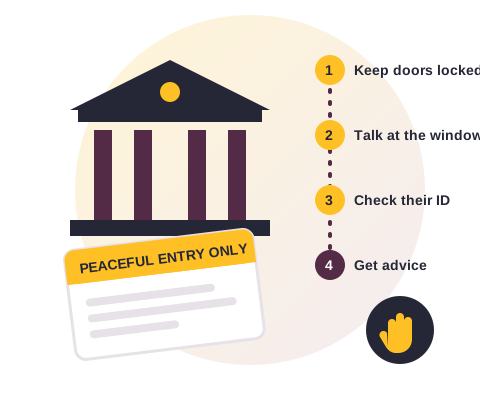
- Stay calm and keep the door shut. Talk through a window, the letterbox or by phone.
- Ask what debt it's for and to see their ID, enforcement agent certificate and the warrant, writ or liability order. Ask them to post copies through the letterbox.
- Check the type of debt. For council tax, parking fines, utility bills and consumer debts, they can't force entry on a first visit.
- Write down what was said, with the bailiff's name, the firm, the date and the time. Record the conversation if you can.
- Complain if they misrepresented their powers. Bailiffs mustn't mislead you about their right to enter. Use our complaint letter.
- Deal with the debt. Offer a payment or get free debt help so the visits stop. If you can, agree a payment plan before signing a controlled goods agreement, which gives the bailiff rights over your belongings.
Does it matter which bailiff company it is?
No. The rules on entry are set by law and apply to every enforcement company, including the large firms used by councils and courts. If any firm says it can force entry when the rules say it can't, ask it to confirm its legal power in writing and complain.
See all the ways to stop bailiffs, or read more free bailiff help.
Worried about a bailiff visit?
Tell us about your debts and a licensed insolvency practitioner will call you back to talk through your options. It's free, with no obligation.
Questions about bailiffs forcing entry
Can bailiffs force entry into your home in the UK?
In England and Wales, usually not. For most debts, bailiffs can only enter your home peacefully, through an unlocked door or if you let them in. Forced entry is only allowed in rare cases, such as magistrates' court fines, some HMRC debts, or after you've broken a controlled goods agreement. Scotland and Northern Ireland have different rules.
Can bailiffs force entry for council tax arrears?
No. Bailiffs collecting council tax arrears can only enter peacefully, through an unlocked door or if you let them in. The only exception is if you've already let them in, signed a controlled goods agreement and then broken it.
Can bailiffs force entry for credit card or loan debts?
No. Credit cards, personal loans, overdrafts and buy now pay later debts are collected through a County Court judgment, and bailiffs enforcing them can only enter your home peacefully.
Can bailiffs force entry for a CCJ?
No, not to your home. A County Court judgment, even with a warrant of control, doesn't give bailiffs the right to break in. They can only enter peacefully. Business premises can be different.
Can bailiffs force entry if you're not home?
Not by force. If a door is left unlocked, bailiffs could walk in whether or not you're there, because that counts as peaceful entry. If your home is locked, they can't force their way in for most debts, so lock all outer doors, including porches and back doors, when you go out or away.
Can bailiffs force entry with a locksmith?
Only in the rare cases where forced entry is allowed, such as unpaid magistrates' court fines, some HMRC tax debts, business premises, or after you've broken a controlled goods agreement. A locksmith can't be used for council tax, parking fines or consumer debts on a first visit.
When can bailiffs force entry in the UK?
In England and Wales, bailiffs can only use force in limited cases: to collect magistrates' court fines (as a last resort, usually with the court's permission), for some HMRC tax debts with a court warrant, at business premises in some cases, and to re-enter after you break a controlled goods agreement, usually with 2 clear days' notice.
What happens if I ignore a bailiff?
Ignoring them won't make the debt go away. For most debts they have to leave if you don't open the door, but they can visit again, clamp or take a car parked outside, and the fees go up. Use the time to offer a payment, get Breathing Space or get free advice.
Can bailiffs force entry after a controlled goods agreement?
Yes. If you've let a bailiff in, signed a controlled goods agreement and then missed the payments, they can come back and use reasonable force to take the goods they listed. They must usually give you 2 clear days' notice first.
Can bailiffs force entry if you are vulnerable?
Bailiffs must take extra care if you're vulnerable, and they can't enter if the only people at home are children under 16 or vulnerable adults. Tell the bailiff firm and your creditor about your circumstances in writing. They should consider pausing action or returning the debt to your creditor.
Can Bailiff Helpline stop bailiffs from coming to my home?
We can help you understand your rights and, if you ask for a free call back, put you in touch with a licensed insolvency practitioner who can explain options that may stop or pause bailiff action, such as a payment arrangement, Breathing Space or a formal debt solution. It's free, with no obligation.
What should you do if a bailiff threatens forced entry?
Stay calm and keep the door shut. Ask what debt it's for and to see their ID and paperwork through the letterbox. Note their name and what they said. For council tax, parking fines, utility bills and consumer debts, they can't force entry on a first visit, so you can complain if they claim otherwise.
Does a warrant of control let bailiffs force entry?
No. A warrant of control lets bailiffs take control of goods, but for most debts they still need peaceful entry to your home. It doesn't give them the right to break in.
Can bailiffs force entry for parking fines?
No. Bailiffs collecting unpaid penalty charge notices can only enter your home peacefully.
Can the police help bailiffs get in?
No. Police may attend to prevent a breach of the peace, but they don't help bailiffs enter your home or take your goods for civil debts.
Are the rules different for business premises?
Yes. Premises used only for business don't have the same protection as a home, and bailiffs may be able to force entry there in some cases, usually with the court's permission. If someone lives at the premises, the protections for a home still apply to the living space.
What can a bailiff do if I don't let them in?
For most debts, they can't get inside on that visit. But they can still take goods from outside, such as a car on your drive, and they can come back another day. Fees may be added for the visit.
Can bailiffs force entry if I haven't received a notice?
No. Bailiffs must usually give you at least 14 clear days' notice before a first visit. If they visit without proper notice, you can complain, and fees added without the right notice may not be allowed.