
What should I do if I'm behind on my rent?
You're in rent arrears as soon as you miss a payment, whether your landlord is a private landlord, a housing association or the council. Rent arrears are a priority debt because you could lose your home, so pay rent before credit cards and loans.
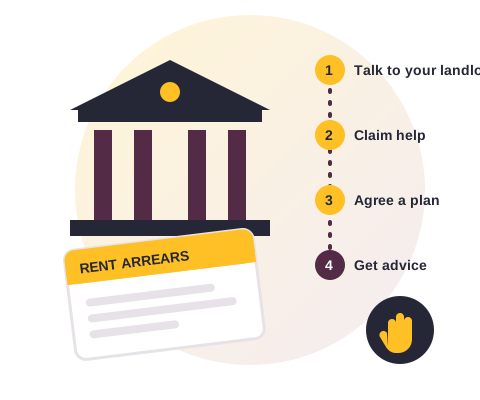
- Don't ignore letters from your landlord, letting agent or the court.
- Keep paying your normal rent if you can, so the arrears don't grow.
- Check you're getting all the help you can: benefits, housing costs and grants. See help to pay rent arrears.
- Do a budget to see what you can afford towards the arrears.
- Talk to your landlord early, explain what's happened and offer a plan.
- Keep records of every payment, letter, email and call, including names and dates.
- Get free advice from Shelter, Citizens Advice or a debt adviser, especially if you've had a notice.
These rules are for England. In Wales, tenancies are called occupation contracts and have different notice rules under the Renting Homes (Wales) Act 2016. Shelter Cymru can advise.
Check what you owe, and who owes it
Before you pay anything, check the figure. Ask your landlord for a written rent statement and compare it with your bank statements, receipts or rent book. If you're on a weekly tenancy, your landlord must give you a rent book.
- If benefits pay some of your rent, ask the DWP (Universal Credit) or the council (Housing Benefit) for a record of what's been paid, and check for gaps.
- Housing Benefit overpayments shouldn't simply be added to council rent arrears. Get advice if you think that's happened.
- A rent increase may not be valid. From 1 May 2026, private landlords can only raise rent once a year, with at least two months' written notice on the proper form, and you can challenge it at a tribunal.
Who is responsible for the arrears?
- Joint tenancy: every tenant named on it is responsible for all the rent, even if only one person stopped paying.
- Separate agreements: only the person with arrears is responsible.
- Took over someone's tenancy: you may not be responsible for their old arrears. Get advice.
How do I make a repayment plan for rent arrears?
A repayment plan means paying your normal rent plus an extra amount towards the arrears until they're cleared.
Example: your rent is £600 a month and you missed a month. You offer to pay £700 a month for six months: your £600 rent plus £100 off the arrears. After six months you're back to £600.
- Send your budget with your offer, so your landlord can see it's what you can afford.
- Don't offer more than you can keep up. A small offer you stick to is better than a big one you break.
- Start paying straight away, even if your landlord hasn't agreed. It shows the court you're doing your best.
- Get it in writing, signed by both of you if possible.
- If you can clear it in one go, do, and get a written receipt.
Private landlords don't have to accept a plan. Council and housing association landlords must try to agree one before going to court, under a pre-action protocol. Many housing associations have also committed not to evict anyone for financial hardship who is working with them to get back on track.
What help can I get to pay rent arrears?
| Help | How it works |
|---|---|
| Universal Credit housing costs | Check you're getting the right amount. The first payment takes about five weeks, so ask for an advance if you can't wait. Advances are loans, repaid from future payments. |
| Rent paid straight to your landlord | You can ask for your UC housing costs to go directly to your landlord. If you're two months or more behind, your landlord can ask for this too. |
| Deductions for arrears | If you owe about two months' rent, the DWP can take a set amount from your benefits towards the arrears, usually 10% to 15% of your UC standard allowance, or a small weekly amount from older benefits. |
| Housing Benefit | Still available for some people over State Pension age or in supported housing. If your claim has taken more than 14 days and you've given the council everything, ask for an interim payment. |
| Crisis and Resilience Fund Housing Payment (England) | Extra money from your council if your benefits don't cover your rent. It replaced Discretionary Housing Payments in England from April 2026, and doesn't have to be paid back. |
| Discretionary Housing Payment (Wales) | The same kind of help from your council in Wales. |
| Homelessness prevention fund | Many councils can help clear arrears to stop you becoming homeless, even if eviction isn't close. |
| Charity grants | Some charities help with rent arrears, depending on your health, age or job. Search on Turn2us. |
Rules that can cut your benefits
- The "bedroom tax": if you rent from the council or a housing association and have spare bedrooms, your help is cut by 14% for one, or 25% for two or more. Ask about moving somewhere smaller.
- Local Housing Allowance: private tenants get help based on local rents, which may be less than your rent.
- Under 35s renting privately alone usually only get help for a room in a shared home.
- The benefit cap can limit your total benefits if you're working age and not working.
If your rent will always be more than you can afford, ask your landlord to reduce it, look at taking in a lodger (check your benefits and tenancy first), or ask the council about moving.
Can Debt Breathing Space stop eviction?
Debt Breathing Space gives you 60 days when your landlord can't chase the arrears, add charges, or evict you for those arrears. You must keep paying your rent. It doesn't stop eviction for other reasons, such as anti-social behaviour, and your landlord can carry on once it ends. You need a debt adviser to apply, and can usually only have one every 12 months.
Can my landlord evict me for rent arrears?
Only with a court order, unless you live with your landlord as a lodger. Changing the locks, removing your things or harassing you to leave is illegal eviction. Report it to your council. Residential landlords also can't send bailiffs to take your goods for rent.
Private tenants (from 1 May 2026)
Under the Renters' Rights Act 2025, most private tenancies became rolling periodic tenancies, and "no-fault" section 21 evictions ended. Notices served before 1 May 2026 can only be used if the landlord applied to court by 31 July 2026. To evict for rent arrears, your landlord must now serve a section 8 notice and prove a ground:
| Ground | When it applies | Can the court let you stay? |
|---|---|---|
| Ground 8: serious arrears | At least 3 months' rent (13 weeks if weekly) owed when the notice is served and at the hearing. Four weeks' notice. | No, if the arrears are still that high at the hearing. Arrears caused by Universal Credit delays don't count. |
| Ground 8A: repeated arrears | Two months or more owed on three separate occasions in three years | No, even if you've since paid |
| Grounds 10 and 11 | Any arrears, or persistently paying late | Yes. The court decides if eviction is reasonable |
Key tip: if your landlord uses ground 8, getting the arrears below three months by the hearing means the court can consider your offer instead.
Council and housing association tenants
Your landlord must serve a notice and follow the pre-action protocol: contact you, try to agree a plan, help with benefit claims, and not go to court while you keep to an agreement or your benefit claim is being sorted. Courts usually only evict if it's reasonable, and they'll look at whether the protocol was followed.
What happens if my landlord takes me to court?
- Get free legal advice. Once you're told in writing that your landlord wants possession, the Housing Loss Prevention Advice Service gives free early legal advice, whatever your income.
- Fill in the defence form. You'll get a claim form (N5), the landlord's details of claim and a defence form (N11R). Return it within 14 days. Say if the figures are wrong, explain why you fell behind, and make an affordable offer. Mention any counterclaim, such as disrepair, damp or damage to your belongings.
- Keep paying your rent and your offer.
- Go to the hearing, even if you've agreed something, unless it's been formally adjourned. Take three copies of your budget, and use the free duty adviser at court.
What the court can decide
- Dismiss the claim, or adjourn it, for example while a benefit claim is sorted
- Make a suspended or postponed possession order: you stay as long as you pay your rent plus the set amount
- Make an outright possession order, usually giving you 14 to 28 days, or up to six weeks if leaving sooner would cause exceptional hardship
The court can also give your landlord a County Court Judgment for the arrears. If you're evicted, you still owe them, and old arrears can make it harder to rent again.
Can I stop an eviction?
If you break a suspended order or the date on an outright order passes, your landlord can ask for a warrant of possession. County Court bailiffs will usually give you 14 days' notice of the eviction date.
- Apply to suspend the warrant using form N244, at least three days before the eviction if possible, with a new affordable offer or a request for more time.
- You can't stop an eviction this way if the outright order was made on ground 8.
- Contact the council's homelessness team as early as possible. Leaving before you have to can affect whether it must rehouse you, so get advice first.
If you're still there on the day, bailiffs can enter and change the locks. Arrange with your landlord to collect your belongings, usually within about two weeks.
Other things to know
- Lodgers who live with their landlord can be asked to leave without a court order, after reasonable notice.
- Arrears from a previous home are still owed. The old landlord can take court action, so deal with them.
- Missed rent can affect your credit file and future rental checks, especially if there's a CCJ.
- Ask for reasonable adjustments from a council or housing association if you're disabled, such as letters in an accessible format.
- Your mental health matters. If you're receiving crisis mental health treatment, Mental Health Crisis Breathing Space lasts as long as your treatment, plus 30 days.
Debt solutions and rent arrears
| Debt solution | Can it include this debt? |
|---|---|
| Debt Breathing Space | Yes. You can't be evicted for the arrears during it, if you keep paying your rent |
| Debt Management Plan | Arrears can be included, but you must keep paying your rent |
| IVA | Arrears can be included, but you must keep paying your rent |
| Debt Relief Order | Yes, if you meet the rules, but your landlord may still seek possession |
| Bankruptcy | Yes, but your landlord may still seek possession |
Sorting out your other debts can free up money for rent. Read which debts to pay first, or compare all your debt options.
Worried about losing your home?
Tell us about your debts and a licensed insolvency practitioner will call you back to talk through your options. It's free, with no obligation.
Questions about rent arrears
Can my landlord evict me for rent arrears?
Only with a court order. In England, a private landlord using the mandatory ground needs at least three months' arrears at the notice and the hearing. For smaller arrears, the court decides whether eviction is reasonable.
How much rent arrears before eviction?
For private tenants in England, the mandatory ground 8 needs three months' rent (13 weeks if weekly) since 1 May 2026. Landlords can use discretionary grounds for any arrears, but the court can let you stay.
Can bailiffs take my belongings for rent arrears?
No. Residential landlords can't use bailiffs to take your goods for rent. Court bailiffs can only evict you after a possession order and warrant.
Does Debt Breathing Space stop eviction?
Yes, for the arrears, for 60 days, as long as you keep paying your rent. It doesn't stop eviction for other reasons, and the landlord can carry on afterwards.
Can I get help paying rent arrears?
You may be able to get a Crisis and Resilience Fund Housing Payment in England, or a Discretionary Housing Payment in Wales, plus help from a homelessness prevention fund or charity grants.
Can rent arrears be taken from my Universal Credit?
Yes. If you owe about two months' rent, the DWP can pay part of your Universal Credit to your landlord towards the arrears.
Am I responsible for my flatmate's rent arrears?
On a joint tenancy, yes: every tenant is responsible for all the rent. On separate agreements, only the person with arrears is.
What happens to rent arrears after eviction?
You still owe them. Your landlord can take you to court for a County Court Judgment, and old arrears can make it harder to rent again.
Sources
- GOV.UK: Guide to the Renters' Rights Act
- Pre-action protocol for possession claims by social landlords
- GOV.UK: Legal aid for possession proceedings
- GOV.UK: Universal Credit and rented housing
- Shelter: Rent arrears
- Shelter Cymru: Rent arrears
- Citizens Advice: Dealing with rent arrears
- Turn2us: Grants search
- GOV.UK: Debt respite scheme (Breathing Space)