
What should I do if I can't pay my credit card?
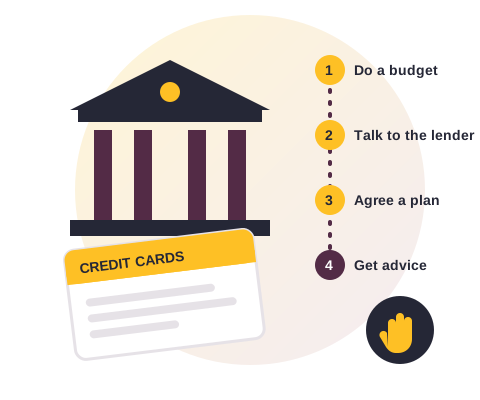
Start with a budget, then talk to your card provider. Knowing exactly what you can afford puts you back in control and makes any offer you make more likely to be accepted.
- Work out your budget. List your income and essential spending, and see what's left for debts.
- Pay priority bills first. Rent or mortgage, council tax, energy and court fines come before credit cards.
- Stop using the card. It's very hard to clear a balance you're still adding to.
- Keep paying at least the minimum if you can, on time, while you sort things out. This stops your account being marked as late.
- Contact your provider early if you can't. Explain what's happened and what you can afford.
- Get advice if you have several debts or can't see a way through. Debt Breathing Space freezes interest and charges for 60 days while you do.
Tip: moving the money you'll use for debt payments into a separate account makes it easier to protect it and see your progress.
What happens if I don't pay my credit card?
Credit card debt is a non-priority debt, so the consequences build up gradually rather than all at once:
- Late fees and missed payment markers are added, and your provider will contact you.
- A default notice is sent, giving you at least 14 days to catch up. Accounts are usually defaulted after about three missed payments.
- The account is closed and a default is recorded on your credit file for six years.
- The debt may be passed or sold to a debt collection agency. Debt collectors have no special powers.
- The provider may take you to court for a County Court Judgment. You can offer affordable payments in your reply.
- Only if you don't pay the CCJ can the creditor use bailiffs, take money from your wages or ask for a charging order on your home.
Can I go to prison for credit card debt?
No. You can't be sent to prison for not paying a credit card. If a lender, collector or bailiff tells you otherwise, that's misleading and you can complain.
Who is responsible on a joint or additional card?
UK credit card accounts are in one person's name only. An additional cardholder can spend on the card, but the main account holder is responsible for the whole balance, even money someone else spent.
What help can my card provider give me?
Card providers must treat customers in financial difficulty fairly. Not every provider offers everything, but you can ask for:
- an affordable payment plan based on your budget
- a short payment break, often up to three months
- interest and charges to be reduced or frozen
- a lower credit limit, or the card to be stopped, to help you avoid new spending
Some of these can affect your credit file, and a payment break may mean you pay more interest overall, so ask how it will work before you agree. If your provider won't help, complain to it, then the Financial Ombudsman Service.
Minimum payments and persistent debt
The minimum payment is usually a small percentage of your balance, often 1% to 3% plus interest. On a £1,000 balance with a 3% minimum, you'd pay at least £30 a month. Paying only the minimum means the balance falls very slowly, and you pay much more interest overall.
What is persistent credit card debt?
You're in persistent debt if, over 18 months, you've paid more in interest, fees and charges than you've paid off the amount you borrowed. FCA rules then set out what your provider must do:
| When | What your provider does |
|---|---|
| After 18 months | Writes to you, explains you're in persistent debt and encourages you to pay more if you can afford it |
| After 27 months | Writes again if nothing has changed |
| After 36 months | Offers ways to repay the balance in a reasonable time. If you can't afford them, it must help, for example by reducing, waiving or cancelling interest and charges. It may suspend the card. |
A persistent debt letter doesn't mean you've done anything wrong. But don't increase payments you can't afford: tell your provider, and get advice.
Can you negotiate credit card debt?
Yes. You may be able to pay in stages, or pay back less than you owe:
- A reduced payment plan, agreed directly with the provider. See informal payment arrangements.
- A Debt Management Plan, where a provider deals with your creditors and shares one monthly payment between them.
- A full and final settlement, where you offer a lump sum that's less than the balance. Providers are more likely to accept if you can show you can't repay the full amount in a reasonable time. Get the agreement in writing before you pay.
Paying less than the agreed amount will usually show on your credit file.
Consolidation and balance transfers
Consolidating means combining several debts into one, using a loan or a balance transfer card.
| Can help | Risks |
|---|---|
| One payment is easier to manage | A longer term can mean paying more interest overall |
| A lower rate can cut the cost | New credit, fees and searches can affect your credit file |
| Regular payments can improve your credit record | A secured loan puts your home at risk |
| It doesn't fix the reason the debt built up, and the old cards can be run up again |
How do balance transfers work?
You move a balance to a new card, usually at 0% or a low rate for a set time. There's normally a fee of around 2% to 3% of the amount moved: transferring £2,000 at 3% costs £60. They're hard to get with a poor credit record, and you need to clear the balance before the offer ends. Cut up the old card so you don't spend on both.
If you're thinking of a loan, read about Debt Consolidation Loans and whether to borrow your way out of debt first.
How does credit card debt affect my credit file?
Your provider reports your balance, limit and payment history to the credit reference agencies (Experian, Equifax and TransUnion). Missed payments, defaults and CCJs stay on your file for six years.
- If a debt is partly written off after a default, it's usually marked partially satisfied.
- If it's settled for less without a default, it's usually marked a partial settlement.
- An account is only marked settled if it was paid in full under the original terms.
You can check your credit file free with each agency. Be wary of "credit repair" firms that charge for things you can do yourself.
Can credit card debt be written off?
Sometimes. There's no "magic loophole", and firms promising one are usually describing the options below, often for a fee.
1. Your provider agrees to write it off
Providers may write off a debt if you can show you're unlikely ever to repay it, for example because of a long-term illness or disability, long-term benefits or retirement, and you have no valuable assets. Send your budget and evidence, and ask in writing. They're less likely to agree if you have spare income, own property, or your situation may improve.
2. A debt solution that writes off what's left
A Debt Relief Order, IVA or bankruptcy can all write off credit card debt if you keep to the rules.
3. Statute-barred debts
In England and Wales, a creditor usually has six years to take court action for a credit card debt. If you haven't made a payment or acknowledged the debt in writing in that time, and there's no CCJ, the debt may be statute barred, so the creditor can't take you to court. A payment or written acknowledgement within the six years restarts the clock. The rules are complex, so get advice before relying on this.
4. Unenforceable agreements
You can ask your provider in writing for a copy of your credit agreement, with a £1 fee. If it doesn't provide one within 12 working days, it can't enforce the debt until it does. It only needs to send a true copy, not the signed original, and courts can still enforce some agreements with missing details. Get advice before you stop paying.
The "7-year rule" is American. It's about how long debts show on US credit files. It doesn't apply in the UK.
What happens to credit card debt when someone dies?
The debt is paid from the person's estate, if there is one. If there isn't enough, it's usually written off. Family members don't have to pay unless they were a guarantor or the debt was in joint names, which isn't possible for a credit card account itself.
Debt solutions that can help with credit card debt
| Debt solution | Can it include this debt? |
|---|---|
| Debt Breathing Space | Yes |
| Debt Management Plan | Yes |
| IVA | Yes |
| Debt Relief Order | Yes |
| Bankruptcy | Yes |
Compare all your debt options.
Credit card debt getting out of hand?
Tell us about your debts and a licensed insolvency practitioner will call you back to talk through your options. It's free, with no obligation.
Questions about credit card debt
How serious is credit card debt?
It's a non-priority debt, so you won't lose your home or go to prison straight away. But interest builds quickly, and missed payments lead to defaults, collectors and possibly a CCJ. The sooner you act, the more options you have.
Can I go to jail for not paying a credit card?
No. Not paying a credit card isn't a criminal offence, and you can't be sent to prison for it.
Can credit card companies send bailiffs?
Not directly. They'd have to take you to court and get a County Court Judgment. Bailiffs can only be used if you then don't pay as the court ordered.
What is persistent credit card debt?
When you've paid more in interest, fees and charges than off your balance over 18 months. Your provider must then contact you, and after 36 months help you clear it in a reasonable time.
Is there a 7-year rule for credit card debt in the UK?
No. That's a US rule about credit files. In the UK, defaults stay on your file for six years, and creditors usually have six years to go to court.
Can my credit card debt be written off?
Yes, in some cases: if your provider agrees because you can't ever repay it, through a DRO, IVA or bankruptcy, or if the debt becomes statute barred.
Does a £1 payment restart the six-year time limit?
Yes, if it's made within the six years. A payment or written acknowledgement after the debt is already statute barred doesn't restart it.
Am I responsible for debt on a card in my partner's name?
No. Credit card accounts are in one person's name, and only that person is responsible, even if you were an additional cardholder.
