
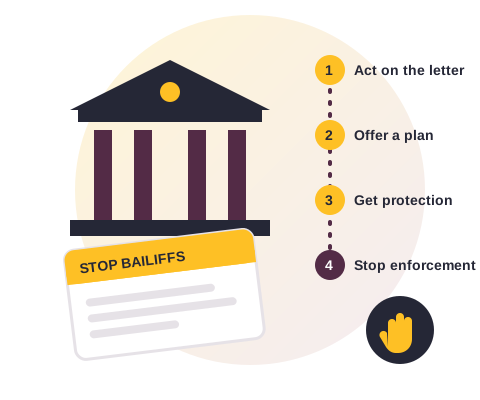
Why acting quickly matters
The sooner you act, the more options you have and the lower the fees. As soon as a debt is passed to bailiffs, a £79 compliance fee is added. Once a bailiff visits, an enforcement fee of £247 (plus 7.5% of any debt over £1,900) is added too, even if you don't open the door. For High Court enforcement the fees are higher.
What to do first if bailiffs contact you
Whether you've had a letter, a text or a call, work through these checks before you do anything else:
- Check it really is a bailiff. Debt collectors aren't bailiffs. They have no right to enter your home or take your things. A bailiff (enforcement agent) acts under a court order, warrant or liability order.
- Check who they are and what the debt is for. Note the firm, the bailiff's name, the creditor, the reference number and the amount, including the fees.
- Check you've had proper notice. You must usually get at least 14 clear days' notice before a first visit.
- Don't ignore it. Fees go up as enforcement moves on, and ignoring letters is the most expensive option.
- Get advice if anything looks wrong, or if you think the letter might be a scam. Check the bailiff on the official Certificated Enforcement Agents Register on GOV.UK.
What to do if bailiffs are at your door
Stay calm. You don't have to open the door. For most debts, bailiffs can only come in on a first visit if you let them in or a door is unlocked. You can talk through a closed or chained door, a window or the letterbox.
Ask them to show you
- their ID and enforcement agent certificate
- who they work for and a contact number
- a breakdown of what you owe, including fees
- the warrant, writ or liability order details
Remember
- Make sure everyone at home knows not to let them in.
- A bailiff shouldn't push past you if you open the door.
- You can pay on the doorstep without letting them in. Always get a receipt.
- If you can't deal with it there and then, say you're getting debt advice and ask them to put everything in writing.
Bailiffs can't come in if the only people at home are children under 16 or vulnerable adults. For criminal fines, and HMRC with a warrant, the rules on forced entry are different. Read our full guide: can bailiffs force entry?
What can bailiffs take?
Bailiffs can't take everything. Essentials are protected, including clothes, bedding, a cooker, fridge and washing machine, and things you need for basic household life. Tools, equipment and a vehicle you need for work or study are protected up to £1,350 in total.
- Other people's goods shouldn't be taken, but you may need to prove who owns them. Keep receipts or bank statements for valuable items.
- Vehicles are often targeted because they're kept outside. If you can, park away from your home.
- Goods on finance usually belong to the finance company and shouldn't be taken. See things on finance.
See our full guide: what can bailiffs take?
Which bailiff companies does this apply to?
Whichever enforcement company has written to you, the same rules apply, and the same steps can stop or pause bailiff action. That includes the large firms many councils and courts use, such as:













Read our guides to stopping CDER Group, Marston Holdings, Bristow & Sutor, Equita, Newlyn PLC, DCBL, Dukes Enforcement, Jacobs Enforcement.
Bailiff Helpline isn't connected to, or endorsed by, any of these companies. Their logos are shown only so you can recognise the firm that has contacted you, and they remain the property of their owners.
10 ways to stop or pause bailiff action
Pay the debt in full
Paying everything you owe, including the fees added so far, ends enforcement straight away. Pay the bailiff firm directly and get a receipt. See paying bailiffs in full below. If you can only pay in full by borrowing at a high cost, think carefully and get advice first.
Offer an affordable payment plan
Contact the bailiff firm as soon as the Notice of Enforcement arrives and offer an amount you can keep up, with a copy of your budget. If you agree a plan before anyone visits, only the £79 compliance fee should be added. Start paying straight away, even if they haven't replied. See how to agree a bailiff payment plan below.
Ask for more time
Since 1 May 2026, bailiffs must give you at least 14 clear days' notice before visiting. For most personal debts, a free debt adviser can ask for this to be extended to 28 clear days, if they ask before the 14 days run out. You can also ask the bailiff firm or creditor for more time yourself. Use our free letter to ask for more time.
Apply for Breathing Space
Breathing Space pauses most enforcement action, interest and charges for 60 days while you get advice. A debt adviser applies for you. If you're in mental health crisis treatment, it can last for as long as your treatment plus 30 days. It doesn't cover court fines.
Tell them you're vulnerable and ask for a recall
If illness, disability, age, pregnancy, bereavement or other circumstances make enforcement especially hard, tell the bailiff firm and your creditor. Creditors such as councils can take the debt back from the bailiffs: see asking the creditor to recall the debt. Use our vulnerability letter.
Check the debt and the paperwork
Make sure the debt is yours, the amount is right and the correct process was followed, such as a liability order for council tax or a County Court judgment. Check the bailiff is certificated on the official register. Debt collectors are not bailiffs and can't take your goods.
Apply to the court
For a County Court warrant of control, apply on the N245 form to suspend the warrant with an affordable offer. For High Court enforcement, ask for a stay of execution on the N244 form. You can also apply to set aside a judgment you didn't know about. The fee to vary or suspend is £16.
Choose a formal debt solution
Once a Debt Relief Order, IVA or bankruptcy is in place, the creditors included usually can't continue enforcement for those debts. It's a bigger step with long-term effects, so compare the options on our debt advice page. Court fines can't be included.
Complain if the bailiff breaks the rules
If a bailiff overcharges you, enters unlawfully, ignores your vulnerability or takes goods they shouldn't, complain to the firm and your creditor, then the Enforcement Conduct Board. Use our overcharging letter or complaint letter.
Keep the door locked while you sort things out
For most debts, bailiffs can't force their way into your home on a first visit. Keep doors locked, talk through a window or by phone, and park your car out of reach if you can. This buys time, but it doesn't stop the debt or the fees, so use the time to act.
How do I pay bailiffs in full safely?
Paying in full ends enforcement. Paying before a visit means only the £79 compliance fee is added to the debt. Before you pay:
- Check the debt is yours and the amount is right. If not, see disputing a bailiff debt.
- Check the fees against our bailiff fees guide, and ask for a full breakdown and a final settlement figure in writing.
- Pay the bailiff firm using the details on its letters or official website, not details in an unexpected text or email. Once a debt is with bailiffs, paying the creditor directly can leave the fees unpaid.
- Use a traceable method, such as a debit card or bank transfer, and quote your reference. If you pay cash at the door, get a signed receipt.
Afterwards, ask for written confirmation that the case is closed. Goods listed on a controlled goods agreement are released, and a clamped or removed vehicle should be returned. Keep receipts for at least six years.
How do I agree a payment plan with bailiffs?
Most people stop bailiffs with a payment plan. The best time is before the Notice of Enforcement deadline, while only the £79 fee has been added.
- Work out a budget. List your income, then your essential costs: rent, council tax, energy, water, food, travel and childcare. Put priority debts first. What's left is what you can offer.
- Make the offer by phone, then confirm it in writing with your budget. Many firms accept the Standard Financial Statement that debt advisers use.
- Explain your situation briefly, including any illness, disability or other vulnerability.
- Get the plan confirmed in writing: the amount, dates, total and that enforcement is on hold.
- Start paying straight away, by standing order if you can, even if they haven't replied yet.
If the bailiffs refuse your offer
- Ask the creditor to tell the bailiffs to accept it, or to take the debt back.
- Pay what you offered anyway, and keep proof. It shows you're acting reasonably.
- Ask a debt adviser about Debt Breathing Space, which pauses enforcement for 60 days.
- Complain if they won't consider a reasonable offer. From January 2027, Enforcement Conduct Board standards will require accredited firms to make sure payment plans are affordable.
If your circumstances change, contact the bailiff firm before you miss a payment. If you've signed a controlled goods agreement, a missed payment can lead to goods being removed.
Can I ask the creditor to take the debt back from bailiffs?
Yes. The creditor, such as your council, is still responsible for how its debt is collected. It can tell the bailiffs to stop and return the case, so you can agree a plan with the creditor instead. Fees already added may still be payable, but no new ones are. Recall is most likely if:
- you're vulnerable, for example seriously ill, disabled, pregnant, recently bereaved or have a mental health condition
- the debt or amount is wrong, or you've disputed it
- you've applied for a council tax reduction, discount or a benefit that would change the debt
- the bailiffs refused a reasonable payment plan
- you're getting debt advice, or have entered Debt Breathing Space
- the bailiffs behaved badly
- Write to the creditor, by email if you can, quoting your account number, and say clearly you want the debt recalled from the bailiffs and why.
- Send evidence, such as a doctor's letter, your budget or proof of payment, and offer an affordable payment if you can.
- Copy in the bailiff firm and ask it to pause while the creditor decides.
Councils follow government guidance on council tax collection and their own policies for vulnerable people, and many will recall a debt if you show you're vulnerable or can't afford to pay. If the council refuses, use its complaints process, then the Local Government and Social Care Ombudsman. For council tax, adapt our letter to the council, and see council tax bailiffs.
What can I do at each stage?
| Stage | What you can do |
|---|---|
| Notice of Enforcement arrives | Pay, offer a payment plan, ask a debt adviser to get you 28 days, apply for Breathing Space, tell them you're vulnerable, check the debt |
| Bailiff at the door | Keep the door locked, ask to see ID and the warrant or liability order, offer a payment, call the creditor |
| Goods listed (controlled goods agreement) | Keep up the agreed payments, ask to change them if you can't, apply to the court, complain if exempt goods were listed |
| Goods taken or due for sale | Pay before the sale (you must get at least 7 clear days' notice), challenge the removal of exempt or other people's goods, get urgent advice |
Stopping bailiffs for different types of debt
The options depend on the debt the bailiffs are collecting. Read the guide for your type of debt:
- Council tax bailiffsAsk the council to recall the debt, claim reductions and agree a plan.
- County Court bailiffsSuspend the warrant of control with the N245 form.
- High Court enforcement officersAgree instalments or ask for a stay of execution.
- Magistrates' court finesContact the fines officer to change your payments.
For everything else about your rights, see our free bailiff help guides.
Want help to stop the bailiffs?
Tell us about your debts and a licensed insolvency practitioner will call you back to talk through your options. It's free, with no obligation.
Questions about stopping bailiffs
Can I stop bailiffs coming to my house?
Often, yes. The quickest ways are to pay in full, agree an affordable payment plan with the bailiff firm, ask your creditor to take the debt back, or get Breathing Space through a debt adviser. Acting as soon as the Notice of Enforcement arrives gives you the most options.
Can I stop bailiffs at the last minute?
Sometimes. You can still pay, offer a payment plan or call the creditor on the day. For a County Court warrant you can apply to suspend it with the N245 form. Fees will be higher the later you act, so don't wait if you can avoid it.
Do I have to let bailiffs in?
For most debts, no. Bailiffs can't force entry to your home on a first visit, so you can keep the door locked and talk to them through a window or by phone. Bailiffs collecting criminal fines, and HMRC with a warrant, have wider powers.
Will a payment plan stop the bailiffs?
Yes, if the bailiff firm agrees and you keep to it. Offer an amount you can afford with a copy of your budget, and start paying straight away. If you miss payments, enforcement can start again.
Does Breathing Space stop bailiffs?
Yes, for most debts. Breathing Space stops most creditors and bailiffs taking enforcement action for 60 days, or longer if you're in mental health crisis treatment. You need to apply through a debt adviser. It doesn't cover court fines.
What happens if I ignore a bailiff?
The fees keep going up and the bailiff can visit, clamp your car or take goods that aren't protected. Ignoring letters also means you miss the cheapest point to agree a payment plan. Contact the bailiff firm or get free advice as soon as you can.
What if I've already let the bailiff in?
They can list goods that aren't protected and ask you to sign a controlled goods agreement to pay in instalments. Only agree to payments you can afford. If they listed exempt goods or someone else's things, you can challenge it. Get advice quickly.
Can bailiffs take my car?
Yes, if it's yours and isn't protected. A car on the road or your drive can be clamped or removed. Cars on finance, a vehicle you need for work up to the £1,350 limit, and a Blue Badge vehicle are usually protected.
What times can bailiffs visit?
Bailiffs can only visit between 6am and 9pm, unless you run a business that's open at other times. They can visit any day of the week.
How do I stop council tax bailiffs?
Contact the council as well as the bailiff firm, especially if you're vulnerable, and offer an affordable payment with a budget. Check you've claimed any council tax reductions. Our council tax bailiffs guide explains your options.
Should I pay the bailiffs or the creditor?
Once your debt is with bailiffs, pay the bailiff firm unless the creditor tells you otherwise. Paying the creditor directly can leave bailiff fees unpaid.
Do bailiffs have to accept a payment plan?
They don't have to, but they should consider a reasonable offer with a budget, especially if you're vulnerable. If they refuse, ask the creditor to step in.
Can the council take my debt back from bailiffs?
Yes. The council is the creditor and can tell the bailiffs to stop and return the case. Ask in writing, explain why and send evidence.
Can a debt solution stop bailiffs?
Yes. Once a Debt Relief Order, IVA or bankruptcy starts, creditors included in it usually can't continue enforcing those debts. Court fines can't be included, and you'll still need to keep up with your current bills.
Sources
- GOV.UK: Bailiff powers when they visit your home
- GOV.UK: Get Breathing Space (debt respite scheme)
- The Taking Control of Goods (Miscellaneous Amendments) Regulations 2026
- Enforcement Conduct Board
- GOV.UK: Council tax collection: guidance for local authorities
- The Taking Control of Goods (Fees) Regulations 2014
