
What is a Debt Relief Order?
A Debt Relief Order (DRO) is a formal way to write off your debts if you have a low income, few assets and less than £50,000 of debt. It's run by the Insolvency Service and costs nothing.
For 12 months you don't have to pay the debts in your DRO, and the creditors can't chase you. If your situation hasn't improved by the end, those debts are written off. It's often called a cheaper, simpler alternative to bankruptcy.
Who can get a DRO?
You must meet all of these tests:
| Test | Limit |
|---|---|
| Total debts | Less than £50,000 |
| Spare income | Less than £75 a month after essential bills |
| Assets (savings, valuables) | Less than £2,000 in total |
| Vehicle | One vehicle worth less than £4,000 (not counted in your assets) |
| Home | You don't own your home |
| Where you live | You've lived or worked in England or Wales in the last 3 years |
| Past DRO | You haven't had a DRO in the last 6 years |
| Cost | Free. There's no fee. |
You also can't get a DRO if you're already bankrupt, in an IVA (or applying for one), or a creditor has applied to make you bankrupt and the hearing hasn't happened yet, unless that creditor agrees. You can't apply if you have a Bankruptcy Restrictions Order or a Debt Relief Restrictions Order.
Your adviser will also check the last 2 years. They'll look at whether you've paid one creditor ahead of others, or sold or given away anything valuable for less than it's worth. Either could affect your application. Tell them too if you've borrowed money in the last few months.
Your spare income is worked out using a standard budget of your essential living costs, such as rent, food, energy and travel.
If you qualify for a DRO, an IVA usually isn't appropriate. Under the IVA Protocol, a DRO should be considered first because it's free and much shorter.
Which debts can go into a DRO?
| Can usually be included | Can't be included |
|---|---|
| Credit cards, store cards and catalogues | Magistrates' court fines |
| Personal loans, overdrafts and payday loans | Student loans |
| Council tax arrears | Child maintenance |
| Energy and water arrears | Social Fund loans |
| Rent arrears | Debts from fraud |
| Benefit overpayments, in most cases | Secured debts, such as a mortgage |
| County Court judgment (CCJ) debts | Unpaid TV Licence fees |
| Income tax and National Insurance owed to HMRC | Court-ordered damages for personal injury |
| Buy now, pay later agreements | Confiscation orders |
| Money owed to friends and family | Debts taken on after the DRO starts |
You still have to pay your ongoing bills, such as rent, council tax and energy.
- List every debt. A debt you forget to include can't usually be added once the DRO is made, and you'll still owe it.
- Rent arrears: they can be included, but you'll usually be advised to agree a plan with your landlord to keep paying them, so they don't start eviction proceedings. Check your tenancy agreement, as some contain an insolvency clause. Get advice before you apply.
- Joint debts can be included, but the other person, or any guarantor, can still be asked to pay the full amount.
Can a DRO stop bailiffs?
Yes, for the debts it includes. Once your DRO is made, the creditors listed in it can't take action to recover their money without the court's permission. That means bailiff action for debts like council tax arrears or a CCJ has to stop.
- Court fines can't be included, so bailiffs collecting magistrates' court fines can carry on. See our court fines guide.
- While you apply, bailiffs can still act. A debt adviser can apply for Breathing Space to give you 60 days' protection. You can also ask bailiffs for more time.
- Keep paying your current council tax, as new arrears aren't covered.
For other ways to deal with enforcement, see how to stop bailiffs.
How to apply for a DRO
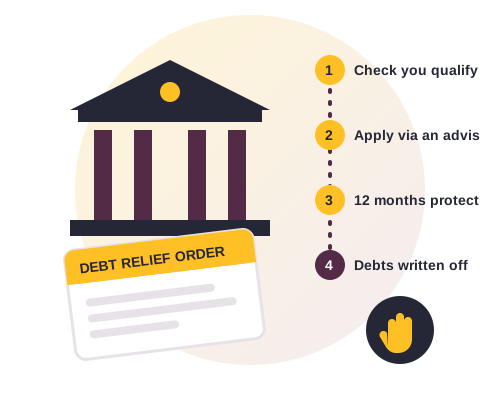
- Speak to an approved debt adviser. You can't apply on your own. Approved advisers (called intermediaries) work at free debt advice services such as National Debtline, Citizens Advice, PayPlan, Christians Against Poverty and Shelter, and there's no charge for their help.
- Check your figures. The adviser looks at your income, spending, debts and assets to check you meet every test.
- The adviser applies online to the Official Receiver at the Insolvency Service.
- The Official Receiver decides. If your application is approved, your DRO starts and your creditors are told.
- 12 months of protection. You don't pay the debts in your DRO and creditors can't chase you.
- Your debts are written off. At the end of the 12 months, the debts in your DRO are cleared.
Restrictions during a DRO
For the 12 months, you must not:
- borrow more than £500 without telling the lender about your DRO
- act as a company director, or set up, manage or promote a company without the court's permission
- run a business without telling the people you deal with about your DRO
- open a bank account without telling the bank about your DRO
Creditors in your DRO can send statements and letters, but they can't ask you to pay. If one does, tell them about your DRO and speak to your adviser.
Your bank account: if you owe money to your bank, for example an overdraft, it may freeze your account or take money from it. Open a basic bank account with a different bank before you apply.
Hire purchase: you may be able to keep paying for something essential on hire purchase if you're up to date, but some agreements let the lender end the deal if you get a DRO.
Breaking these rules can lead to prosecution, and the restrictions can be extended for 2 to 15 years under a Debt Relief Restrictions Order. Creditors can also ask for one if they think you acted dishonestly or made your debts worse before applying. You must also tell the Official Receiver if your situation changes. If your income rises above the limit, or you come into money or assets, for example an inheritance, your DRO could be cancelled.
Your credit file and the public register
A DRO is listed on the public Individual Insolvency Register and removed 3 months after it ends. It stays on your credit file for 6 years, so borrowing will be harder during that time.
When your DRO ends
After 12 months, the restrictions stop and you no longer have to pay the debts listed in your DRO. You can check your end date on the Individual Insolvency Register. Keep all your paperwork, as you may need to show proof that your DRO has ended when you apply for credit or correct your credit file.
Paid a £90 fee before April 2024 but didn't get a DRO? The fee was scrapped in April 2024, and the Insolvency Service is refunding people who paid but didn't go ahead. See GOV.UK for how to claim.
Advantages and disadvantages of a DRO
| Advantages | Disadvantages |
|---|---|
| It's free | Strict limits on debt, income and assets |
| It usually lasts just 12 months | It's on a public register and your credit file for 6 years |
| Debts included are written off at the end | Some debts, like court fines and student loans, can't be included |
| Creditors in the DRO can't chase you, including bailiffs | It can be cancelled if your income or assets increase |
| No monthly payments to creditors | You can't be a company director during it |
If you don't qualify for a DRO
- Debts over £50,000, or you own a home: look at bankruptcy or an IVA.
- Spare income over £75 a month: a Debt Management Plan or an IVA may suit you.
- Need time first: Breathing Space can give you 60 days' protection while you get advice.
Compare all your options on our debt advice page.
How Bailiff Helpline works: DROs can only be set up through an approved debt adviser, and they're free. If you ask us to, we pass your details to a licensed insolvency practitioner from our panel, who may pay us a fee. If a DRO looks right for you, they should tell you and point you to a free approved adviser. You can also go straight to a free service through MoneyHelper.
Not sure if you qualify for a DRO?
Tell us about your debts and a licensed insolvency practitioner will call you back to talk through your options. It's free, with no obligation.
Questions about Debt Relief Orders
What is a Debt Relief Order?
A Debt Relief Order (DRO) is a formal way to write off debts for people with low income, few assets and less than £50,000 of debt. It lasts 12 months, during which creditors can't chase you, and the debts included are then written off.
How much does a DRO cost?
Nothing. There's no fee for a DRO, and approved debt advisers apply for you free of charge.
Who qualifies for a DRO?
You must owe less than £50,000, have less than £75 a month spare income, have assets worth less than £2,000 (plus a vehicle worth less than £4,000), not own your home, have lived or worked in England or Wales in the last 3 years, and not have had a DRO in the last 6 years.
Can I apply for a DRO myself?
No. You have to apply through an approved debt adviser, called an intermediary. They're available through free debt advice services.
How long does a DRO last?
12 months. At the end, the debts included are written off, as long as your situation hasn't improved and you've kept to the rules.
Does a DRO stop bailiffs?
Yes, for the debts included, such as council tax arrears or CCJ debts. Once the DRO is made, those creditors can't take action without the court's permission. Court fines can't be included, so bailiffs can still collect them.
Can council tax arrears go into a DRO?
Yes. Council tax arrears can usually be included. You must keep paying your current council tax.
Can I keep my car with a DRO?
Yes, if it's worth less than £4,000. One vehicle under that value isn't counted as an asset.
Can I get a DRO if I'm on benefits?
Yes. Many people with a DRO are on benefits. What matters is that you have less than £75 a month left after your essential costs.
What happens if my income goes up during a DRO?
You must tell the Official Receiver. If your spare income goes above £75 a month, or you come into money or assets, your DRO could be cancelled.
Will a DRO affect my credit rating?
Yes. It stays on your credit file for 6 years, and it's listed on the public Individual Insolvency Register until 3 months after it ends.
What if I forget to include a debt?
A debt that isn't listed can't usually be added once your DRO is made, so you'll still owe it. Tell your adviser about every debt, even if you're not sure it qualifies.
Can I keep my bank account with a DRO?
Usually, yes, as long as you don't owe that bank money. If you have an overdraft or loan with your bank, it may freeze your account, so open a basic account elsewhere first.
Can I get a refund of the old £90 DRO fee?
If you paid the fee before April 2024 but didn't go on to get a DRO, you may be due a refund from the Insolvency Service. Details are on GOV.UK.
Is a DRO better than an IVA?
If you qualify for a DRO, it's usually the better option, because it's free, lasts only 12 months and writes off your debts. Under the IVA Protocol, an IVA usually isn't appropriate if you qualify for a DRO.
Sources
- GOV.UK: How to get a Debt Relief Order
- MoneyHelper: What is a Debt Relief Order?
- Citizens Advice: Debt relief orders
- GOV.UK: Debt Relief Orders
- GOV.UK: Insolvency Service review of DRO reforms (July 2026)
- Insolvency Proceedings (Monetary Limits) (Amendment) Order 2024: explanatory memorandum
- MoneyHelper: Debt advice locator
