
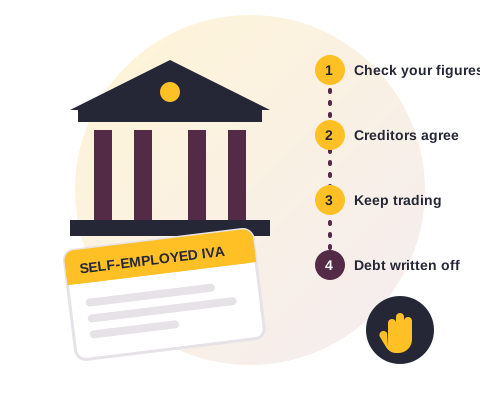
What is a self-employed IVA?
A self-employed IVA is an Individual Voluntary Arrangement built around a business owner's income. Legally it's the same as any IVA: a formal, binding agreement to pay what you can afford to your creditors through a licensed insolvency practitioner, usually for 5 to 6 years, with what's left written off at the end.
The difference is in how it's set up. Your payment is worked out from your business profits, your proposal includes your trading figures, and the terms are designed so you can keep running your business while you pay off your debts.
Who is a self-employed IVA for?
- Sole traders, including tradespeople, drivers and freelancers
- Partners in a business partnership
- Contractors, including construction workers paid under CIS
- Limited company directors with personal debts, or who have personally guaranteed company borrowing
Your business needs to produce a reasonably regular income. If your income goes up and down, for example with the seasons, that can be built into the proposal, as long as you can meet the agreed yearly total.
A self-employed IVA can't deal with a limited company's own debts. The company is a separate legal person, so its debts stay with the company. Free advice on company debt is available from Business Debtline.
Which debts can be included?
| Business type | What can usually be included |
|---|---|
| Sole trader or partner | Personal and business debts, because legally they're the same. That includes business loans and credit cards, overdrafts, supplier debts, and HMRC arrears such as income tax, National Insurance and VAT. |
| Limited company director | Your personal debts, and any company debts you've personally guaranteed. Other company debts stay with the company. |
The same debts are excluded as in any IVA, including magistrates' court fines, child maintenance, student loans and secured debts. See which debts can go into an IVA.
HMRC and your IVA
For many self-employed people, HMRC is one of the biggest creditors. That matters because an IVA needs creditors owed 75% of your debt to agree, so if HMRC is owed more than a quarter, it can block your IVA on its own.
To give your IVA the best chance, HMRC will usually expect:
- all your tax returns to be filed and up to date, so the amount owed is accurate
- a realistic cash flow forecast for your business, usually covering at least the first 12 months
- you to pay new tax on time during the IVA, as any new tax debt isn't covered
- an affordable offer that it thinks fairly reflects what you can pay
Set money aside for your tax bills as you go. Falling behind on new tax is one of the most common reasons self-employed IVAs fail. If HMRC is your only real problem, ask about a Time to Pay arrangement first.
Keeping your business going
- You can keep trading. An IVA doesn't stop you running your business, and you can stay a company director, unlike in bankruptcy.
- Business assets: you can usually keep the tools, equipment, vehicles and stock you need to trade.
- Leased premises: check your lease. Some leases let the landlord end the lease if you enter an IVA, so speak to your landlord early.
- Suppliers: you may be able to keep paying key suppliers you need to carry on trading. Your insolvency practitioner will explain how.
- Professional rules: some regulated jobs, such as in financial services or law, have rules about IVAs. Check with your professional body.
- Borrowing: during an IVA you usually can't borrow more than £500 without your supervisor's permission, including for the business.
How your payments are worked out
- Your business figures. Your income and business costs, using your recent accounts, tax returns and bank statements.
- Your household budget. Your essential personal living costs, such as rent or mortgage, council tax, energy and food.
- What's left. The surplus becomes your IVA payment. Seasonal businesses can sometimes pay more in busy months and less in quiet ones.
- Yearly review. Each year your supervisor checks your accounts. If profits rise, your payment may go up. If they fall, it may be reduced.
Self-employed IVA or bankruptcy?
| Self-employed IVA | Bankruptcy | |
|---|---|---|
| Keep trading? | Yes, usually | Your business may have to close, and staff may lose their jobs |
| Company director? | Yes, you can stay a director | No, not without the court's permission |
| Business assets | Essential assets are usually kept | Assets over the allowed value can be sold |
| How long? | Usually 5 to 6 years | Usually 1 year, with payments for up to 3 years |
| Cost | Fees taken from your payments | £680 application fee |
Other options include a Debt Management Plan, a Debt Relief Order if your debts and income are low, or a Time to Pay deal with HMRC. Compare them all on our debt advice page.
Things to check before you apply
- Are your tax returns up to date? File any missing returns first.
- Is your business viable? An IVA can't fix a business that's losing money. If it isn't viable, other options may be better.
- Can you afford the payment for 5 to 6 years and still set money aside for tax?
- Do you understand the fees, and have you read the key facts document?
- Is the insolvency practitioner licensed and experienced with self-employed IVAs?
How Bailiff Helpline works: we don't arrange IVAs ourselves. If you ask us to, we pass your details to a licensed insolvency practitioner from our panel, who may pay us a fee. They must check whether an IVA is right for you and explain the other options. Free advice for the self-employed is also available from Business Debtline and MoneyHelper.
An IVA may not be suitable in all circumstances. Fees apply, and your credit rating will be affected.
Self-employed and struggling with debt?
Tell us about your debts and a licensed insolvency practitioner will call you back to talk through your options. It's free, with no obligation.
Questions about self-employed IVAs
Can I keep trading in an IVA?
Yes. An IVA doesn't stop you running your business, and it's designed around your trading income. You can usually keep the tools, equipment, vehicles and stock you need.
Can business debts be included in an IVA?
If you're a sole trader or partner, yes, because your business and personal debts are legally the same. If you run a limited company, only your personal debts and any company debts you've personally guaranteed can be included.
Can HMRC debts go into a self-employed IVA?
Yes. Income tax, National Insurance and VAT arrears can usually be included. HMRC will expect your tax returns to be up to date and new tax to be paid on time during the IVA.
Can HMRC block my IVA?
If HMRC is owed more than 25% of your total debt, it can block your IVA on its own, because an IVA needs creditors owed 75% of the debt to agree. A realistic proposal with up-to-date returns and a cash flow forecast gives you the best chance.
Can I be a company director in an IVA?
Yes. Unlike bankruptcy, an IVA doesn't stop you being a director of a limited company.
Can an IVA deal with my limited company's debts?
No. A limited company is a separate legal person, so its debts can't go into your personal IVA, apart from any you've personally guaranteed. Business Debtline gives free advice on company debts.
What if my income changes from month to month?
That's common for the self-employed. Your proposal can reflect seasonal or uneven income, as long as you meet the agreed total each year. Your payments are reviewed each year using your accounts.
What happens to my tax refund in an IVA?
A refund for a tax year before or during the year your IVA was approved is often paid to your supervisor or set against what you owe HMRC. Your insolvency practitioner will explain how it's treated.
Can I get a business loan during an IVA?
You usually can't borrow more than £500 without your supervisor's permission, including for the business. Speak to your supervisor before taking any new credit.
What if my business fails during the IVA?
Tell your insolvency practitioner straight away. If you move into a job, your IVA may be changed to reflect your new income. If you can't make any payments, the IVA may end, and you'd need advice about other options.
Is a self-employed IVA better than bankruptcy?
It depends. An IVA usually lets you keep trading and stay a director, but it lasts longer and you pay more. Bankruptcy is usually shorter but may mean closing your business. Compare both with an adviser.
