
How is child maintenance paid through the CMS?
Child maintenance arrears are a priority debt. If you pay through the Child Maintenance Service (CMS), there are two ways to pay:
| Direct Pay | Collect and Pay | |
|---|---|---|
| How it works | The CMS works out the amount, and you pay the other parent directly | The CMS collects the money from you and passes it on |
| Fees | None | Paying parent: 20% on top. Receiving parent: 4% taken off |
| If payments are missed | The receiving parent tells the CMS, and the case is usually moved to Collect and Pay | The CMS can take enforcement action straight away |
Missing payments on Direct Pay can mean you're moved to Collect and Pay, and the 20% fee makes every payment bigger. So it's worth acting at the first sign of trouble.
How do I check my child maintenance is right?
The CMS works out maintenance mainly from your gross income, the number of children, other children living with you and how many nights the children stay with you. Ask it to look again if:
- your income has changed by 25% or more
- you have another child living with you, or more children to pay for
- the children stay with you overnight more often
- the CMS used the wrong income figure, or an estimate because it didn't have yours
If you think a decision is wrong, ask for a mandatory reconsideration, usually within 30 days, then appeal to a tribunal if needed. Report changes promptly: arrears built up on an old calculation can be hard to undo, and changes usually only take effect from when you report them.
What can the Child Maintenance Service do if I don't pay?
| Action | How it works | Court needed? | CMS charge |
|---|---|---|---|
| Deduction from earnings order | Your employer takes maintenance and arrears from your wages or pension | No | £50 |
| Regular deduction order | Regular payments taken from your bank or building society account | No | £50 |
| Lump sum deduction order | A one-off amount taken from your account | No | £200 |
| Deductions from benefits | A set weekly amount taken from your benefits or pension | No | None |
| Liability order | Confirms the debt, so stronger action can follow | Yes (magistrates' court) | £300 |
| Bailiffs, charging order, order for sale, third party debt order | Taking control of goods, securing the debt on your home or forcing a sale, or freezing savings | After a liability order | Bailiff and court fees |
| Driving ban or passport removal | Up to two years | Yes | None |
| Prison | Up to six weeks, as a last resort | Yes | None |
The CMS will tell you in writing before it charges an enforcement fee. It can also put a liability order on the public Register of Judgments, Orders and Fines, which affects your credit.
How do deductions from wages and bank accounts work?
- From your wages: your employer must deduct what the CMS tells it to, leaving you a protected amount. If you change jobs, the order lapses and starts again when the CMS finds your new employer. You can appeal to a court, in limited cases, within 28 days of the order. The CMS must change it if your maintenance goes down, for example because your income falls by 25% or more.
- From your bank account: often used if you're self-employed, retired or have savings. It can include joint, business and partnership accounts. You'll be told before a lump sum is taken and can make representations, for example if the money belongs to someone else.
If deductions leave you unable to pay rent or bills, tell the CMS straight away, with your budget, and ask it to review the amount taken towards arrears.
Can I lose my licence or go to prison for child maintenance arrears?
If deductions don't work, the CMS can ask the magistrates' court for a liability order. It can then send bailiffs, get a charging order on property you own and ask for it to be sold, or freeze money in your accounts.
As a last resort, the CMS can ask a court to:
- disqualify you from driving for up to two years
- take away your passport for up to two years
- send you to prison for up to six weeks
The court must find that you've wilfully refused or culpably neglected to pay. It often suspends the order as long as you pay. Always go to the hearing with your budget and payslips, and get advice beforehand.
What changes are coming to the CMS?
The government has said it will make these changes when parliamentary time allows. None of them were in force as of November 2026:
- Direct Pay will be scrapped, and all cases will move to a single service run like Collect and Pay, so missed payments are spotted straight away.
- Collection fees will be cut to 2% for both parents, but parents who don't pay will still face higher charges.
- Administrative liability orders will let the CMS make liability orders itself, without going to court, so enforcement could move faster.
We'll update this page when these changes take effect.
What about private arrangements and court orders?
- Family-based arrangements aren't legally binding. If you stop paying, the other parent can apply to the CMS, but the CMS normally only collects from the date of the application, not for the past.
- Court orders for child maintenance, such as a consent order on divorce, are enforced through the family court, not the CMS. After a year, either parent can usually go to the CMS instead, which replaces the order.
- Old Child Support Agency arrears may have been closed down or written off when the CSA closed. If you're chased for old CSA arrears, ask for a breakdown.
Can child maintenance arrears be reduced or written off?
- Arrears don't end when the child grows up. The CMS can keep collecting after your child stops qualifying for maintenance, and can claim from your estate if you die.
- The receiving parent can agree to accept a lump sum in settlement, or ask the CMS to stop collecting some or all of the arrears.
- The CMS can write off arrears in limited cases, for example if they're from the old CSA schemes, the receiving parent has died, or they're no longer collectable.
- Arrears caused by a wrong calculation can be corrected if you challenge the decision. Ask for a mandatory reconsideration.
Child maintenance arrears can't be written off by bankruptcy, an IVA or a Debt Relief Order.
How do I deal with child maintenance arrears?
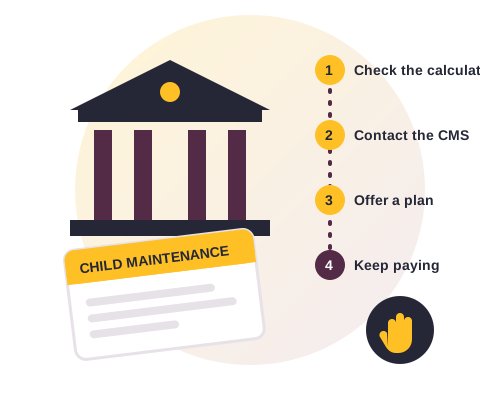
- Keep paying your ongoing maintenance if you possibly can. It stops the arrears growing and shows good faith.
- Check the calculation, and report any change in your income or circumstances straight away.
- Contact the CMS and offer an affordable amount towards the arrears, with a budget showing your income and essential costs.
- Follow calls up in writing, and keep a note of who you spoke to and what was agreed.
- Put child maintenance with your other priority debts, ahead of credit cards and loans.
- Get free advice if you have other debts too. Dealing with those can free up money for maintenance.
Can child maintenance go into a debt solution?
| Debt solution | Can it include this debt? |
|---|---|
| Debt Breathing Space | It doesn't stop child maintenance collection |
| Debt Management Plan | It can free up money for maintenance, but can't include it |
| IVA | No |
| Debt Relief Order | No |
| Bankruptcy | No. Child maintenance arrears survive bankruptcy |
Child maintenance arrears can't be written off by a debt solution. But dealing with your other debts can help you keep up with maintenance.
Compare your debt options for your other debts.
Struggling to keep up with maintenance and other debts?
Tell us about your debts and a licensed insolvency practitioner will call you back to talk through your options. It's free, with no obligation.
Questions about child maintenance arrears
Is child maintenance a priority debt?
Yes. The Child Maintenance Service has strong powers, including taking money from your wages or bank account without going to court.
How much does the CMS charge for enforcement?
£50 for a deduction from earnings order or regular deduction order, £200 for a lump sum deduction order and £300 for a liability order application. Collect and Pay also adds a 20% fee.
Can I go to prison for not paying child maintenance?
As a last resort, yes. A court can send you to prison for up to six weeks if you wilfully refuse or culpably neglect to pay.
Can the CMS take money from my bank account?
Yes. It can take regular payments or a lump sum from your account, including joint and business accounts, without going to court.
Do child maintenance arrears stop when my child turns 16?
No. Ongoing maintenance may stop, but the CMS can keep collecting arrears after your child stops qualifying.
Can child maintenance arrears be included in bankruptcy?
No. Child maintenance arrears can't be written off in bankruptcy, an IVA or a Debt Relief Order.
Can I reduce my child maintenance payments?
Ask the CMS to review the calculation if your income changes by 25% or more, or your circumstances change. Changes usually apply from when you report them.
Is the CMS getting rid of Direct Pay?
The government plans to remove Direct Pay and cut fees to 2%, but as of November 2026 these changes haven't taken effect.