What are County Court bailiffs?
County Court bailiffs are enforcement agents employed by HM Courts and Tribunals Service. They collect unpaid County Court judgments (CCJs) when you haven't paid what the court ordered. Unlike private bailiff firms, they work for the court itself.
A creditor can only send them once you've missed payments the court ordered. If you've kept to the payments on your CCJ, a warrant can't be issued.
What is a warrant of control?
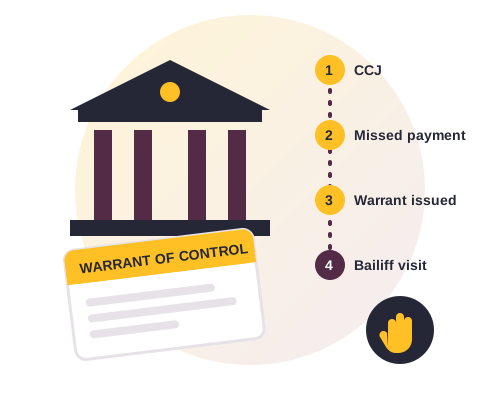
A warrant of control is a court document that lets a County Court bailiff visit your home, list your belongings and sell them to pay the debt. The creditor asks the court for one after you miss CCJ payments, and the court fee they pay is added to what you owe.
- You miss payments on your CCJ. The creditor applies to the court for a warrant of control.
- You get a Notice of Enforcement. Since 1 May 2026 this must give you at least 14 clear days before any visit.
- The bailiff visits. They'll ask for payment in full. If you can't pay, they may list goods under a controlled goods agreement while you pay in instalments.
- Goods may be sold. If you don't keep to the agreement, goods can be removed. You must get at least 7 clear days' notice before a sale.
What can County Court bailiffs do?
Enter peacefully
Only through a normal door, and only if you let them in or a door is unlocked. Never through a window. Read can bailiffs force entry?
Clamp or remove vehicles
A car parked on the road or your drive can be clamped or taken, if it's yours and isn't protected.
List your goods
Goods can be listed in a controlled goods agreement, which lets you keep using them while you pay.
Only between 6am and 9pm
Visits must be within these hours, unless you run a business that's open at other times.
What County Court bailiffs can't take
- Clothes, bedding, furniture and household items you reasonably need, such as a cooker, fridge and washing machine.
- Tools, equipment and vehicles you need for work or study, up to £1,350 in total.
- Anything that belongs to someone else, such as a partner, child or lodger, or goods on finance.
Read more: what can bailiffs take?
How can I stop County Court bailiffs?
Pay in full
Paying the creditor or the court in full ends enforcement straight away.
Offer instalments
Contact the creditor as soon as the notice arrives. Send your offer and budget in writing, and start paying straight away.
Apply to suspend the warrant
Use court form N245 to offer an affordable payment. If the court agrees and you keep paying, the bailiff can't act. A fee applies, but you may get Help with Fees.
Ask for more time
A debt adviser can ask for the notice period to be extended, or apply for Breathing Space, which pauses enforcement for 60 days.
If the judgment itself is wrong, for example you never received the court papers, you can ask the court to set aside the judgment using the N244 form. Get advice first, as you'll need a good reason.
Got a warrant of control?
Tell us about your debts and a licensed insolvency practitioner will call you back to talk through your options. It's free, with no obligation.
Questions about County Court bailiffs
Can County Court bailiffs force entry?
No, not to your home on a first visit. They can only come in peacefully, for example through an unlocked door. They can only use reasonable force to re-enter if you've broken a controlled goods agreement and they've given you notice first.
How long does a County Court bailiff have to give me?
Since 1 May 2026, you must get at least 14 clear days' notice before a bailiff can visit to take control of your goods. Sundays, bank holidays and Christmas Day don't count.
How do I stop a warrant of control?
Pay the debt, agree a payment plan with the creditor, or apply to the court on the N245 form to suspend the warrant with an affordable offer. If the court agrees and you keep paying, the bailiff can't take your goods.
Are County Court bailiffs the same as High Court enforcement officers?
No. County Court bailiffs are employed by HM Courts and Tribunals Service. High Court enforcement officers work for private firms, charge higher fees and can only collect debts over £600 that aren't regulated by the Consumer Credit Act.
What can't County Court bailiffs take?
Clothes, bedding, furniture and household items you need, plus work tools, equipment and vehicles you need for your job or studies, up to £1,350 in total. They also can't take goods that belong to someone else.