
How do personal loans and overdrafts work?
| Personal loan | Overdraft | |
|---|---|---|
| How you borrow | A fixed amount, paid to you in one go | Spending below zero on your current account, up to a limit |
| How you repay | Fixed monthly payments over a set term | No fixed plan. The bank can ask for it back at any time ("repayable on demand") |
| Interest | Usually a fixed rate, based on the amount, term and your credit record | A single annual rate, often 35% or more, charged on what you use |
| Priority? | Non-priority, unless it's secured on your home or car | Non-priority |
Most personal loans and overdrafts are non-priority debts: you won't lose your home or go to prison for not paying. Deal with rent, mortgage, council tax and energy first. See priority and non-priority debts.
A longer loan term means lower monthly payments, but you pay interest for longer, so it costs more overall. Variable-rate loans can become unaffordable if rates rise.
What should I do if I can't make my loan or overdraft repayments?
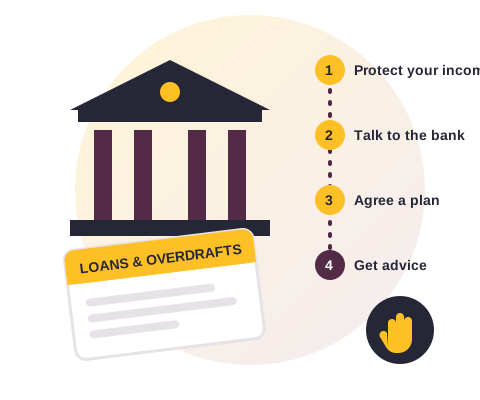
- Protect your income. If you owe money to the bank your wages or benefits go into, see the right of set-off.
- Do a budget. List your income, essential spending and every debt, with the balance, interest rate and monthly payment.
- Pay priority bills first.
- Contact your lender before you miss a payment. Explain what's happened, whether it's short or long term, and what you can afford. Mention any health problems: lenders must take them into account.
- Don't just stop paying or cancel your Direct Debit without telling the lender. Agree a plan first.
- Get free debt advice if you have several debts. Debt Breathing Space freezes interest and charges for 60 days while you do.
Be wary of taking a new loan to pay this one. Read should I borrow my way out of debt? first.
Can my bank take money from my account to pay my debt?
Yes. If you owe a bank money on a loan, overdraft or credit card, and your wages or benefits are paid into an account with the same bank, it can use the right of set-off to take money to cover what you owe. FCA guidance says banks should leave you enough for essential living costs and priority bills, but it can still leave you short.
Protect yourself: open a basic bank account with a bank you don't owe money to, and move your income and essential Direct Debits there. Basic accounts have no overdraft, and the big banks must offer them, even if you have a poor credit record.
What help can my bank or lender offer?
FCA rules say lenders must treat customers in financial difficulty fairly, and at least consider requests to freeze interest. Depending on your situation and your income and spending, they may offer:
| Option | How it works | The catch |
|---|---|---|
| Freeze interest and charges | Your payments all go towards the balance for a while | May be noted on your credit file |
| Payment break | Payments stop or reduce for an agreed time | Interest usually builds up, so payments rise afterwards |
| Reduced or interest-only payments | Lower payments for a set period | The rest of the loan is recalculated at the end, so payments go up |
| Extend the loan term | Spreads the balance over longer to cut monthly payments | You pay more interest overall |
| Add arrears to the loan | Missed payments are spread over the remaining term | Monthly payments increase slightly |
| Convert an overdraft to a loan | The overdraft becomes a structured loan with an end date | Only helps if the new payments are affordable |
If you don't feel able to talk to your lender, a free debt adviser can do it with you.
What happens if I don't repay a personal loan?
- Reminder letters and a late fee, often around £10 to £25. A missed payment may be reported to the credit reference agencies, although if you catch up quickly and explain, some lenders won't record it.
- A notice of arrears, usually after two missed payments, with details of free advice.
- A default notice, giving you at least 14 days to catch up. This usually comes after three to six missed payments.
- The account defaults. A default stays on your credit file for six years, and the lender can ask for the whole balance.
- Collection. The debt may be passed or sold to a debt collection agency. Collectors have no special powers.
- Court. The lender can apply for a County Court Judgment. Only if you don't pay that can bailiffs or other enforcement be used.
Guarantor and secured loans
If someone guaranteed your loan, the lender can ask them to pay. If the loan is secured on your home or car, read secured loans: the lender could repossess it.
Overdraft debt: what are my rights?
Since 6 April 2020, FCA rules mean:
- One simple interest rate. Banks charge the same annual rate whether or not the overdraft was arranged. Daily and monthly overdraft fees are banned.
- Refused payment fees must reflect the bank's real costs.
- Help for repeat use. If you're overdrawn most of the time, month after month, your bank must contact you and discuss options, such as a cheaper way to repay.
If you can't clear your overdraft
- The bank may lower or remove your limit and refuse payments that take you over it.
- It can demand the full balance, then send a default notice, close the account and record a default.
- The debt may be sold to a collector, or the bank may go to court.
Ask your bank to freeze interest or turn the overdraft into a loan you can afford. If the account is closed, you have the right to a basic bank account elsewhere.
Can I cut the cost of my loan or overdraft?
- Switch to a cheaper loan if your credit record still allows. Check for early repayment charges first.
- A 0% money transfer credit card can pay off an overdraft or expensive loan, interest-free for a set time, for a fee. It only works if you clear it before the offer ends and don't spend on the card.
- Credit unions often lend more cheaply than banks, and may help people with poor credit or low incomes.
Lower payments today aren't a fix if you're borrowing to cover everyday bills. Read about Debt Consolidation Loans before taking out more credit.
Which debt should I pay off first?
- Priority debts first: rent or mortgage, council tax, energy and court fines.
- Keep up minimum payments on everything else, if you can.
- Put any extra money towards the non-priority debt with the highest interest rate. When that's cleared, move what you were paying onto the next highest.
If you can't afford the minimums, offer each creditor a fair share instead, or look at a Debt Management Plan.
Time limits, write-offs and complaints
- Statute-barred debt: in England and Wales, a lender usually has six years to go to court. For a loan, the clock normally starts from your last payment or written acknowledgement. For an overdraft, it usually starts when the bank formally demanded repayment. Get advice before relying on this.
- Writing off debt: a lender may agree to write off a debt if you'll never be able to repay it. Otherwise, a DRO, IVA or bankruptcy can.
- Complaints: if your lender isn't treating you fairly, or lent you more than you could afford, complain in writing. If you're not happy after eight weeks, or with its final response, go to the Financial Ombudsman Service. It's free.
Debt solutions for loans and overdrafts
| Debt solution | Can it include this debt? |
|---|---|
| Debt Breathing Space | Yes |
| Debt Management Plan | Yes. Banks usually close the account and treat the overdraft as a fixed debt |
| IVA | Yes |
| Debt Relief Order | Yes, if you meet the rules |
| Bankruptcy | Yes |
Most banks close your current account if you enter a debt solution, so set up a basic bank account elsewhere first. Compare all your debt options.
Loan or overdraft repayments too high?
Tell us about your debts and a licensed insolvency practitioner will call you back to talk through your options. It's free, with no obligation.
Questions about loan and overdraft debt
Is a personal loan or overdraft a priority debt?
No, unless the loan is secured on your home or car. Pay priority bills like rent, council tax and energy first.
Can my bank take money from my account to pay my loan or overdraft?
Yes, using the right of set-off, if the debt and the account are with the same bank. Moving your income to a basic bank account with a different bank protects it.
What happens if I miss a loan payment?
You'll usually get a reminder and a late fee, and it may go on your credit file. After more missed payments you'll get a default notice, then the account may default and be passed to collectors or taken to court.
Can my bank demand my overdraft back?
Yes. Overdrafts are repayable on demand, although banks usually warn you first and must treat you fairly if you're struggling.
Can I ask my bank to freeze interest?
Yes. Lenders must consider requests to freeze interest if you're in financial difficulty, especially if you show them your budget.
Can I turn my overdraft into a loan?
Many banks can convert an overdraft into a personal loan with fixed payments, often at a lower rate. Ask, especially if you're always in your overdraft.
Can bailiffs come for a personal loan?
Not directly. The lender would need a County Court Judgment, and bailiffs can only be used if you then don't pay as the court ordered.
Can loan or overdraft debt be written off?
Yes, through a Debt Relief Order, IVA or bankruptcy, or if the lender agrees you'll never be able to repay. Debts can also become statute barred after six years in some cases.
