
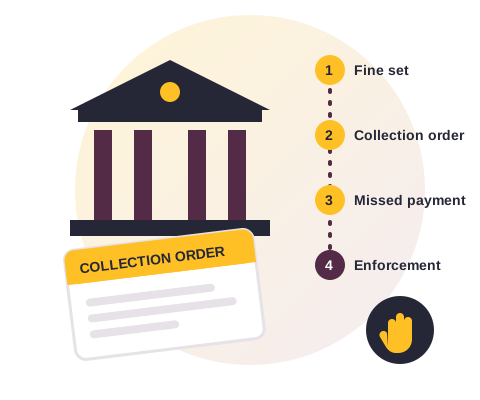
What is a magistrates' court fine?
Magistrates' courts deal with criminal cases. They can fine you for things like driving and speeding offences, not having a TV licence, unpaid train fares and public order offences. On top of the fine, the court can order you to pay compensation to a victim, prosecution costs and a victim surcharge.
The amount depends on the offence, how serious it was and how much you can afford. That's why it's important to give the court full, accurate details of your income and outgoings. If you don't, it may set a fine you can't manage, and failing to give information when ordered is itself an offence.
What is a collection order?
When you're fined, the court makes a collection order. It tells you how much you owe, how to pay and when. You might have to pay in full within a set time, or you may be allowed to pay in weekly or monthly instalments.
The order also names the fines officer who manages your case. If your payments become unaffordable, contact them before you miss one. You'll usually need to fill in a statement of means (form MC100) showing your income and outgoings.
- If the fines officer agrees, your payments can be reduced without a hearing.
- If they refuse, you can ask for the decision to be reviewed by the court, usually within 10 days.
- If your circumstances have changed since the fine was set, the court can reduce the fine itself, though not compensation or costs.
What happens if I miss payments on a fine?
The fines officer can take further steps, usually after sending you a notice. If you already have another fine you've fallen behind on, you can be treated as an existing defaulter, and the court must take money from your wages or benefits.
Wage or benefit deductions
An attachment of earnings order or a deduction from benefits order takes payments automatically.
Bailiffs
Enforcement agents can take control of goods and, as a last resort, use reasonable force to enter your home. See can bailiffs force entry?
Clamping your vehicle
A clamping order lets your vehicle be clamped and, if you still don't pay, sold.
Increasing the fine
The fine can be increased by 50% if you don't pay without a good reason.
Registering the fine
An unpaid fine can be added to the Register of Judgments, Orders and Fines, which affects your credit rating.
A court hearing and prison
As a last resort the court can order unpaid work or prison. You can't be sent to prison without a hearing.
What can I do if I can't afford to pay my fine?
- Act before the bailiffs are involved. Contact the fines officer or your regional fines team as soon as you know you'll struggle.
- Work out a budget. List your income and essential costs so you can show what you can genuinely afford.
- Make an offer. Send the fines officer your offer, your budget and an explanation of any change in your circumstances, such as illness or job loss.
- Go to any hearing. If there's a hearing, attend and take proof of your income and outgoings. If you might be sent to prison, get legal advice from a solicitor.
- Deal with your other debts. Freeing up money from non-priority debts can help you keep up with the fine.
Court fines can't be included in a Debt Relief Order, an IVA or bankruptcy, and they aren't covered by Breathing Space. But dealing with your other debts through one of these can make the fine much easier to pay.
Struggling with fines and other debts?
Tell us about your debts and a licensed insolvency practitioner will call you back to talk through your options. It's free, with no obligation.
Questions about magistrates' court fines
Can bailiffs force entry for a magistrates' court fine?
Yes, in some cases. Unlike most other debts, bailiffs collecting a criminal fine can use reasonable force to enter your home as a last resort. That's one reason fines are a priority debt.
Can I go to prison for not paying a court fine?
Yes, but only as a last resort, and never without a court hearing first. The court must be satisfied that you could pay and refused, or that every other way of collecting the fine has failed. It may suspend prison to give you a last chance to pay.
Can I reduce my fine?
If your circumstances have changed since the fine was set, the court can reduce (remit) all or part of the fine itself. It can't remit compensation or prosecution costs. You can also ask the fines officer to lower your payments.
Can a court fine go into an IVA, DRO or bankruptcy?
No. Magistrates' court fines can't be written off in a Debt Relief Order, an IVA or bankruptcy, and they aren't covered by Breathing Space. You'll need to keep paying them alongside any debt solution.
Who do I contact about my fine?
Contact the fines officer named on your collection order. If you've lost it, find the court's contact details on GOV.UK or ask the court clerk, and have your case number ready.