
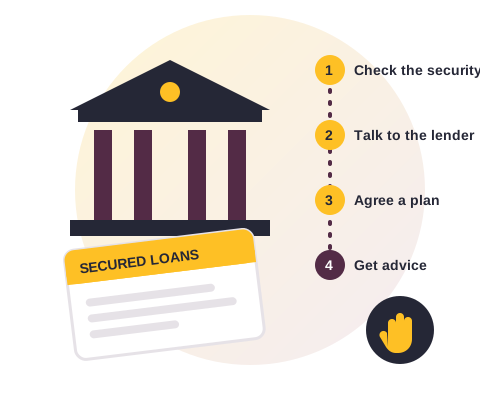
What is a secured loan?
A debt is secured when the agreement, or the law, lets the lender take something you own if you don't pay. Your main mortgage is secured on your home. A secured loan is extra borrowing secured on the same property. It's also called a:
- second mortgage or second charge (your main mortgage lender holds the first charge)
- homeowner loan or further advance
- secured consolidation loan, when it's used to pay off other debts
People often take them out for home improvements or to combine debts. Check your loan paperwork: if a loan is secured on your home, treat it as a priority debt, just like your mortgage. See priority and non-priority debts.
Why are secured loans risky?
Because the lender can fall back on your home, it may offer a lower rate, lend more, or lend to people with poor credit. That's why secured loans are often advertised as a way to consolidate debts. But:
- If you can't keep up, you could lose your home, even if your main mortgage is up to date.
- They usually run for a shorter term than a mortgage, often 5 to 10 years, so payments can be high.
- Some have higher rates than you'd expect, or rates that rise if you miss payments.
- Paying off early can mean early repayment charges.
- The only way out is to pay it off in full, usually by remortgaging or selling. Lenders very rarely write off secured debt.
If you're thinking of a secured loan to clear other debts, that's often a sign you're already struggling. Read about Debt Consolidation Loans and get free advice before you put your home on the line.
What should I do if I miss secured loan payments?
- Do a budget and a financial statement of your income, spending and debts.
- Put your mortgage and secured loan first, alongside rent, council tax and energy.
- Contact the lender quickly and offer an affordable plan to pay your normal instalment plus something towards the arrears.
- Pay what you can even before it's agreed.
- Check for help: Support for Mortgage Interest can sometimes cover interest on a loan secured on your home if you get Universal Credit. See help with mortgage payments.
- Ask your main lender about a remortgage if you have enough equity. One new mortgage can cost less each month than two.
- Get free advice, and consider Debt Breathing Space.
The letters you'll get
Lenders must keep you informed. On older loans covered by the Consumer Credit Act, you'll usually get a notice of arrears after two missed monthly payments, then a default notice giving you at least 14 days to put things right. Both should tell you where to get free advice.
What must my lender do before going to court?
Second charge lenders are regulated by the FCA, and loans taken out since March 2016 are covered by the same mortgage rules as first mortgages. Your lender must:
- treat you fairly and explore alternatives to repossession
- consider your proposals, such as a payment plan or a longer term
- follow the mortgage pre-action protocol, which applies to second charges too, before starting a court claim
- treat repossession as a last resort
It's unclear whether the Mortgage Charter covers second charge loans, so ask your lender what help it offers. If it isn't treating you fairly, complain, then go to the Financial Ombudsman Service.
What happens if my secured lender goes to court?
The process is the same as for a main mortgage. Read what happens if your lender takes you to court for the forms, deadlines and what to say.
- Get free early legal advice. It's available once your home is at risk, whatever your income, through the Housing Loss Prevention Advice Service.
- Fill in the defence form and go to the hearing. The court can let you stay if you can afford your payments and a realistic plan for the arrears.
- Ask about a time order. For loans covered by the Consumer Credit Act, the court can reduce payments, extend the term or change the interest. Get advice first.
You can only be evicted by court bailiffs if the court makes an outright possession order and the date has passed, or you break a suspended order. You can still apply to suspend an eviction warrant using form N244.
What happens after my home is sold?
The bailiffs hand the keys to the lender, which sells the property, usually through an estate agent and sometimes at auction. The money pays costs first, then your first mortgage, then the secured loan. Anything left goes to you.
If there isn't enough to repay everything, the rest is a shortfall debt, and you still owe it. It becomes an unsecured debt, so you can offer affordable payments or include it in a debt solution. Lenders usually have 12 years to chase the capital and 6 years for the interest.
Logbook loans, pawn and guarantor loans
| Type | What's at risk | If you don't pay |
|---|---|---|
| Logbook loan (bill of sale) | Usually your car, which the lender owns until you've repaid | The lender can take it without a court order, after a default notice |
| Pawn agreement | Jewellery, electronics or other goods the pawnbroker holds | They can be sold to clear the debt |
| Guarantor loan | Not your property, but your guarantor's money | The lender can ask your guarantor to pay |
Logbook and guarantor lenders must be authorised by the FCA. If you're struggling, contact the lender early, and get advice before your car is taken.
Charging orders: when unsecured debt becomes secured
If a creditor gets a County Court Judgment and you own your home, it can ask the court for a charging order. This secures the debt on your home like a mortgage, so it's paid when you sell.
- For consumer credit debts, a creditor can't usually get a charging order while you're keeping up with the payments the court ordered.
- It can ask the court to force a sale, but that's rare, and not allowed for consumer credit debts under £1,000.
Keeping to your CCJ payments is the best protection.
Debt solutions and secured loans
| Debt solution | Can it include this debt? |
|---|---|
| Debt Breathing Space | Yes, it pauses action on the arrears for 60 days |
| Debt Management Plan | Sometimes, with the lender's agreement, but your home stays at risk |
| IVA | Arrears may be included, but the lender can still rely on its security |
| Debt Relief Order | No. You can't get a DRO if you own your home |
| Bankruptcy | Your home may have to be sold |
Dealing with your unsecured debts can free up money for your mortgage and secured loan. Compare all your debt options.
Behind on a secured loan?
Tell us about your debts and a licensed insolvency practitioner will call you back to talk through your options. It's free, with no obligation.
Questions about secured loans
Can a secured loan lender repossess my house?
Yes, if you don't keep up the payments, even if your main mortgage is up to date. It needs a court order, must follow the pre-action protocol and should treat repossession as a last resort.
Is a secured loan a priority debt?
Yes. Because it's secured on your home, you could lose your home if you don't pay. Deal with it alongside your mortgage, rent, council tax and energy.
Can I get out of a secured loan?
Only by paying it off in full, usually by remortgaging or selling. Check for early repayment charges first.
Can a secured loan be written off?
It's very unlikely, because the lender can recover the money from your home. Any shortfall after a sale becomes unsecured and could be included in a debt solution.
Who gets paid first if my house is repossessed?
Costs are paid first, then your first mortgage, then the secured loan. Anything left over goes to you.
Can a logbook lender take my car?
Yes. The lender owns the car until you've repaid, so it can take it without a court order if you fall behind, after sending a default notice.
Can a CCJ be secured on my home?
Yes, through a charging order, if you own your home. For consumer credit debts, it can't usually happen while you're keeping up with the court's payments.
Does Debt Breathing Space cover secured loans?
It can stop action over secured loan arrears for 60 days, but you should keep paying your normal instalments.
Sources
- FCA Handbook: MCOB 13 (arrears and repossessions)
- Pre-action protocol for possession claims based on mortgage arrears
- Consumer Credit Act 1974, sections 86B, 87 and 129
- GOV.UK: Legal aid for possession proceedings
- Shelter: Arrears on second mortgages and secured loans
- FCA: Logbook loans
- MoneyHelper: Dealing with debt
- National Debtline
