
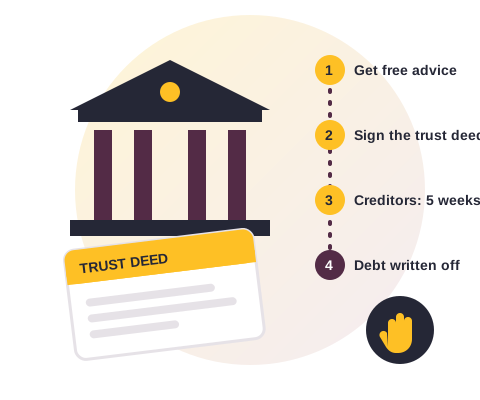
What is a Protected Trust Deed?
A trust deed is a formal, voluntary agreement in Scotland to pay part of your debts over a set period, usually 4 years. You sign over your financial affairs to a licensed insolvency practitioner, who becomes your trustee. You make monthly payments to them, and they share the money between your creditors.
A trust deed becomes protected once it's recorded on the Register of Insolvencies. A protected trust deed binds all your creditors, including those who didn't agree to it. When it ends successfully, the rest of the debts it includes are written off.
Live in England or Wales? Trust deeds are only available in Scotland. The closest option for you is an IVA (Individual Voluntary Arrangement).
Protected Trust Deed vs IVA: what's the difference?
Both let you pay what you can afford and have the rest written off, but they work under different laws.
| Protected Trust Deed | IVA | |
|---|---|---|
| Where | Scotland | England, Wales and Northern Ireland |
| Usual length | At least 4 years | Usually 5 to 6 years |
| Creditor approval | Protected unless half your creditors, or creditors owed a third of your debt, object. Silence counts as agreeing. | Creditors owed 75% of the debt who vote must agree |
| Minimum debt | £5,000 | No legal minimum |
| Benefits-only income | Not allowed | Possible, but rarely suitable |
| Your assets | Generally pass to the trustee, apart from essentials | Usually kept, with the home outside the IVA under the protocol |
| Company director | Usually not, unless your trustee agrees and the company's rules allow it | You can stay a director |
| Overseen by | Accountant in Bankruptcy (AiB) | Insolvency Service |
| Public record | Register of Insolvencies | Individual Insolvency Register |
Who can get a Protected Trust Deed?
- You must have lived in Scotland, or had a place of business there, at some point in the year before the trust deed is granted.
- You must owe at least £5,000 in total.
- You must not be able to repay your debts in full within 4 years.
- You need income from work or other sources. If your only income is benefits, you can't get a trust deed.
Partnerships can have a trust deed. Limited companies can't, although a director can use one for their personal debts. Your payment is worked out using the Common Financial Tool, a standard way of assessing your income and essential spending in Scotland.
Which debts can be included?
| Can usually be included | Can't be included |
|---|---|
| Credit cards, store cards and catalogues | Court fines, penalties and compensation orders |
| Personal loans, overdrafts and payday loans | Student loans |
| Council tax arrears | Debts from fraud |
| Energy and water arrears | Court-ordered maintenance to an ex-partner |
| Rent arrears (although your landlord can still seek eviction) | Mortgages and other secured debts |
| CSA and CMS child maintenance arrears | Limited company debts, unless you gave a personal guarantee |
How does a Protected Trust Deed work?
- Get free advice. A money adviser checks whether a trust deed suits you or whether another Scottish option, such as the Debt Arrangement Scheme, would be better. If creditors are taking action, you can apply for a 6-month moratorium to pause it while you get advice.
- Your trustee works out your payment. A licensed insolvency practitioner looks at your income, spending, debts and assets.
- You read the information document. Your trustee must give you a Debt Advice and Information Package explaining all your options. For trust deeds signed from 20 January 2025, they must also give you a Trust Deed Information Document and at least 3 working days to think about it before you sign.
- Creditors have 5 weeks. Your trustee writes to your creditors. The trust deed can't be protected if more than half of them, or creditors owed a third or more of your debt, object. Creditors who don't reply are treated as agreeing. During these 5 weeks, a creditor can still apply to make you bankrupt, so make sure you tell your trustee about every creditor.
- The trust deed is protected. If there aren't enough objections, the Accountant in Bankruptcy registers it and it becomes protected.
- You pay for at least 4 years. Interest and charges stop while you keep to the terms.
- You're discharged. At the end, the rest of the debts in the trust deed are written off.
Can a trust deed stop sheriff officers?
In Scotland, debts are enforced by sheriff officers rather than bailiffs, using steps called diligence, such as taking money from your wages or bank account.
Once your trust deed is protected, no new diligence can be carried out for the debts it includes. Before that, a 6-month moratorium can give you breathing room. Court fines can't be included, so they still have to be paid.
What happens to my home and belongings?
- Belongings: in general, what you own passes to your trustee, but you can keep basic household items and a car you reasonably need.
- Your home: a special "section 10" trust deed can leave your home out if your mortgage lender agrees, but very few are granted. Otherwise, if there's equity, there are usually other ways to deal with it first: a family member could buy out your share, you could remortgage, or you could make payments for longer. Your home would only be sold as a last resort. If your partner or children live there, the trustee needs their agreement or a court order, and the court can delay a sale for up to 3 years.
- Hire purchase: goods on hire purchase may be affected, and you may have to return them.
- Rented home: rent arrears can be included, but your landlord can still try to evict you, so keep paying your rent.
How much does a trust deed cost?
Trustee fees are often £4,000 or more. They're paid from your monthly payments or from selling assets, and can't be charged before the trust deed is set up. The Accountant in Bankruptcy can check that the work charged for was needed.
Your credit file and the public register
A protected trust deed is listed on Scotland's public Register of Insolvencies, which banks and credit reference agencies can see. It stays on your credit file for 6 years, so borrowing will be harder and more expensive. You usually can't carry on as a company director during a trust deed, unless your trustee agrees and the company's rules allow it.
What if it isn't protected, or I can't keep up?
- If it isn't protected, only the creditors who agreed are bound. The others can take action against you or apply to make you bankrupt (sequestrated). You can appeal to the Sheriff Court.
- If you miss payments, tell your trustee straight away. If you're employed and miss two or more payments, your trustee can take payments straight from your wages.
- If you don't cooperate, your trustee can refuse your discharge or apply to make you bankrupt.
Living with a trust deed
- Creditors stop chasing you. Once your trust deed is protected, creditors can't contact you directly, chase you for payment, add interest or take court action. Pass any letters to your trustee.
- Some letters will still arrive. By law, lenders often still have to send annual statements and arrears notices. This doesn't mean anything has gone wrong.
- Your job: most people carry on working as normal. Check your contract, as some jobs and public offices have rules about insolvency.
- Your bank account: you can usually keep a basic account with a debit card, but not an overdraft.
- If your income changes: if it goes up, you may need to pay more. If it drops, your trustee may let you pay less, or pause payments for a while.
- New money or assets: anything new of value, such as an inheritance, may be used to pay your creditors.
- Tell your trustee if you move house or your circumstances change.
When your trust deed ends
If you've kept to the terms, you're discharged, usually after 4 years. If the trust deed was protected, your discharge applies to all your creditors, and the rest of the debts included are written off. Your trustee can refuse to discharge you, with the Accountant in Bankruptcy's agreement, if you haven't kept to the terms.
Early discharge: if something happens that you couldn't have foreseen or prevented, your trustee can ask your creditors to let you finish early. It goes ahead unless half your creditors, or creditors owed a third of your debt, object. If they do, the Accountant in Bankruptcy decides whether it's fair.
Unhappy with your trustee? Complain to them in writing first. If that doesn't resolve it, you can complain to the Insolvency Service's complaints gateway, which can refer it to the trustee's professional body.
Other debt solutions in Scotland
- Debt Arrangement Scheme (DAS): repay your debts in full over a longer period, with interest and charges frozen and protection from creditors.
- Minimal Asset Process (MAP): a cheaper, simpler form of bankruptcy for people with low income, few assets and smaller debts.
- Sequestration: the Scottish name for bankruptcy.
- Informal arrangements and debt management plans with your creditors.
Free, impartial advice in Scotland is available from Money Advice Scotland, Citizens Advice Scotland and MoneyHelper.
How Bailiff Helpline works: our guides mainly cover England and Wales. If you ask us to, we pass your details to a licensed insolvency practitioner from our panel, who may pay us a fee. They must check whether a trust deed or another option is right for you.
A trust deed may not be suitable in all circumstances. Fees apply, and your credit rating will be affected.
Living in Scotland and struggling with debt?
Tell us about your debts and a licensed insolvency practitioner will call you back to talk through your options. It's free, with no obligation.
Questions about Protected Trust Deeds
What is a Protected Trust Deed?
A Protected Trust Deed is a formal agreement in Scotland to pay part of your debts through a licensed insolvency practitioner, usually over 4 years. Once it's protected, it binds all your creditors, and the rest of the debts included are written off when it ends successfully.
Is a trust deed the same as an IVA?
They're similar, but a trust deed is the Scottish version and works under Scottish law. A trust deed usually lasts at least 4 years, needs at least £5,000 of debt and is protected unless enough creditors object. An IVA usually lasts 5 to 6 years and needs creditors owed 75% of the debt to vote in favour.
Can I get a trust deed if I live in England or Wales?
No. Trust deeds are only for people who have lived or had a business in Scotland in the year before the trust deed is granted. In England and Wales, the closest option is an IVA.
How much debt do I need for a trust deed?
You must owe at least £5,000 in total, and you must not be able to repay it in full within 4 years.
How long does a Protected Trust Deed last?
Trust deeds set up since 28 November 2013 last at least 4 years. Some last longer.
Can I get a trust deed if I'm on benefits?
Not if benefits are your only income. If you work and also get benefits, you can, but your payments can't be more than your monthly earnings.
Will I lose my home with a trust deed?
Possibly. Unless you have a special section 10 trust deed that leaves your home out, you may need to release equity, and your home could be sold as a last resort. Get advice before you sign.
How much does a trust deed cost?
Trustee fees are often £4,000 or more, taken from your monthly payments or from selling assets. Nothing can be charged before the trust deed is set up.
Can a trust deed stop sheriff officers?
Yes, for the debts included. Once the trust deed is protected, creditors can't start new diligence, such as wage or bank arrestments. Court fines can't be included.
What happens if my creditors object?
If more than half of your creditors, or creditors owed a third or more of your debt, object within 5 weeks, the trust deed won't be protected. Creditors who didn't agree can then take action against you or apply for your sequestration.
Will a trust deed affect my credit rating?
Yes. It's recorded on the public Register of Insolvencies and stays on your credit file for 6 years.
Can I stay a company director with a trust deed?
Usually not. You can only carry on as a director if your trustee agrees and the company's rules (its articles of association) allow it.
Can I keep my bank account?
Yes. You can usually keep a basic bank account with a debit card, but not an overdraft or a cheque book.
Will a trust deed affect my job?
Most people carry on working as normal, and your employer doesn't need to know unless they're one of your creditors. Check your contract, as some jobs and public offices have rules about insolvency.
Can I end my trust deed early?
If something happens that you couldn't have foreseen or prevented, your trustee can ask your creditors to agree to an early discharge. It goes ahead unless half your creditors, or creditors owed a third of your debt, object. If you come into money, speak to your trustee about your options.
How do I complain about my trustee?
Complain to your trustee in writing first. If you're not happy with the reply, you can complain to the Insolvency Service's complaints gateway, which can refer it to the trustee's professional body, such as ICAS.
