
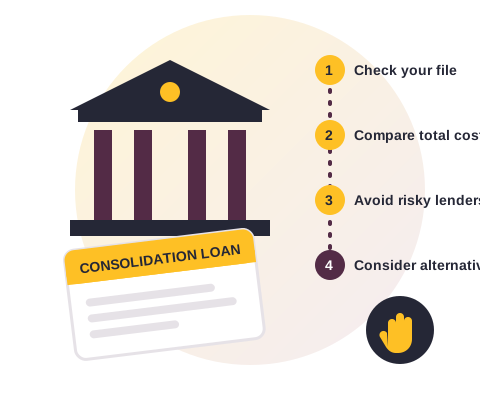
What is a debt consolidation loan?
A debt consolidation loan is a new loan that pays off several existing debts, such as credit cards, an overdraft and store cards. You're left with one monthly payment to one lender, at one interest rate, usually over 1 to 5 years.
It doesn't reduce what you owe. It only moves your debt into one place. It saves money only if the new loan costs less overall than your current debts.
Can I get a consolidation loan with bad credit?
Sometimes, but it's harder and usually more expensive. If you've missed payments, have defaults or a County Court judgment, or use a lot of your available credit, lenders see you as a higher risk. That usually means:
- a higher interest rate, which may be more than you're paying now
- a smaller loan than you need to clear everything
- being turned down, which leaves a search on your credit file
- offers of secured or guarantor loans, which carry extra risks
The advertised rate isn't the rate you'll get. A "representative APR" only has to be offered to at least 51% of the people accepted. With poor credit, you're likely to be offered more.
Our honest view: if you're already missing payments or struggling to pay your bills, a consolidation loan is unlikely to help, and could make things worse. Read should I try to borrow my way out of debt? first.
Why are debt consolidation loans bad for people with bad credit?
For people with a good credit score, a consolidation loan can be a sensible tool. With bad credit, it often becomes a trap, for five main reasons.
- The interest rate is often higher, not lower. Lenders see poor credit as high risk, so you're unlikely to get the advertised or average rates. You could end up paying a higher rate on the new loan than on the debts you're clearing, which defeats the point.
- Lower payments usually mean a longer loan and a higher total cost. To make the monthly payment look affordable, the loan is often spread over more years. You pay less each month but much more interest overall. If you then miss payments, the lender can ask for the whole balance at once, so you could owe more than before.
- It doesn't fix what caused the debt. A consolidation loan moves your debt into one place. It doesn't reduce what you owe. If your income still doesn't cover your outgoings, it's common to end up using the cleared cards again, leaving you with the new loan and new debts.
- Applying can damage your credit further. Every full application leaves a search on your credit file. With bad credit, refusals are common, so you can be left with a lower score and no solution. Several applications in a short time make the next lender even more likely to say no.
- You may be pushed towards secured borrowing. To get approved, some lenders offer loans secured on your home or car, or need a guarantor. That turns unsecured debts like credit cards into a risk to your home, your car or someone else's finances.
One more thing to watch: if you pay extra to one creditor while falling behind with others, it can count as treating creditors unfairly. That can limit your options later, for example by making a Debt Relief Order harder to get.
That's why, if you're already behind with payments, free debt advice and options that don't involve new borrowing, like a Debt Management Plan or Debt Breathing Space, are usually safer. See the alternatives below.
Types of consolidation borrowing if you have bad credit
| Option | How it works | Main risks |
|---|---|---|
| Credit union loan | Not-for-profit lenders, often more flexible with lower credit scores. Interest is capped by law. | You usually need to join first, and some ask you to save before you can borrow. |
| Unsecured "bad credit" loan | A personal loan from a lender that accepts lower scores | High APRs. The total cost can be more than your current debts. |
| Guarantor loan | A friend or relative promises to pay if you don't | They could have to pay the full balance, and it can damage relationships. |
| Secured loan (homeowner loan) | Borrowing secured against your home | Your home could be repossessed if you can't keep up. It turns unsecured debt into secured debt. |
| 0% balance transfer card | Moves card debt to a 0% deal for a set time | Hard to get with poor credit. There's a fee, and a high rate when the deal ends. |
| Payday or high-cost short-term loans | Not suitable for consolidation | Very expensive, and easy to fall into repeat borrowing |
Check any lender is authorised by the Financial Conduct Authority on the FCA register before you apply. Never pay an upfront fee to a company promising to "find" you a loan, and never borrow from an unlicensed lender. If someone offers you cash with no checks and asks for your bank card, it's likely a loan shark.
Should I get one? A quick checklist
A consolidation loan with bad credit only makes sense if you can say yes to all of these:
- I'm up to date with my rent or mortgage, council tax and energy bills
- the loan's total cost is lower than what I'd pay on my current debts
- it will clear all, or at least the most expensive, of my debts
- I can comfortably afford the monthly payment, with money left for emergencies
- it's unsecured, so my home isn't at risk
- I've dealt with why I got into debt, and I'll stop using the cleared cards
If you answered no to any of these, look at the alternatives below first.
How to improve your chances, and avoid making things worse
- Check your credit file for free with the credit reference agencies, and correct any mistakes before applying.
- Use eligibility checkers that do a "soft search", which doesn't show to lenders, before making a full application. Avoid lots of full applications in a short time.
- Get settlement figures for any loans you want to clear, as there may be early repayment charges.
- Compare the total amount repayable, not just the monthly payment. A longer term costs more in interest.
- Register on the electoral roll at your current address, as this helps lenders confirm who you are.
- If accepted, pay the old debts off straight away, and close or cut the limits on the cleared cards.
Alternatives to a consolidation loan with bad credit
If you can't get a loan at a lower cost, or you're already behind, these options can consolidate your payments without new borrowing:
| Option | What it does | Best for |
|---|---|---|
| Debt Management Plan | One affordable payment, with creditors asked to freeze interest. No credit check. | People who can repay in full, just more slowly |
| IVA | One payment for 5 to 6 years, then the rest is written off | Larger debts you can't repay in full |
| Debt Relief Order | Free. Debts are written off after 12 months. | Debts under £50,000, low income and few assets |
| Debt Breathing Space | 60 days' protection from interest, charges and enforcement | Time to get advice before deciding |
| Bankruptcy | Most debts written off, usually after a year | No realistic way to repay |
Being chased by bailiffs? Don't take out an expensive loan to pay them. Offer an affordable payment plan instead. See how to stop bailiffs, or compare every option on our debt advice page.
How Bailiff Helpline works: we're not a lender or a loan broker, and we don't arrange loans. If you ask us to, we pass your details to a licensed insolvency practitioner from our panel, who may pay us a fee. They can talk you through your options for dealing with debt. Free, independent advice is also available from MoneyHelper, National Debtline and StepChange.
Turned down for a consolidation loan?
Tell us about your debts and a licensed insolvency practitioner will call you back to talk through your options. It's free, with no obligation.
Questions about consolidation loans with bad credit
Can I get a debt consolidation loan with bad credit in the UK?
Sometimes, but it's harder and usually more expensive. You may be offered a higher rate, a smaller loan, or a secured or guarantor loan instead. If the total cost is higher than your current debts, it won't help.
What's the best debt consolidation loan for bad credit?
There's no single best loan. Credit unions are often a good place to start, because they're not-for-profit and their interest is capped by law. Always compare the total amount repayable, check the lender is FCA authorised, and avoid secured loans for unsecured debts.
Will a consolidation loan improve my credit score?
It can over time, if you make every payment on time and don't build up new debt. But applying leaves a search on your file, and missing payments on the new loan will harm your score further.
Should I use a secured loan to consolidate debts?
Be very careful. A secured loan turns unsecured debts like credit cards into debt secured on your home, so you could lose your home if you can't keep up. Get independent advice first.
What if I'm turned down for a consolidation loan?
Don't keep applying, as each application leaves a search on your credit file. Look at options that don't need a credit check, such as a Debt Management Plan, or a solution that writes off debt, like an IVA or Debt Relief Order.
Is a guarantor loan a good idea?
Rarely. If you can't pay, your guarantor may have to pay the whole balance, which can damage their finances and your relationship. Make sure they understand the risk before agreeing.
Can I consolidate debts without a loan?
Yes. A Debt Management Plan combines your debts into one affordable payment without new borrowing or a credit check. Free DMPs are available from debt charities.
Why are debt consolidation loans bad for people with bad credit?
With bad credit you're likely to be offered a higher rate, often over a longer term, so the total cost can be more than your current debts. Applications can lower your score further, refusals are common, and you may be pushed towards secured or guarantor loans. A loan also doesn't fix what caused the debt.
What's the difference between debt consolidation and a Debt Management Plan?
Debt consolidation means taking out new credit to pay off your existing debts. A Debt Management Plan doesn't involve new borrowing: you make one affordable payment to a provider, who shares it between your creditors and asks them to freeze interest. Free DMPs are available from debt charities.
Can I consolidate credit card debt into one payment?
Yes, with a consolidation loan or a balance transfer to a cheaper or 0% card, if you can get one and afford it. If you can't, a Debt Management Plan can combine your credit card payments into one without new borrowing.
Does Bailiff Helpline offer consolidation loans?
No. We're not a lender or broker. We provide free information, and if you ask, we can put you in touch with a licensed insolvency practitioner to talk through your debt options.
