
What is unsecured debt?
A debt is unsecured if it isn't tied to something you own. If you don't pay, the lender can't simply take your home or car. It has to chase you for the money, and usually go to court first.
Most everyday borrowing is unsecured, including:
- credit cards and store cards
- personal loans and overdrafts
- payday loans and other short-term credit
- catalogues and buy now pay later
- money borrowed from friends and family
Falling behind on bills also creates unsecured debt, for example on council tax, gas, electricity and water, broadband or a mobile phone contract.
What's the difference between secured and unsecured debt?
| Secured debt | Unsecured debt | |
|---|---|---|
| Examples | Mortgages, secured loans, logbook loans | Credit cards, loans, overdrafts, catalogues |
| If you don't pay | The lender can take the asset, usually your home or car | The lender must chase you and go to court for most enforcement |
| Interest | Often lower, because the lender's risk is lower | Often higher |
| Risk to you | Higher: you could lose the asset | Lower, but it can still lead to a CCJ |
Can unsecured debt become secured?
Yes. If a creditor gets a County Court Judgment and you own your home, it can ask the court for a charging order, securing the debt on your home. A forced sale is rare. Keeping to your CCJ payments usually prevents a charging order for consumer credit debts.
What about hire purchase?
Hire purchase, conditional sale and car PCP deals are different. The item belongs to the finance company until you've finished paying, so it can take it back. Once you've paid a third or more, it usually needs a court order first, and it always needs one to take goods from inside your home.
Are all unsecured debts treated the same?
No. Some unsecured debts have serious consequences, so they're priority debts. Pay these first:
- Council tax: deductions from wages or benefits, bailiffs, and in rare cases prison
- Rent: eviction. See rent arrears
- Gas and electricity: a prepayment meter, or rarely disconnection
- Court fines, HMRC debts and child maintenance: strong collection powers
Credit cards, loans, overdrafts, catalogues and buy now pay later are non-priority: you won't lose your home or go to prison for not paying them. See priority and non-priority debts.
What happens if I don't pay unsecured debt?
- Charges and arrears letters. The lender asks you to catch up and may add fees.
- Default. After a default notice, the account can be closed and the lender can ask for the whole balance. A default stays on your credit file for six years.
- Debt collectors. The debt may be passed or sold to a collection agency.
- Court. The creditor can claim a CCJ. Reply to the claim and offer what you can afford: the court can set lower payments.
- Enforcement, only if you don't pay the CCJ: an attachment of earnings order on your wages, bailiffs, or a charging order on your home.
You can't be sent to prison for unpaid credit cards, loans or overdrafts.
Do debt collectors have the same powers as bailiffs?
No. Debt collection agencies have no special powers. They can write, phone and ask you to pay, but they can't enter your home or take your belongings. Only enforcement agents with a court order or warrant can do that.
- Collectors must follow FCA rules: no harassment, threats or misleading claims.
- You can ask them to prove the debt and show how the balance was worked out.
- Offer an affordable payment, or tell them you're getting debt advice and ask them to pause.
- If they behave badly, complain to them, then the Financial Ombudsman Service.
How can I deal with unsecured debt?
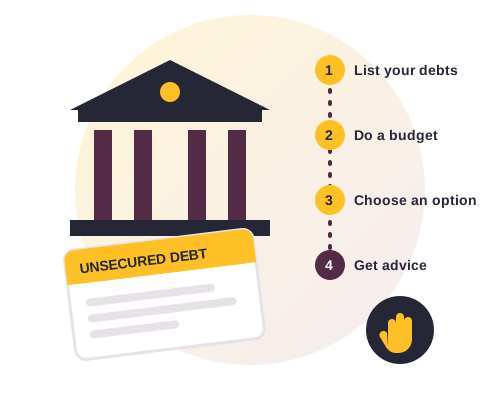
- List every debt, with who you owe, the balance and the monthly payment.
- Do a budget, putting essentials and priority debts first.
- Talk to your creditors before you miss payments, and ask for interest and charges to be frozen.
- Pick the right solution if you can't clear the debts in a reasonable time.
| Option | Best for | Writes off debt? |
|---|---|---|
| Informal arrangement | A few debts, short-term problems | No |
| Debt Management Plan | People who can repay in full, but slowly | No |
| Debt Breathing Space | Time to get advice: a 60-day pause | No |
| Administration Order | Debts of £5,000 or less, with a CCJ | Sometimes |
| Debt Relief Order | Low income, few assets, debts of £50,000 or less | Yes, after 12 months |
| IVA | Larger debts and a regular income | Yes, what's left at the end |
| Bankruptcy | Debts you can't repay in a reasonable time | Yes, usually after a year |
Be careful with Debt Consolidation Loans, especially secured ones: turning unsecured debt into secured debt puts your home at risk.
Can unsecured debt be written off?
- By the creditor: some creditors agree to write off debt if you can show you'll never be able to repay, for example because of long-term illness, disability or living on benefits, and you have no assets of value.
- Through a debt solution: a DRO, IVA or bankruptcy can write off unsecured debt.
- Statute-barred debt: in England and Wales, creditors usually have six years to go to court for most unsecured debts. The clock restarts if you pay or acknowledge the debt in writing.
A few unsecured debts usually can't be written off this way, such as student loans, court fines and child maintenance. Check which of your debts can be included before you choose a solution.
Debt solutions for unsecured debt
| Debt solution | Can it include this debt? |
|---|---|
| Debt Breathing Space | Yes |
| Debt Management Plan | Yes, non-priority debts |
| IVA | Yes. There's no legal minimum, but providers usually look for several thousand pounds of debt and at least two creditors |
| Debt Relief Order | Yes, if you owe £50,000 or less and meet the other rules |
| Bankruptcy | Yes |
Compare all your debt options. Formal solutions have fees, aren't right for everyone and affect your credit rating.
Unsecured debts out of control?
Tell us about your debts and a licensed insolvency practitioner will call you back to talk through your options. It's free, with no obligation.
Questions about unsecured debt
What counts as unsecured debt?
Any debt that isn't secured on something you own, such as credit cards, personal loans, overdrafts, payday loans, catalogues, buy now pay later and bill arrears.
Is unsecured debt a priority debt?
Most unsecured credit, like credit cards and loans, is non-priority. But some unsecured debts, such as council tax, rent, energy bills and court fines, are priority debts because of what can happen if you don't pay.
Can unsecured creditors take my house?
Not directly. They'd need a County Court Judgment and then a charging order. Forcing a sale needs another court order and is rare.
Can debt collectors come into my home?
No. Debt collectors have no special powers. Only bailiffs with a court order or warrant can take control of goods.
Can I go to prison for unsecured debt?
Not for credit debts like credit cards, loans or overdrafts. In rare cases, refusing to pay council tax or court fines can lead to prison.
Can unsecured debt be written off?
Yes, through a Debt Relief Order, IVA or bankruptcy, or if a creditor agrees you'll never be able to repay. Some debts can also become statute barred after six years.
How much unsecured debt do I need for an IVA?
There's no legal minimum, but IVA providers usually look for several thousand pounds of unsecured debt owed to at least two creditors, and a regular income.
Is hire purchase secured debt?
Not exactly. The goods belong to the finance company until you've paid, so it can take them back, but it usually needs a court order once you've paid a third or more.
