
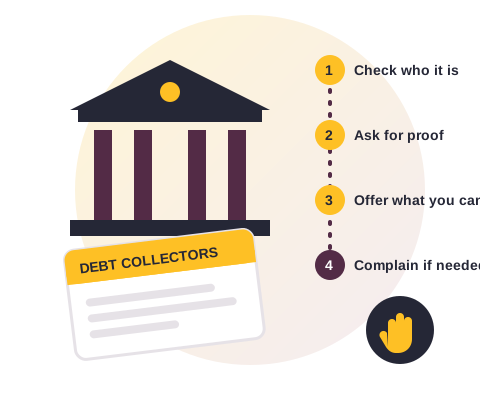
How do I know if it's a debt collector or a bailiff?
Debt collectors work for a debt collection agency (DCA). Contact from one is a normal stage when you've missed payments or had a default notice. They are not bailiffs, and have no more legal power to make you pay than the original lender.
| Debt collector | Bailiff (enforcement agent) | |
|---|---|---|
| Legal powers | None. Can only ask you to pay | Can take control of goods, under a court order, warrant or liability order |
| When they're used | After missed payments or a default, before any court action | Usually after a court judgment you haven't paid, or for council tax, fines and some HMRC debts |
| First letter | Letters, texts, emails, calls | A Notice of Enforcement giving at least 14 clear days |
| Can they come in? | No. They must leave if you ask | Only by peaceful entry for most debts |
| Fees | Can't add their own fees unless your agreement allows it | Fixed by law: see bailiff fees |
| Regulated by | The Financial Conduct Authority, for most credit debts | The courts, with oversight from the Enforcement Conduct Board |
Collection letters sometimes use phrases like "field agent", "doorstep collection" or "pre-court action" and are designed to look official. Unless there's a court order, warrant or liability order, and a certificated enforcement agent, it isn't a bailiff. Pretending to be a bailiff or court officer can be a criminal offence.
What are the different types of debt collector?
| Type | Who owns the debt? | Who you pay |
|---|---|---|
| In-house collectors | Your original lender. Its collections team may use a different name to seem more serious | The original lender |
| Third-party collectors | Your original lender, which pays the agency, often a percentage of what it collects | Usually the agency, on the lender's behalf |
| Debt purchasers | The company that bought the debt, usually for much less than you owe | The debt purchaser |
It isn't always obvious which you're dealing with. Check where the letters ask you to send payments, or ask the agency directly whether it's acting for the lender or has bought the debt.
How do I check a debt collector is genuine?
- Most debt collectors chasing credit debts, such as loans, credit cards and overdrafts, must be authorised by the Financial Conduct Authority. Search for them on the FCA register.
- Collectors of other debts, such as energy, water, phone, rent or business debts, may not need FCA authorisation, so different rules can apply. They still mustn't harass you or mislead you.
- Many genuine agencies are members of a trade body such as the Credit Services Association.
Watch out for scams. Criminals send texts and emails pretending to be collection agencies, often with a payment link. Never pay through a link in an unexpected message. Find the agency's official website or phone number yourself, or check with the original lender, before paying anything.
What can debt collectors do?
Debt collectors can:
- contact you by letter, phone, text and email
- visit your home to ask for payment
- use your credit file and tracing agents to find your current address
- agree a payment plan, or a reduced settlement if the owner of the debt allows
- take court action, or advise the lender to, for a County Court Judgment
What can't debt collectors do?
Collectors chasing credit debts must follow FCA rules. They mustn't:
- enter your home without your permission or a court order, or refuse to leave when asked
- take your belongings
- lie or mislead you about their powers, or threaten action they can't or won't take
- contact you at unreasonable times, too often, or ignore reasonable requests about how and when to contact you
- embarrass you publicly, or discuss your debt with anyone else unless they owe it too
- act in a threatening way, or visit you somewhere inappropriate, such as your workplace
- change the terms of your original agreement
- keep pressing you for a debt you've told them is statute barred, if it is
Will a debt collector visit my home?
It's not common, but some agencies send a "doorstep collector" or "field agent". If one comes to your home:
- you don't have to open the door, talk to them or let them in
- ask to see their ID and which agency they work for, then check with the agency
- they must leave if you ask them to
- they can't take anything from your home
- you don't have to pay cash at the door. Set up a standing order with the agency instead. If you do pay, get a receipt
There are no fixed visiting hours for debt collectors, but early-morning or late-night visits may be unreasonable. Write to the agency saying when and how you want to be contacted, and why.
What happens when a debt is sold?
Your agreement usually allows the lender to sell ("assign") the debt after it defaults, often for a fraction of what you owe. The buyer becomes the legal owner and can chase you for the full balance. You should get a notice of assignment telling you who now owns it.
- Your rights stay the same, and the new owner can't change the terms of your original agreement.
- If you owe the debt, you still need to pay it, unless it's statute barred.
- If you don't recognise the company, ask for the original lender's name and your account number before paying.
Can debt collectors add interest and charges?
Often, interest and charges stop when an account defaults or is sold. But not always: a lender or agency can keep adding them if your original agreement allows. Ask the agency to freeze them while you pay what you can afford.
More than one collector is contacting me about the same debt
Only one company should be chasing you for each debt. Some agencies use several trading names, so check the return address on the letters: if it's the same, it's probably the same company. You can ask it to use one name only. If two different firms are chasing the same debt, tell the original lender.
The debt isn't mine
Agencies sometimes contact the wrong person, for example someone with a similar name or a previous occupant. Tell them in writing that the debt isn't yours and ask them to stop. See disputing a debt.
Can I ask a debt collector to prove I owe the money?
Yes. You can ask for:
- a statement showing how the balance was worked out, and any charges added
- a copy of your credit agreement. For most credit, you can ask in writing with a £1 fee, and the creditor can't enforce the debt until it provides one. This doesn't apply to bills like energy or phone debts
- the notice of assignment, if the debt has been sold
Ask them to put collection on hold while they reply. If they can't show you owe it, they shouldn't keep chasing.
How should I deal with debt collectors?
- Don't ignore them, but don't panic either: they can only ask you to pay.
- Check the debt is yours, and the amount is right.
- Work out your budget, putting priority debts first. Debts with collectors are usually non-priority.
- Ask for contact in writing only, and keep copies of everything.
- Offer only what you can afford, even if they ask for the full amount or large instalments. A token payment is fine for a short time.
- Tell them if you're vulnerable, for example because of a bereavement, illness, anxiety or depression, a learning difficulty or addiction. They should take it into account.
- Tell them you're getting debt advice. Many will pause. Debt Breathing Space legally stops collection for 60 days.
If you can raise a lump sum, you can offer a full and final settlement for less than you owe. Get the agreement in writing before you pay. If several collectors are chasing you, look at your debt options.
The "11-word phrase" is a myth. Phrases you may see online, such as asking a collector to "cease and desist all contact", have no special legal force in England and Wales. Writing to ask for contact in writing only is just as effective.
What happens if I ignore a debt collector?
The contact will usually increase at first. The only way a collector or lender can force you to pay is to go to court for a County Court Judgment. You'd get court papers and a chance to make an affordable offer. A CCJ stays on your credit file for six years, so it's better to deal with the debt early.
How do I complain about a debt collector?
- Keep a diary of calls, visits and letters, with dates and times.
- Complain in writing to the agency, and the creditor that owns the debt, explaining what they've done wrong.
- Go to the Financial Ombudsman Service if you're not happy with the reply, or haven't had one after eight weeks. It's free.
If the collector isn't FCA regulated, how you complain depends on the type of debt. If you're threatened or harassed, you can also report it to the police or Trading Standards. Business debts? Business Debtline can help.
Being chased by debt collectors?
Tell us about your debts and a licensed insolvency practitioner will call you back to talk through your options. It's free, with no obligation.
Questions about debt collectors
Can debt collectors come into my home?
No. Debt collectors have no right of entry. You don't have to let them in, and they must leave if you ask.
Are debt collectors the same as bailiffs?
No. Bailiffs act under a court order, warrant or liability order and can take control of goods. Debt collectors can only ask you to pay.
Can a debt collector take me to court?
A company that has bought your debt can take court action itself. Otherwise it can recommend the original lender does. Only after a CCJ that you don't pay can bailiffs be used.
Do I have to pay a debt collector if my debt was sold?
If you owe the debt, yes, unless it's statute barred. The buyer becomes the legal owner. You only have to offer what you can afford.
Can debt collectors add fees and interest?
Only if your original agreement allows it. Often interest and charges stop when an account defaults or is sold, but not always.
What is the 11-word phrase to stop debt collectors?
There isn't one with any legal force in England and Wales. Ask in writing for contact by letter only, and complain if they harass you.
How do debt collectors find my address?
They can check your credit file, use forwarding addresses, or use tracing agents who search public records.
How do I stop debt collectors calling me?
Write asking for contact by letter or email only, at reasonable times. If they harass you, complain to them and then the Financial Ombudsman Service.
