
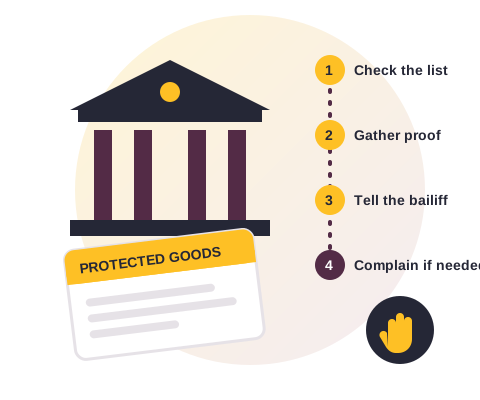
What can't bailiffs take? A room-by-room checklist
The law calls these exempt goods. They're listed in regulation 4 of the Taking Control of Goods Regulations 2013, and they apply to every bailiff in England and Wales, including High Court enforcement officers. Use this checklist before a visit so you know what's safe.
| Where | Protected goods |
|---|---|
| Kitchen | A cooker or microwave, a fridge, a washing machine, and a dining table with enough chairs for everyone in your home. |
| Bedrooms | Beds and bedding for everyone in your home, and clothing. |
| Children's things | Items needed to care for children under 18, such as a cot, pushchair, school things and toys. |
| Health and care | Medical equipment, and items needed to care for a disabled or older person in your home. |
| Around the home | Things needed for safety, security, lighting and heating, and one landline (or a mobile if you have no landline). |
| Work and study | Tools, books, equipment or a vehicle you need for work or study, up to £1,350 in total. |
| Animals | Pets, assistance dogs (including guide and hearing dogs), sheep dogs and guard dogs. |
| Vehicles | A vehicle with a valid Blue Badge used to carry a disabled person. |
What does "reasonably required" mean?
Household items are only protected if they're reasonably required for the basic domestic needs of the people living in your home. In practice:
- One of each essential. Your fridge is protected, but a second fridge or a drinks fridge may not be.
- Enough for everyone. Beds, bedding and chairs are protected for each person who lives with you, including children and lodgers.
- Not luxury versions. If an essential item is very valuable, a bailiff can argue a cheaper one would do the same job. This is rare, and bailiffs must not leave you without the item.
- Things in use. Bailiffs also shouldn't take items someone is using at the time, if that would cause a breach of the peace.
TVs, games consoles, jewellery, computers you don't need for work, and second cars aren't protected, so they can be taken if they belong to you.
Can bailiffs take my work tools?
Tools, books, vehicles and other equipment you need personally for your job, business or study are protected, up to a total value of £1,350. That could include a van you drive for work, a laptop you need for study, or a tradesperson's tools.
- If your work items are worth more than £1,350 in total, the bailiff can take items over the limit, and you can choose which ones to keep.
- The items must be needed for your work. A vehicle you need to get to work may count if there's no reasonable alternative.
- This protection doesn't apply to business rates and commercial rent arrears.
Keep evidence ready, such as a letter from your employer, invoices or a course enrolment.
Which vehicles can't bailiffs take?
- a vehicle with a valid Blue Badge on display, used to carry a disabled person
- a vehicle you need for work or study, within the £1,350 limit
- a car on hire purchase, PCP, lease or Motability, because it isn't yours (see below)
- a car that belongs to someone else, such as a partner or employer
Bailiffs usually run a vehicle check that shows finance and registered keepers. The registered keeper isn't always the owner, so keep proof of ownership. Read can bailiffs take my car?
Can bailiffs take pets?
No. Regulation 4 specifically protects domestic pets (such as dogs, cats, rabbits, birds and fish), assistance dogs (including guide and hearing dogs), sheep dogs and guard dogs. This applies whatever the animal is worth: a pedigree dog kept as a family pet is protected in the same way as a rescue cat.
The protection doesn't cover animals kept as part of a business, such as:
- livestock, such as cattle, sheep or pigs on a farm
- animals bred or kept for sale, for example by a breeder or pet shop
- horses and other animals kept as a business asset
Whether an animal counts as a pet can depend on how it's kept. A horse your family rides is different from a racehorse owned by a business. Pet equipment, such as a cage or tank, isn't specifically listed, so tell the bailiff if it's needed to keep your pet safe and well.
During a visit: if your dog may be nervous or protective, keep it in another room or talk to the bailiff outside. A bailiff who threatens to take a pet is breaking the rules. Note their name and the time, and complain.
Can bailiffs take things on finance?
It depends on who owns the item. Bailiffs can only take goods that belong to the person who owes the debt. With some finance, the lender owns the goods until you've paid in full. With other finance, you own the item from day one and only the money is borrowed.
| How you paid | Can bailiffs take it? | Why |
|---|---|---|
| Hire purchase (HP) or conditional sale | Usually not | The finance company owns it until you make the final payment. |
| PCP car finance | Usually not | The finance company owns the car unless you pay the final balloon payment. |
| Leasing or personal contract hire | No | The leasing company owns it. You never own it. |
| Rent-to-own or rental goods | No | The rental company owns it until the agreement says ownership passes to you. |
| Bought with a credit card | Yes | You own it as soon as you buy it. Only the card debt is on credit. |
| Bought with a personal loan | Yes | You own it. The loan is separate from the item. |
| Buy now pay later (such as Klarna or Clearpay) | Yes, usually | You normally own the item straight away. |
| Catalogue or store account | Yes, usually | Most catalogue and store credit gives you ownership straight away. Check your agreement. |
| Logbook loan | Get advice | You own the car, but the lender has a legal claim over it. |
Most advice services say bailiffs shouldn't take goods on hire purchase or conditional sale, because the finance company still owns them. The law on this isn't completely settled, though, so always show the bailiff your agreement, or send a copy to the bailiff firm before a visit. If you can't find it, ask the lender for a copy. And keep up the finance payments: if you fall behind, the lender may take the goods back itself.
Can bailiffs take other people's belongings?
No. Bailiffs can only take goods that belong to the person named on the court order, warrant or liability order. They can't take things that belong to:
- your partner, children, parents or a lodger
- a rental or leasing company, such as a rented TV or a leased car
- your employer, such as a work laptop or company car
- a landlord, such as furniture in a furnished let
If you own something jointly with someone who doesn't owe the debt, bailiffs may still take it, but the other owner is entitled to their share of the sale money. Bailiffs shouldn't assume everything in your home is yours, but you may need to prove it isn't.
How do I prove an item is protected or not mine?
- Receipts and bank statements showing who paid for an item
- Finance, rental or lease agreements
- A letter from your employer for work equipment, or evidence of what you need for your job or course
- A Blue Badge, Motability agreement or medical letter for disability-related items
- Photos of items with names, labels or gift tags
- if there's no receipt, a signed statement from the owner, or a formal statutory declaration
Keep copies together so you can show them quickly, and send copies to the bailiff firm in writing.
What can bailiffs take?
Anything that belongs to you and isn't on the protected list, such as TVs, games consoles, computers you don't need for work, jewellery, designer items, a second car or a car you own outright, and cash. They should only take goods worth roughly enough to cover the debt and fees. For the full picture, read what can bailiffs take?
What if bailiffs take something they shouldn't?
- Write to the bailiff firm straight away with your evidence, and ask for the item back before it's sold.
- If it belongs to someone else, the owner should write too. If the firm refuses, they can apply to the court using an N244 form, which pauses any sale.
- Complain using our complaint letter, and copy in your creditor. See complaining about bailiffs.
- Claim compensation through the court if you lost out because a bailiff broke the rules.
Bailiffs coming to your home?
Tell us about your debts and a licensed insolvency practitioner will call you back to talk through your options. It's free, with no obligation.
Questions about what bailiffs cannot take
Can bailiffs take my TV?
Usually, yes. A TV isn't on the list of protected goods, so it can be taken if it belongs to you. It's protected if it's rented, on hire purchase or belongs to someone else.
Can bailiffs take my laptop or phone?
They can't take one landline, or a mobile if you have no landline. A laptop is protected if you need it for work or study, within the £1,350 limit. Otherwise it may be taken.
Can bailiffs take my children's things?
No. Items needed to care for children under 18, and things that belong to your children, are protected.
Can bailiffs take my dog?
No. Domestic pets, including dogs, are protected by law, as are assistance dogs, sheep dogs and guard dogs, whatever they're worth.
Can bailiffs take my horse?
It depends on whether the horse is kept as a pet or as part of a business. Get advice if bailiffs show an interest in a horse.
Can bailiffs take a car on PCP or hire purchase?
Usually not, because the finance company owns it until the final payment. Show the bailiff your agreement.
Can bailiffs take something I bought on a credit card?
Yes, if it isn't otherwise protected. You own goods bought on a credit card from the moment you buy them.
Can bailiffs take rented furniture?
No. Rented goods belong to the rental company, not to you.
Can bailiffs take goods belonging to my partner?
No. Bailiffs can only take the debtor's own goods. Your partner may need to show proof that something belongs to them.
Can bailiffs take work tools for business rates?
Yes. The £1,350 work tools protection doesn't apply to business rates or commercial rent arrears.
Sources
- Taking Control of Goods Regulations 2013, regulation 4 (exempt goods)
- The Taking Control of Goods Regulations 2013
- Tribunals, Courts and Enforcement Act 2007, Schedule 12
- GOV.UK: Bailiff powers when they visit your home
- MoneyHelper: Hire purchase explained
- Citizens Advice: Bailiffs
- Enforcement Conduct Board