
Who are CDER Group?
CDER Group is one of the larger enforcement agent firms in England and Wales. Its certificated enforcement agents (bailiffs) collect debts for local councils, Transport for London, National Highways (for example, Dart Charge penalties) and HM Courts and Tribunals Service.
CDER is one of the companies approved to enforce magistrates' court fines for HMCTS. It's the main contractor for court fines in London, the South East and the Midlands, and a secondary contractor in other regions.
CDER are bailiffs, not debt collectors. If they've written to you, a court order or liability order has usually already been made, so it's important to act.

Why have CDER contacted me?
CDER collect several types of debt. What you can do depends on which one it is, so check your letter for the creditor and the type of debt.
| Type of debt | What it means for you |
|---|---|
| Council tax arrears | The council got a liability order from the magistrates' court. Contact the council as well as the bailiffs. See our council tax bailiffs guide. |
| Business rates | The council got a liability order for unpaid business rates on commercial premises. |
| Parking and road traffic penalties | An unpaid penalty charge notice was registered at the Traffic Enforcement Centre and a warrant issued. In some cases you can challenge it. |
| Commercial rent arrears | A landlord of business premises is using Commercial Rent Arrears Recovery. Different rules apply to business premises. |
| Magistrates' court fines | A priority debt with stricter rules. See our magistrates' court fines guide. |
Is the CDER letter genuine?
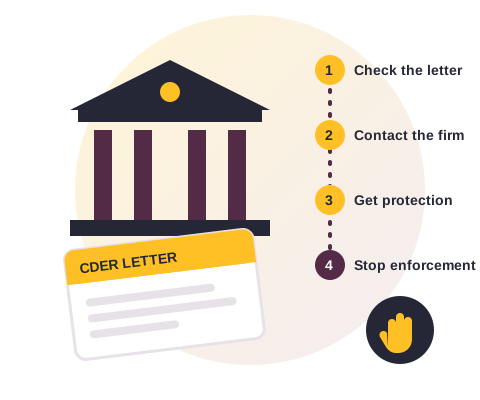
Don't ignore it, but do check it before you pay anything:
- Check the details: your name, address, the creditor (such as your council), the debt and a case reference.
- Check the agent: certificated enforcement agents are listed on the official Certificated Enforcement Agents Register on GOV.UK. Agents enforcing court fines for HMCTS are Approved Enforcement Agents.
- Contact the firm through its official website or the contact details on your letter, rather than a number in an unexpected text or email.
- Check the notice period: you should get a Notice of Enforcement giving at least 14 clear days before a first visit.
- Ask your creditor: the council or other creditor can confirm whether it has passed your debt to CDER.
How to contact CDER
You may need to speak to CDER to check the balance, ask about your case or set up a payment plan. Where your letter gives a phone number, use that one, and check any number against the firm's official website before you pay.
Before you get in touch
Have your CDER reference number ready, and ask CDER to confirm:
- who instructed them (the council, court or other creditor) and what the debt is for
- the original amount and the current balance, with every fee listed separately
- the name and address on the case, and what stage the enforcement has reached
Don't recognise the debt? If it's already paid, isn't yours, or is for someone who has moved out, tell CDER straight away and ask what proof they need, such as a payment receipt or a tenancy agreement. Ask them to put enforcement on hold while they check.
Before you agree to pay: work out what you can really afford once your rent, energy and food are covered. A plan you can't keep up usually leads to another visit and more fees, so ask for any agreement in writing.
General email
Court fines (HMCTS)
For magistrates' court fines passed to CDER by HM Courts and Tribunals Service
Court fines email
CDER also offers live chat and an online portal for payments and payment plans on its official website. Contact details can change, so check them against your letter.
What fees can CDER charge?
CDER can only charge the fees set by law, the same as every other enforcement firm. For most debts, these are:
| Stage | Fee | When it's added |
|---|---|---|
| Compliance | £79 | When the debt is passed to the firm and the Notice of Enforcement is sent |
| Enforcement | £247 + 7.5% of the debt over £1,900 | When an agent visits your property, even if you don't open the door |
| Sale or disposal | £116 + 7.5% of the debt over £1,900 | When goods are removed for sale |
If you agree a payment plan before an agent visits, only the £79 compliance fee should be added. Think you've been overcharged? Use our overcharging letter.
Can CDER force entry or take my things?
For council tax, parking penalties and most other debts, CDER agents can't force their way into your home. They can only come in through an unlocked door or if you let them in. The exception is magistrates' court fines, where agents can use reasonable force as a last resort, usually with the court's permission. Approved Enforcement Agents can also arrest people named on certain court arrest warrants. Forced entry is also possible if you break a controlled goods agreement, but only after 2 clear days' notice.
- You don't have to open the door. Talk through a window or by phone.
- Agents can only visit between 6am and 9pm.
- They can't take essentials, work tools up to £1,350, pets or other people's belongings. See what can bailiffs take?
- They can clamp or take a car parked outside, unless it's protected.
Read our full guide: can bailiffs force entry?
How to stop CDER bailiffs
- Act as soon as the letter arrives. You have at least 14 clear days before a visit. This is when the fees are lowest.
- Offer an affordable payment plan. Contact CDER with an offer you can keep up and a copy of your budget. Start paying straight away, even if they haven't replied.
- Ask for more time. You or a debt adviser can ask for the notice period to be extended to 28 clear days while you get advice. Use our free letter.
- Tell them if you're vulnerable. Illness, disability, mental health, pregnancy or bereavement can mean action is paused or the debt is sent back to your creditor. Use our vulnerability letter, and ask your creditor to recall the debt.
- Get Breathing Space. A debt adviser can apply for 60 days' protection from most enforcement (Breathing Space doesn't cover court fines).
- Challenge a parking penalty if it's wrong. If you never got the original penalty notices, you may be able to file a statement with the Traffic Enforcement Centre to cancel the warrant. Act quickly, because there are time limits.
- Look at a longer-term solution. If you have other debts too, a debt solution such as an IVA or DRO may stop enforcement for the debts it includes (court fines can't be included).
See all 10 ways to stop bailiffs, or get free debt help.
How to complain about CDER
- Complain to CDER first, in writing, using its complaints procedure. Our complaint letter can help.
- Copy in your creditor. The council, TfL or other creditor is responsible for the agents it uses, and can tell CDER to pause action or return the debt.
- Escalate if needed. If the firm is accredited by the Enforcement Conduct Board, you can take your complaint there once the firm has replied. For council debts, you can also go to the Local Government and Social Care Ombudsman (England) or the Public Services Ombudsman for Wales.
Bailiff Helpline isn't connected to, or endorsed by, CDER Group. We provide free, independent information to help you understand your rights.
Contacted by CDER?
Tell us about your debts and a licensed insolvency practitioner will call you back to talk through your options. It's free, with no obligation.
Questions about CDER Group
Who are CDER Group?
CDER Group is an enforcement agent (bailiff) company in England and Wales. It collects council tax, business rates, parking and road charges, commercial rent arrears and magistrates' court fines for councils, Transport for London, National Highways and HM Courts and Tribunals Service.
Are CDER real bailiffs?
Yes. CDER use certificated enforcement agents, which is the legal name for bailiffs. You can check an agent on the Certificated Enforcement Agents Register on GOV.UK. Always check the details on your letter and contact the firm through its official website or the number on your letter.
Can CDER force entry into my home?
Not for council tax, parking penalties or most other debts. CDER agents can only enter peacefully, through an unlocked door or if you let them in. For magistrates' court fines, forced entry is possible as a last resort, usually with the court's permission. Forced entry is also possible if you break a controlled goods agreement.
What can CDER take?
CDER can take non-essential goods that belong to you, such as a TV, games console, jewellery or a car. They can't take essentials like your cooker, fridge, bed or children's things, tools for work up to £1,350, pets, or things that belong to someone else.
Can I set up a payment plan with CDER?
Yes. Contact CDER as soon as you get the Notice of Enforcement, offer an amount you can afford and send a copy of your budget. If you agree a plan before an agent visits, only the £79 compliance fee should be added. CDER doesn't have to accept your offer, so start paying anyway and get free advice if they refuse.
Can I ignore CDER?
No. Ignoring the letters usually leads to a visit, more fees and possibly your goods being taken. Acting during the 14-day notice period gives you the most options and keeps the costs lowest.
Do CDER agents have to show ID?
Yes. An enforcement agent must show you their identification and their certificate if you ask. Most agents also wear a body-worn camera. You can check their name on the GOV.UK register before you open the door or pay anything.
Can CDER arrest me?
Only in limited cases. Agents enforcing court matters for HM Courts and Tribunals Service can arrest someone named on certain court arrest warrants. They can't arrest you for council tax, parking or other civil debts.
How do I complain about CDER?
Complain to CDER in writing first, and send a copy to your creditor. If you're not happy with the reply and the firm is accredited by the Enforcement Conduct Board, you can take your complaint there. For council debts, you can also go to the ombudsman once the council has replied.