
What is the N245 form?
N245 form is called an "application for suspension of a warrant and/or variation of an order". You use it in the County Court when you owe money under a County Court judgment (CCJ) and:
- you can't afford the monthly payments any more and want them lowered (varied), or
- the creditor has got a warrant of control and you want to stop County Court bailiffs by offering an affordable payment, or
- both. If bailiffs are involved, tick both boxes so the warrant is suspended and your payments are changed at the same time.
It's similar to the N9A admission form you may have filled in when the creditor first took you to court. Most of it is about your income, outgoings and other debts.
Download the N245 form
- N245 form applicationPDF, 2 pages, about 330 KB
- N245 form, large print versionPDF, 24 pages, about 460 KB
- Ffurflen N245 (Welsh and English)PDF, 6 pages, on GOV.UK (opens in a new tab)
You can also get a paper copy from the County Court that issued the judgment or warrant. Court forms are updated from time to time, so check you have the latest version on the GOV.UK the N245 form page.
N245 vs N244: what's the difference?
N245 form is a simpler, specific form for lowering County Court judgment payments or suspending a County Court warrant of control. Form N244 is the general application for asking a judge to make, change, cancel or pause a court order.
| N245 form | N244 form | |
|---|---|---|
| What it is | Application to suspend a warrant and/or vary an order | General application notice |
| Main debt uses | Lower CCJ payments set by the creditor or a court officer, suspend a County Court warrant of control | Set aside a CCJ, stay a High Court writ, stop an eviction, change payments a judge set |
| Courts | County Court only | County Court and High Court |
| What you provide | A full financial statement (income, outgoings, dependants, debts) and a payment offer | What order you want, your reasons and evidence (often a witness statement) |
| Usually decided | By a court officer, often without a hearing | At a hearing |
| Court fee (from 13 July 2026) | £16 | £321 on notice, £126 by consent or without notice, £16 to vary or suspend |
N245 can't be used for
- Cancelling (setting aside) a CCJ or disputing that you owe the debt: use N244.
- Payments a judge set at a hearing: use N244.
- A High Court writ of control: ask for a stay on N244. See our stay of execution letter.
- Council tax, magistrates' court fines or parking penalties: these have their own processes. See our bailiff guides.
- Stopping an eviction under a warrant of possession: use N244.
When can I apply to vary a CCJ with N245?
You can use N245 to change your payments at any time if your circumstances change, as long as a judge didn't set the rate. For example, if:
Your income has dropped
You or someone in your household has lost a job, had hours cut or can't work because of illness.
Your household has changed
You have more dependants, such as a new baby, or a partner has left.
Priority bills come first
You need to pay priority debts like rent, council tax or energy arrears, so less is left for the CCJ.
Bailiffs have been sent
The creditor has a warrant of control and you need to stop the bailiffs while you pay an amount you can afford.
You can also use N245 if you didn't reply to the original claim, replied admitting the debt without making an offer, had your offer accepted by the creditor, or defended the claim and lost.
How much does it cost?
The court fee is £16 (from 13 July 2026). It's the same fee whether you're asking to vary the payments, suspend a warrant, or both, and whether you use N245 or N244 to vary or suspend.
Can't afford it? Apply for Help with Fees online or on form EX160. If you get certain benefits or are on a low income, you may pay nothing.
How do I fill in the N245 form?
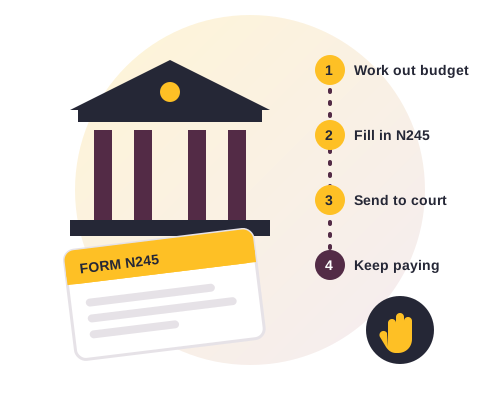
Work out a full budget first. Then copy your figures onto the form. There's room on the N245 for all your income and spending, so you don't usually need to send the budget separately.
- Case details. The court name, claim number and, if bailiffs are involved, the warrant number. These are on your judgment and the bailiff's Notice of Enforcement.
- What you're applying for. Tick to suspend the warrant, vary the order, or both.
- About you. Your name, address, age, employment and any dependants.
- Your income. Wages, benefits, pensions and any money from others in your household.
- Your outgoings. Rent or mortgage, council tax, energy, water, food, travel, childcare and other essential costs.
- Priority debts and other court orders. Arrears on rent, council tax or energy, and any other CCJs or court orders you're paying.
- Credit debts. Credit cards, loans and other debts, with what you pay towards them.
- Your offer. The amount you can realistically pay each month, and why your circumstances have changed.
- Sign the statement of truth. Make sure everything is accurate.
What happens after I send the N245 form?
- Send it to the court that made the judgment or issued the warrant, with the £16 fee or your Help with Fees reference. Keep a copy.
- The court sends your offer to the creditor. They can accept it, accept a suspension but dispute the amount, or oppose any suspension.
- If they accept, the court makes a new order at your offered rate and, if there's a warrant, suspends it.
- If they dispute the amount, a court officer decides a fair payment, usually without a hearing. Either side can ask for a judge to reconsider it.
- If they oppose any suspension, the court arranges a hearing where you can both explain your case.
- The court writes to you with the result. This can take a few weeks.
- Sending N245 doesn't automatically stop the bailiffs. Enforcement can carry on until the court makes an order, and fees can keep being added. Apply as early as you can, and tell the bailiff and the creditor that you've applied.
- Keep paying the original amount, if you can, until you hear from the court.
- Once the warrant is suspended, bailiffs can't act as long as you keep up the new payments. If you miss payments, the creditor can have the warrant reissued and bailiffs can visit again.
- A warrant of control lasts 12 months. If it runs out, the debt doesn't disappear. The creditor can try other ways to collect it, such as an attachment of earnings order or a charging order.
Struggling with a CCJ and other debts?
Tell us about your debts and a licensed insolvency practitioner will call you back to talk through your options. It's free, with no obligation.
Questions about the N245 form
What is the N245 form used for?
N245 form is used to ask the County Court to lower the payments on a County Court judgment (vary the order), to suspend a warrant of control so bailiffs can't take your goods, or both at the same time.
How much does the N245 form cost?
The court fee is £16 (from 13 July 2026), whether you're applying to vary the payments, suspend a warrant, or both. If you're on a low income or certain benefits, you can apply for Help with Fees.
Do I need to go to a hearing for N245?
Usually not. If the creditor only disputes the amount, a court officer decides a fair payment without a hearing. If the creditor opposes any suspension of the warrant, the court will arrange a hearing.
Should I keep paying while I wait?
Yes. Keep paying the amount in your original judgment, if you can, until the court writes to you with the new amount. If you stop, the creditor could take more enforcement action.
Can I use N245 if a judge set my payments?
No. If a judge decided your payment rate at a hearing, use the N244 form to ask the court to change it. N245 is for payments set by the creditor's acceptance or by a court officer.
Will bailiffs stop as soon as I send the N245 form?
Not automatically. Enforcement can carry on until the court makes an order, so apply as soon as you can and tell the bailiff and the creditor you've applied.