What should I do if I'm behind on my energy bills?
Owing money to your gas or electricity supplier is called being in arrears. Treat energy arrears as a priority debt, because your supply could be affected, and pay them before credit cards and loans.
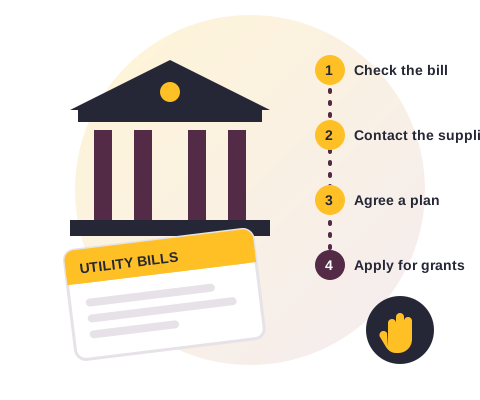
- Contact your supplier straight away, ideally before you miss a payment. It must give you a free way to contact it once it knows you're struggling.
- Check the bill is right before agreeing to pay it. See below.
- Tell your supplier about anything that makes you vulnerable, such as age, illness, disability, mental health, pregnancy or young children, and ask to join its Priority Services Register.
- Agree an affordable plan and keep paying for what you use now.
- Apply for grants and check your benefits. See help with energy bills.
- Get free advice if you have other debts. Debt Breathing Space pauses action and charges for 60 days.
How do I check my energy bill is right?
- Actual or estimated? Your bill says whether it used a real meter reading. If it's estimated, take your own reading and send it in. Older smart meters sometimes stop sending readings, so check yours is working.
- Is it all yours? You're not usually responsible for energy used before you moved in, or on someone else's account.
- Back-billing rule: if your supplier didn't bill you correctly, it usually can't charge for energy used more than 12 months ago.
- Is your Direct Debit too high? Ask how it was worked out. It may be based on a high estimate, or include debt repayments you can't afford.
- Paying your landlord for energy? Landlords can't charge you more than they pay.
A bill is made up of the unit rate (what you pay for each unit you use) and a standing charge (a fixed daily amount). The Ofgem price cap sets the maximum for most standard tariffs and changes every three months.
If you genuinely dispute the bill, your supplier shouldn't cut you off while it's being sorted out.
Does my supplier have to give me a payment plan?
Yes. Ofgem rules say suppliers must take your ability to pay into account, use your budget and circumstances, and make it easy to talk about money worries. If you're struggling, they must offer you a way to pay the arrears by:
- regular instalments based on an agreed plan, weekly, fortnightly or monthly
- Fuel Direct, taken from your benefits, if you're eligible
- a prepayment meter, if it's safe and practical for you
They may also offer a short payment break, lower payments, energy-saving advice, or help from their hardship fund.
Working out your offer
Add up your energy bills for the last year and divide by 12 (or 52 for weekly). Put that in your budget as an essential cost, add your other essentials, and offer what's left towards the arrears. If your circumstances change, ask your supplier to lower the payments or pause the arrears payments for a while.
Can I pay energy arrears from my benefits?
If you get Universal Credit, Pension Credit, income-related ESA or certain other benefits, the Fuel Direct scheme can take a fixed amount from your benefits to pay your gas or electricity arrears.
| If you get | Amount taken for each debt |
|---|---|
| Universal Credit | 5% of your payment |
| Other qualifying benefits | £4.80 a week |
Up to three debts can be paid this way at once. You can also pay for your ongoing energy this way, but only with your consent. Contact your supplier to set it up, and the DWP if you want to stop. If the deductions would leave you short, agree a plan with your supplier instead.
Can my supplier make me have a prepayment meter?
With a prepayment meter you pay before you use energy, and part of each top-up can go towards your debt. Your supplier may suggest one, and may be able to fit one without your agreement, by getting a court warrant or switching a smart meter to prepayment mode. But Ofgem rules now limit this.
When a prepayment meter shouldn't be forced on you
- everyone in your home is 75 or over
- there's a child under 2 in your home
- no one in your home could use or top up the meter
- being on a prepayment meter could harm someone's health, for example if they rely on medical equipment, or have a serious illness or disability
Tell your supplier if any of these, or anything else that makes a prepayment meter unsafe, applies to you. If a meter is fitted under warrant, you may be charged up to £150, but not if a health condition or vulnerability stopped you dealing with the debt.
Pros and cons
| Pros | Cons |
|---|---|
| You can't build up new energy debt | If you can't top up, you're left without heat or power |
| Debt is repaid in small amounts | Standing charges build up even when you use nothing, and are taken from your next top-up |
| Smart prepayment can be topped up online or by app | You can't spread costs across the year, so winter is hardest |
If you run out of credit
Suppliers must offer emergency credit, and friendly-hours credit when top-up shops are likely to be closed. If you're vulnerable and have self-disconnected, or are cutting back on heating or food to keep topped up, ask for additional support credit. If you can't repay the credit at your next top-up, your supplier must agree an affordable plan.
Can my gas or electricity be cut off?
It's possible, but very rare. Suppliers must offer other ways to pay first, and only disconnect as a last resort. You can usually stop it by agreeing a plan.
Winter protection (1 October to 31 March)
- Suppliers must not disconnect you if you've reached State Pension age and live alone, or only with other pensioners or children under 18.
- They must do all they can to avoid disconnecting a home with someone of pension age, or someone disabled or chronically ill.
- Suppliers that have signed the Energy UK Vulnerability Commitment won't disconnect vulnerable customers, or homes with children under 6 (under 16 in winter).
Warrants to enter your home
If you don't agree a plan, your supplier can ask the magistrates' court for a warrant to enter and fit a prepayment meter or disconnect you. You'll usually be told about the hearing. Make an offer before then, or go to court with your budget and explain the effect on your household. If a warrant is granted, you must get 7 days' notice for gas or 7 working days' for electricity.
Other situations
- Debt from an old address: you can't be cut off at your new home for it.
- Your landlord hasn't paid: contact your council, which may be able to help keep you connected.
- Children at home: social services may be able to help, and suppliers usually wait while they look into it.
- Suspected theft or meter tampering is treated very seriously and can lead to prosecution. Get advice straight away.
Getting reconnected
You'll usually need to pay the debt (or agree a plan) and a reconnection fee. Your council's local welfare scheme may help. Once you've paid or agreed a plan, you should be reconnected within 24 hours, or your supplier usually has to pay you £40.
What happens if I can't pay my water bill?
Water companies in England and Wales can't cut off your home's water supply for unpaid bills. That's why water is usually treated as a non-priority debt. But they can still pass the debt to collectors or take you to court for a CCJ, so keep paying for your current use.
- Social tariffs: most water companies offer cheaper bills for people on low incomes.
- WaterSure: caps your bill if you get certain benefits and use a lot of water, for example because of a large family or a medical condition.
- Payment matching: some companies match what you pay towards arrears, or write some off if you keep to a plan.
- Payment breaks and benefit deductions: water arrears can also be taken from some benefits.
If you're unhappy with your water company, complain to it, then the Consumer Council for Water.
What help can I get with energy bills?
| Help | What it is |
|---|---|
| Warm Home Discount | £150 off your winter electricity bill if you get certain benefits. Most people get it automatically. |
| Winter Fuel Payment | Up to £300 a year if you've reached State Pension age. If your income is over £35,000, HMRC takes it back. |
| Cold Weather Payment | £25 for each 7-day spell of freezing weather between 1 November and 31 March, if you get certain benefits. |
| Crisis and Resilience Fund (England) | Your council may help with energy arrears or other essential costs. |
| Supplier hardship and trust funds | Many suppliers, and some independent trusts, can clear or reduce energy debt. Some help customers of any supplier. |
| Wales and Scotland | Separate schemes, such as Wales's Discretionary Assistance Fund and Nest home improvements. |
Also check you're getting every benefit you're entitled to, and look at energy-saving help: free home energy visits, insulation grants, or simply lowering your boiler's flow temperature.
Can I switch supplier if I'm in debt?
- Credit meter: if you've owed money for 28 days or more, your supplier can block a switch until you've paid.
- Prepayment meter: you should be able to switch if you owe £500 or less, with the debt moving to your new supplier.
- Credit on old accounts: if you've closed accounts in credit, for example after moving, contact the old supplier to claim it back.
Missed energy payments and court action can be reported to credit reference agencies.
How do I complain about my energy supplier?
Complain to your supplier first, using its complaints process. If it hasn't sorted things out after eight weeks, or sends a "deadlock" letter, take it to the Energy Ombudsman within 12 months. It's free, and can make the supplier apologise, put things right or pay compensation. The Citizens Advice consumer helpline can help you prepare.
Debt solutions and utility debt
| Debt solution | Can it include this debt? |
|---|---|
| Debt Breathing Space | Yes. Keep paying for the energy you use |
| Debt Management Plan | Yes, alongside other debts |
| IVA | Yes. Keep paying for your ongoing use |
| Debt Relief Order | Yes, if you meet the rules |
| Bankruptcy | Yes |
Try your supplier's hardship fund or a social tariff first: they can sometimes solve the problem without a formal solution. Compare all your debt options, or read which debts to pay first.
Struggling with energy or water bills?
Tell us about your debts and a licensed insolvency practitioner will call you back to talk through your options. It's free, with no obligation.
Questions about utility bill debt
Can my energy supplier cut me off for not paying?
It's possible but very rare. Suppliers must offer other ways to pay first, need a court warrant to enter your home, and can't disconnect pensioners living alone or with other pensioners or children in winter.
Can my water be cut off for not paying?
No. Water companies in England and Wales can't disconnect a home's water supply, but they can take court action for the arrears.
Does my supplier have to accept a payment plan?
Suppliers must take your ability to pay into account and offer affordable options, such as instalments, Fuel Direct or a prepayment meter if suitable.
Can I be forced onto a prepayment meter?
Sometimes, with a court warrant, but not if everyone at home is 75 or over, there's a child under 2, no one can use the meter, or it could harm someone's health.
Can my supplier bill me for energy used years ago?
Usually not. Under back-billing rules, suppliers generally can't charge for energy used more than 12 months ago if they didn't bill you correctly at the time.
How much is taken from benefits for energy arrears?
Through Fuel Direct, 5% of your Universal Credit for each debt, or £4.80 a week from other qualifying benefits.
Can I get a grant to pay off energy debt?
Yes. Many suppliers and charities run hardship and trust funds that can clear or reduce energy debt, and councils in England may help through the Crisis and Resilience Fund.
What is the Priority Services Register?
A free register run by energy and water companies for people who need extra help, such as pensioners, disabled people, people with long-term illness or young children. It gives you extra support and protections.
Sources
- Ofgem: Getting help if you can't afford your energy bills
- Ofgem: What to do if you get a back bill
- GOV.UK: Manage deductions from your benefits to pay debts and bills
- GOV.UK: Warm Home Discount Scheme
- GOV.UK: Winter Fuel Payment
- GOV.UK: Cold Weather Payment
- Energy Ombudsman
- Consumer Council for Water
- MoneyHelper: Dealing with debt
- National Debtline