
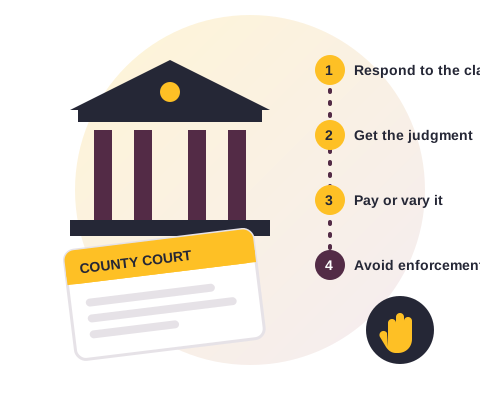
What a CCJ is
A County Court Judgment is a type of court order in England and Wales. It's made when a creditor takes you to court for money you owe and the court decides you must pay. It says how much you owe and how you must pay it, either in one go or by monthly instalments.
Creditors such as credit card companies, catalogues, utility companies and private parking firms can all apply for CCJs. Council tax and council parking fines use different processes.
What happens before a creditor goes to court?
For most consumer debts, the creditor must follow the Pre-Action Protocol for Debt Claims before starting court action. It has to send you a letter of claim with:
- the amount owed, including any interest and charges
- an information sheet and a reply form
- a financial statement form, so you can offer payments
You have 30 days to reply. Use the reply form to say whether you agree you owe the debt, ask for documents such as the credit agreement, or offer payments. If you say you're getting debt advice, the creditor should give you reasonable extra time before going to court. A reply now is your best chance of avoiding a CCJ.
If you get a court claim
Before a CCJ, you'll get a claim form (form N1), usually from the County Court Business Centre or Money Claim Online. Don't ignore it. You have 14 days from service to respond:
- admit the debt and offer affordable payments, using the admission form
- defend the claim if you don't owe it, or the amount is wrong
- acknowledge it to get another 14 days to prepare a defence
If you don't respond, the creditor can get a judgment in default, and the court may order you to pay more than you can afford.
How does the court decide how much I pay?
If you admit the debt, fill in the admission form with your income, spending and an offer. Be realistic: a free debt adviser can help with the figures.
- If the creditor accepts your offer, judgment is entered for that amount each month.
- If it refuses, a court officer or judge decides what you can afford, based on your form. This is called a determination.
- If you disagree with the decision, you can ask for it to be reconsidered by a judge, usually within 14 days.
The judgment will say whether you pay in full or in monthly instalments, and the date to start. If your circumstances change later, apply to vary it with form N245.
After a CCJ is made
- Pay the creditor, not the court, as the judgment says.
- If you can't afford the payments, apply to vary the judgment with form N245.
- If you didn't know about the claim, or have a real defence, you may be able to apply to set the judgment aside with form N244.
- If you have several debts, look at debt solutions such as an Administration Order if you owe less than £5,000.
Can I get a CCJ set aside?
You can ask the court to set aside (cancel) a judgment made without a hearing, using form N244. The court must do so if the judgment was wrongly entered, for example if you'd already paid or filed a defence in time. Otherwise it may do so if:
- you didn't receive the claim, for example because it went to an old address, and
- you have a real prospect of defending the claim, or another good reason
Act quickly once you find out about the CCJ, as delay counts against you. There's a court fee, which you may not have to pay if you're on a low income. If the creditor agrees the CCJ was wrong, it can ask the court to set it aside by consent.
CCJs and your credit file
| If you… | What happens |
|---|---|
| Pay in full within one month | The CCJ is removed from the Register of Judgments and won't show on your credit file |
| Pay in full after one month | It's marked "satisfied" but stays on your credit file for six years from the judgment date |
| Don't pay it | It stays for six years, and the creditor can still enforce it |
To have a paid CCJ marked as satisfied, ask the court for a certificate of satisfaction. There's a small fee.
How can I check if I have a CCJ?
CCJs are recorded on the Register of Judgments, Orders and Fines, run by Registry Trust. You can search it online for a small fee, or check your free credit reports with Experian, Equifax and TransUnion. If you find a CCJ you didn't know about, contact the court that made it to get the details, then look at getting it set aside.
How a CCJ can be enforced
If you miss payments, the creditor can ask the court to enforce the judgment. Options include:
- a warrant of control, for County Court bailiffs
- transfer to the High Court for High Court enforcement, if the debt is £600 or more
- an attachment of earnings order, taking money from your wages
- a third party debt order, freezing money in your bank account
- a charging order on your home
You can ask for a warrant of control to be suspended by offering affordable payments, using form N245.
Interest, old CCJs and other questions
- Interest: larger judgments, of £5,000 or more, can carry interest at 8% a year in some cases. Check the judgment, or ask the creditor.
- Old CCJs: a CCJ doesn't expire, but a creditor needs the court's permission to send bailiffs more than six years after the judgment. See statute-barred debt.
- Your partner: a CCJ only appears on the credit file of the person it's made against. It can affect someone you have a joint account or loan with if lenders treat you as financially linked.
- Jobs and renting: some employers, especially in finance, and some landlords and letting agents check for CCJs. Paying it, or showing it's satisfied, helps.
- Pausing action: Debt Breathing Space stops a creditor applying for or enforcing a CCJ for 60 days while you get advice.
Can a CCJ be included in a debt solution?
Yes. CCJ debts can be included in a Debt Relief Order, an IVA or bankruptcy, which usually stops the creditor enforcing them. If you have a CCJ and owe £5,000 or less in total, an Administration Order lets you make one payment to the court. A debt management plan can include CCJ debts too, but isn't legally binding. Compare all your debt options.
Got a CCJ you can't pay?
Tell us about your debts and a licensed insolvency practitioner will call you back to talk through your options. It's free, with no obligation.
Questions about CCJs
How long does a CCJ stay on your credit file?
Six years from the date of the judgment, unless you pay it in full within one month, in which case it's removed from the register.
Can bailiffs come for a CCJ?
Yes. If you don't pay as ordered, the creditor can apply for a warrant of control for County Court bailiffs, or transfer a debt of £600 or more to the High Court for enforcement.
Can I get a CCJ removed?
If you pay in full within one month it's removed. Otherwise, you may be able to apply to set it aside if, for example, you never received the claim and have a real defence.
What if I can't afford the CCJ payments?
Apply to the court to vary the judgment using form N245. The court looks at your income and outgoings and can set lower payments.
Do I get a warning before a creditor goes to court?
For most consumer debts, yes. The creditor must send a letter of claim and give you 30 days to reply before starting court action.
Can a CCJ be enforced after six years?
Only with the court's permission to send bailiffs. The CCJ doesn't expire, but older ones are harder to enforce.
Does a CCJ affect my partner?
Only if you're financially linked, for example through a joint account or loan. It's recorded against the person named on it.
Can a CCJ go into an IVA or DRO?
Yes. CCJ debts can be included in a DRO, IVA or bankruptcy, which usually stops enforcement.
Do I pay a CCJ to the court?
No. You pay the creditor directly, as the judgment says. Keep proof of every payment.
