
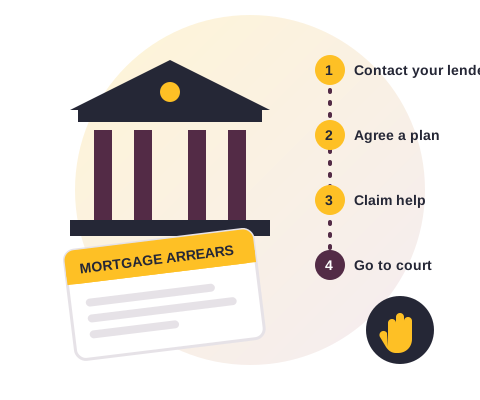
What should I do if I miss a mortgage payment?
Contact your lender straight away, before it contacts you. Mortgage arrears are a priority debt, so they come before credit cards, loans and other non-priority debts. The earlier you talk, the more options you'll usually have.
- Do a budget. List your income, essential bills and other debts, and work out what you can afford for your mortgage and the arrears.
- Call or write to your lender. Explain what's happened, whether it's short or long term, and what you can pay. Say you're getting advice. If the first person isn't helpful, ask for someone else.
- Pay as much as you can, even if it's not the full amount, so the arrears grow more slowly.
- Check for insurance. Mortgage payment protection insurance may cover payments if you're ill or lose your job. People often forget they have it.
- Don't take out a loan to pay the arrears. It's usually expensive and can put your home at more risk.
- Get free advice, especially if you have other debts or have had court papers.
You're not alone. UK Finance figures show 76,080 homeowner mortgages were in arrears of 2.5% or more of the balance in the third quarter of 2026, about 0.87% of all homeowner mortgages. Only 1,150 homes were repossessed in the same period: repossession really is a last resort.
What must my lender do if I'm in arrears?
Most lenders are regulated by the Financial Conduct Authority (FCA). Its mortgage rules say your lender must treat you fairly and:
- consider every option to help, and give you reasonable time to think about them
- agree a realistic payment plan based on your circumstances, which can run for the rest of the mortgage term where appropriate
- tell you about government help you may be able to get
- send you regular statements of your arrears
- not add arrears charges every month while you keep to an agreed plan
- put your payments towards the arrears before charges
- not pressure you with too many calls or letters
- treat repossession as a last resort
The Mortgage Charter
Most UK lenders have signed the government's Mortgage Charter. If yours has, it should not force you to leave your home within 12 months of your first missed payment, unless you agree or there are exceptional circumstances. If you're up to date, it should also let you switch to interest-only for six months, or extend your term, without an affordability check and without affecting your credit file.
If your lender isn't following these rules, complain to it, then the Financial Ombudsman Service.
What are my options for paying off mortgage arrears?
| Option | How it works | Watch out for |
|---|---|---|
| Arrears payment plan | You pay your normal payment plus an extra amount towards the arrears | Lenders often ask for 12 to 24 months, but you can ask for longer if that's all you can afford |
| Extend the term | Spreads the mortgage over more years, so monthly payments fall | You pay more interest overall, and may be paying into retirement |
| Interest-only for a while | You pay only the interest, not the amount borrowed | A short-term fix: the capital still has to be repaid |
| Add the arrears to the mortgage | "Capitalising" spreads the arrears over the rest of the term | Usually only if you have plenty of equity, and your payments go up |
| Payment holiday | A break from payments for a few months | Interest may still build up, so you repay more later |
| Switch from an endowment | Change to a repayment mortgage, possibly using the policy's value | Get independent financial advice first |
Example: your mortgage is £400 a month and you missed one payment. You could offer £500 a month for four months: your normal £400 plus £100 towards the arrears.
If your home is worth more than you owe, a court case called Cheltenham & Gloucester v Norgan says the whole remaining term of the mortgage can be a reasonable time to clear the arrears. Mention it if your lender wants them paid off faster than you can afford.
Can I get help paying my mortgage?
Support for Mortgage Interest (SMI)
If you get a qualifying benefit, the government may lend you money towards the interest on your mortgage. Since April 2018, SMI is a loan, secured on your home, with interest added.
| If you get | When SMI can start |
|---|---|
| Pension Credit | Straight away |
| Universal Credit | Usually after three months |
| Income Support, income-based JSA or income-related ESA | After 39 weeks |
It covers interest on up to £200,000 of mortgage if you're working age, or £100,000 on Pension Credit. You usually only repay it when you sell or transfer your home, or after you die. If there isn't enough equity, the rest is written off.
Help to Stay (Wales)
In Wales, Help to Stay can offer an equity loan to reduce your mortgage, with nothing to pay on it for the first five years. It's for homes worth £300,000 or less, with household income of no more than £67,000, where you're at risk of losing your home. You'll need to have spoken to your lender and a free debt adviser first.
Increasing your income
Check you're getting every benefit you're entitled to with an online benefits calculator, and look at whether you could take in a lodger or work more hours.
Can Debt Breathing Space stop repossession?
Yes, for up to 60 days. Debt Breathing Space stops your lender charging interest and fees on the arrears and taking court action or evicting you for them. You must keep paying your normal monthly mortgage during it. When it ends, the lender can carry on, so use the time to get advice and agree a plan.
Should I sell my home or hand back the keys?
If you can't afford to stay, selling it yourself usually gets a better price than repossession. Some lenders offer an assisted voluntary sale: you stay while it's sold, and they may freeze charges or write off some of any shortfall.
Why handing back the keys is usually a bad idea
- Interest and payments keep being added until the lender sells, which can take months.
- Empty homes sell for less, and the lender adds estate agent, legal and court costs.
- You may still have to pay council tax on the empty property.
- The council may say you made yourself intentionally homeless and refuse to rehouse you.
Be careful with quick-sale and "sale and rent back" companies
They usually pay well below market value. Sale and rent back firms must be FCA regulated, but people have still lost their homes. Get advice before agreeing to anything.
If your home is worth less than your mortgage
With negative equity, a sale may leave a shortfall you still owe. You can offer affordable payments or a smaller lump sum. Lenders usually have 12 years to chase the capital and 6 years for the interest, and should tell you within six years of the sale if they intend to recover it.
Have a second mortgage or secured loan as well? Read secured loans: missing those payments can also lead to repossession, even if your main mortgage is up to date.
What happens if my lender takes me to court?
Your lender can't evict you without a court order. Before going to court, it must follow a pre-action protocol, trying to agree a plan with you, and complete a checklist showing it did.
- Court papers. You'll get a claim form (N5), the lender's details of claim (N120) and a defence form (N11M), with a hearing date.
- Fill in the defence form within 14 days. Say if you disagree with the figures, explain what happened, and make an offer you can afford. Send it even if it's late.
- Get free legal advice. The Housing Loss Prevention Advice Service gives free early legal advice once you're told in writing that your lender wants possession, and many courts have free duty advisers on the day.
- Go to the hearing, even if you've reached an agreement, unless it's been formally adjourned. Take three copies of your budget.
What the court can decide
- Adjourn the case, for example to give an agreement time to work
- Make a suspended possession order: you stay as long as you keep to the payments set
- Postpone possession, for example to let you sell
- Make an outright possession order, usually giving you about four weeks
If you can't keep to an order, or the lender applies for an eviction warrant, apply quickly to the court with form N244 to change the order or suspend the warrant. Evictions are carried out by County Court bailiffs, who can't take your goods for the mortgage.
What happens after repossession?
The lender must sell for the best price it can reasonably get, and tell you in writing how the money was used. Sale proceeds go to costs, your mortgage, then any second mortgages. Anything left over is yours, so give the lender your new address. Missed mortgage payments stay on your credit file for six years.
Debt solutions and mortgage arrears
| Debt solution | Can it include this debt? |
|---|---|
| Debt Breathing Space | Yes, but keep paying your normal monthly mortgage |
| Debt Management Plan | Can't include the mortgage itself, but can free up money for it |
| IVA | Arrears may be included, and you keep paying the mortgage |
| Debt Relief Order | No. You can't get a DRO if you own your home |
| Bankruptcy | Your home may have to be sold |
Dealing with your other debts can free up money for your mortgage. Compare all your debt options, or read which debts to pay first.
Worried about losing your home?
Tell us about your debts and a licensed insolvency practitioner will call you back to talk through your options. It's free, with no obligation.
Questions about mortgage arrears
What happens if I miss one mortgage payment?
Your lender will usually write to you within about two weeks. It may add a late payment fee, and the missed payment goes on your credit file. Contact your lender to agree how to catch up.
Can my lender repossess my home straight away?
No. It must follow the FCA rules and a pre-action protocol, and get a court order. Most lenders have signed the Mortgage Charter, which means you shouldn't be forced to leave within 12 months of your first missed payment unless you agree.
How long do I have to pay off mortgage arrears?
Lenders often ask for 12 to 24 months, but you can ask for longer. If you have equity, the courts accept the whole remaining mortgage term can be a reasonable period.
Can I get help paying my mortgage interest?
If you get Universal Credit, Pension Credit or certain other benefits, you may get a Support for Mortgage Interest loan towards the interest.
Does Debt Breathing Space stop repossession?
It stops action over the arrears for 60 days, as long as you keep paying your normal monthly mortgage. Afterwards the lender can carry on.
Can I sell my house if I have mortgage arrears?
Yes. Selling yourself usually gets a better price than repossession. If you sell for less than you owe, you may still owe the shortfall.
How long do mortgage arrears stay on my credit file?
Missed and late payments stay on your credit file for six years.
Can bailiffs take my belongings for mortgage arrears?
No. Mortgage lenders repossess the property through the court. County Court bailiffs only carry out the eviction after a possession order.
Sources
- FCA Handbook: MCOB 13 (arrears and repossessions)
- GOV.UK: Mortgage Charter
- GOV.UK: Support for Mortgage Interest
- Pre-action protocol for possession claims based on mortgage arrears
- GOV.UK: Legal aid for possession proceedings
- GOV.WALES: Help to Stay – Wales
- UK Finance: Arrears and possessions, Q3 2026
- Shelter: Mortgage arrears
- MoneyHelper: Dealing with debt
