
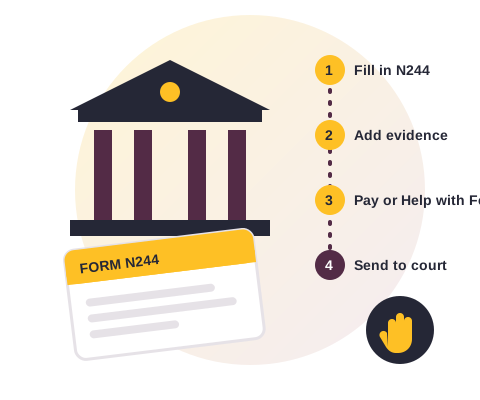
What is the N244 form?
N244 form is the application notice used in the County Court and the High Court in England and Wales. You use it to ask a judge to make an order in a case that already exists, for example to cancel a judgment, change an order or pause enforcement.
It's sometimes called the "general application form" because it covers many different requests. But some applications have their own form, so always check that first. For example, to suspend a County Court warrant of control or change your CCJ payments, you use the N245 form instead.
Download the N244 form
- N244 form application noticePDF, 5 pages, about 100 KB
- N244 form, large print versionPDF, 6 pages, about 180 KB
Court forms are updated from time to time. Before you send it, check you have the latest version on the GOV.UK the N244 form page, where you can also fill it in online.
When might I use an N244 in a debt or bailiff case?
Set aside a County Court judgment
If you didn't receive the court papers, or you have a genuine defence, you can ask the court to cancel the judgment.
Stay of execution
Ask the court to pause High Court enforcement while you pay an affordable amount. See our stay of execution letter.
Challenge bailiff fees
In some cases you can ask the court to assess fees you think a bailiff has charged wrongly. Get advice first.
Stop an eviction
If county court bailiffs are coming to evict you for rent or mortgage arrears, you can ask the court to suspend the warrant of possession.
Other court orders
Ask the court to vary an order, extend a deadline or give directions in your case.
Change a hearing date
Ask the court to move (adjourn) a hearing if you can't attend, for example because of illness.
Using N244 to set aside a County Court judgment
If a County Court judgment (CCJ) was made against you by default, because you didn't respond to the claim, you can ask the court to set it aside. There are two routes:
- The court must set it aside (CPR 13.2) if the judgment was entered wrongly, for example before the time to respond had run out, or after you'd already paid.
- The court may set it aside (CPR 13.3) if you have a real prospect of successfully defending the claim, or there's another good reason. You must act promptly.
Your witness statement is the most important part. It should set out what happened, in date order, why the judgment should be set aside, the evidence for each point, why you didn't respond earlier and any delay since, and what should happen next (for example, your defence).
Using N244 to stop bailiffs evicting you
If county court bailiffs have given you a date to evict you for rent or mortgage arrears, you can use N244 to ask the court to suspend the warrant of possession. Get it to the court as quickly as you can. Call the court to ask the fastest way to send it, such as by email or in person.
- Ask the court to suspend the warrant on terms, for example that you'll pay your normal rent or mortgage plus an amount each month towards the arrears.
- Briefly explain why you fell behind, what's changed and how you'll keep up with payments.
- Include a budget, and proof of income or benefits if you can.
- Ask for your hearing on a day when a duty adviser is at court, who can give free legal help on the day.
- Tell the bailiffs and your landlord or lender that you've applied, and ask court staff to let the bailiffs know.
Shelter and Citizens Advice can give free housing advice. See our extra support page.
Common N244 mistakes to avoid
Vague reasons
"The order is unfair" isn't enough. Explain the specific facts, and the rule you rely on if you know it.
No evidence
Disputed applications usually need a witness statement and documents. Without them the court has nothing to rely on.
Leaving it too late
Delay weakens most applications. Apply as soon as you can and explain any delay.
Wrong court or wrong form
Send it to the court dealing with your case, and check whether a specific form, such as N245, applies instead.
N244 vs N245: what's the difference?
N244 form is the general application for asking a judge to make, change, cancel or pause a court order. Form N245 is a simpler, specific form for lowering County Court judgment payments or suspending a County Court warrant of control.
| N244 form | N245 form | |
|---|---|---|
| What it is | General application notice | Application to suspend a warrant and/or vary an order |
| Main debt uses | Set aside a CCJ, stay a High Court writ, stop an eviction, change payments a judge set | Lower CCJ payments set by the creditor or a court officer, suspend a County Court warrant of control |
| Courts | County Court and High Court | County Court only |
| What you provide | What order you want, your reasons and evidence (often a witness statement) | A full financial statement (income, outgoings, dependants, debts) and a payment offer |
| Usually decided | At a hearing | By a court officer, often without a hearing |
| Court fee (from 13 July 2026) | £321 on notice, £126 by consent or without notice, £16 to vary or suspend | £16 |
Which form should I use?
- Cancel a CCJ (you didn't get the papers, or you dispute the debt): N244.
- Lower CCJ payments a judge set at a hearing: N244.
- Lower CCJ payments the creditor accepted or a court officer set: N245.
- Stop County Court bailiffs taking goods under a warrant of control: N245.
- Pause High Court enforcement (a writ of control) or stop an eviction: N244.
If you're not sure, ask the court or get free debt advice before you apply.
How much does an N244 application cost?
| Type of application | Court fee |
|---|---|
| On notice, for example to set aside a judgment (the other side is told and there's usually a hearing) | £321 |
| By consent, or without notice | £126 |
| To vary a judgment, or suspend or stay enforcement (for example, stopping an eviction or a stay of a High Court writ) | £16 |
| Adjourning a hearing by consent, received at least 14 days before the hearing | No fee |
Fees from 13 July 2026 (HMCTS EX50 civil court fees). The £16 fee is the same whether you use N244 or N245. Court fees change from time to time, so check the current EX50 on GOV.UK before you apply.
Can't afford the fee? If you're on a low income, have little in savings or get certain benefits, you may pay less or nothing. Apply for Help with Fees online or on form EX160 before, or at the same time as, you send your N244.
How do I fill in the N244 form?
Download the latest version from GOV.UK and read the guidance notes that come with it. Then work through it section by section:
- Court and case details. The court name, the claim number (and warrant number, if you're stopping bailiffs) and the names of the claimant (who you owe) and defendant (you). Copy these exactly from your court papers, as a small mistake can cause delay.
- What order you want. Say exactly what you're asking the judge to do, for example "to set aside the judgment dated…" or "to stay execution of the writ of control on condition that I pay £50 a month".
- A draft order. Attach a short draft of the order you want the court to make, if you can. It helps the judge.
- Hearing or no hearing. Most applications need a hearing that you'll be expected to attend. The court will only decide without a hearing if everyone agrees, or it decides a hearing isn't needed. Remote (phone or video) hearings are usually only available where at least one side has a lawyer. Use a covering letter to list any dates in the next 6 weeks when you can't attend.
- How long the hearing will take. If you don't know, leave this blank rather than guessing. If you already have a hearing or trial date, give it.
- Level of judge. In the County Court this is usually a District Judge. In the High Court, say whether it's for a Master, District Judge or Judge.
- Who should be served. Usually the creditor (claimant) or their solicitor. For a stay, include the enforcement firm too.
- Your reasons and evidence. Explain why the court should agree, either in the evidence box on the form or in a separate witness statement. Keep it short and factual. Include your budget, payslips or benefit letters and any medical evidence.
- Vulnerability. You must tell the court if you, or a witness, are vulnerable, for example because of a disability or mental health problem, and explain what support or adjustments you need.
- Your contact details. Sign the form, add your address, and say whether the court and the other side can contact you by phone or email.
- Statement of truth and signature. Sign the statement of truth. Signing it without an honest belief that it's true can lead to proceedings for contempt of court.
Where do I send it, and what happens next?
- Send it to the court dealing with your case, with the fee or your Help with Fees reference, your evidence and any draft order. Make one copy for the court and one for each person to be served, and keep a copy for yourself.
- The court will either list a hearing or deal with it on paper. It will tell you the date, time and how the hearing will happen.
- The other side must get a copy. Usually the court serves it, or tells you to. It must normally be served at least 3 clear days before the hearing.
- Enforcement doesn't stop automatically. Send a copy to the creditor and the bailiff firm and ask them to pause until the court decides. If it's urgent, say so on the form.
- Go to the hearing and take your budget, payslips or benefit letters and any other evidence.
Not sure if an N244 is right for you?
Tell us about your debts and a licensed insolvency practitioner will call you back to talk through your options. It's free, with no obligation.
Questions about the N244 form
What is the N244 form used for?
N244 form is the general application notice for asking a judge to make an order in an existing County Court or High Court case. In debt cases it's often used to set aside a County Court judgment or to ask for a stay of execution of a High Court writ.
How much does an N244 application cost?
Since 13 July 2026, it's £321 for an application with notice to the other side (for example, to set aside a judgment), £126 by consent or without notice, and £16 to vary a judgment or suspend or stay enforcement. Check the current EX50 fee list on GOV.UK, as fees change. If you're on a low income or certain benefits, you can apply for Help with Fees.
Does sending an N244 stop the bailiffs?
Not on its own. Enforcement can carry on until the court makes an order. Send a copy to the bailiff firm and the creditor and ask them to hold off while the court decides. If it's urgent, tell the court.
Do I need a solicitor to complete the N244 form?
No. Many people complete it themselves. Court staff can't give legal advice, but free debt advice services can help you decide whether to apply and what to say.
What's the difference between N244 and N245?
N245 is the specific form to suspend a County Court warrant of control or change the instalments on a County Court judgment. N244 is the general form for other applications, such as setting aside a judgment or a stay of a High Court writ. Always check whether a specific form exists first.
Sources
- GOV.UK: N244 form application notice
- GOV.UK: How to complete the N244 application notice
- GOV.UK: Court and tribunal fees (EX50)
- GOV.UK: Get help paying court and tribunal fees
- Civil Procedure Rules Part 13: Setting aside or varying default judgment
- Shelter: How to stop bailiffs evicting you
- Civil Procedure Rules Part 23: General rules about applications