
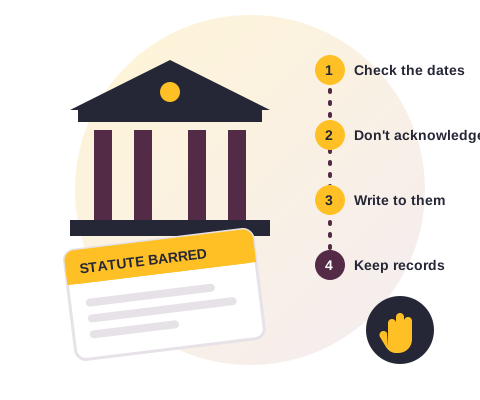
What does statute barred mean?
The Limitation Act 1980 gives creditors a time limit to take you to court. For most unsecured debts in England and Wales, it's six years. Once that time has passed, the debt is statute barred. The creditor has run out of time to get a County Court Judgment, so it can't use bailiffs, take money from your wages or put a charge on your home.
A statute-barred debt doesn't disappear. You still technically owe it, and the creditor can ask you to pay voluntarily. What it loses is the power to make you. (Scotland has different rules: most debts are wiped out completely after five years.)
How do I know if my debt is statute barred?
An unsecured debt such as a credit card, loan, catalogue or utility bill is probably statute barred if all four of these are true:
- more than six years have passed since the creditor could first take court action, usually from the default
- no one, including anyone you owe the debt jointly with, has made a payment in the last six years
- you haven't admitted the debt in writing in the last six years
- the creditor hasn't started court action in that time
Check your bank statements and your credit file for the date of your last payment and any default. The creditor, not you, has to prove it's still in time if it goes to court.
When does the six years start?
| Type of debt | Time limit | Usually runs from |
|---|---|---|
| Credit cards, store cards, loans, catalogues | 6 years | When the creditor could first sue, usually after a default notice, or your last payment or written acknowledgement if later |
| Overdrafts | 6 years | When the bank formally demanded repayment |
| Gas, electricity, water and phone bills | 6 years | The date of the bill, or your last payment or written acknowledgement |
| Mortgage shortfall | 12 years for the capital, 6 for the interest | When the lender became entitled to the full balance, usually around repossession |
| Rent arrears (former tenancy) | 6 years | Each missed rent payment |
On mortgage shortfalls, lenders have agreed to contact you within six years of the sale if they intend to recover the shortfall. If you haven't heard from them in that time, get advice before paying.
What restarts the six-year clock?
- Any payment, however small, even £1 a month, or a reactivated direct debit or standing order.
- A written, signed acknowledgement that you owe the debt. Signing a collector's form or reply slip can count, and an email might too.
These don't restart it:
- phone calls, or agreeing to something verbally
- letters from the creditor or collector to you
- the debt being sold to another company
- disputing the debt, or asking for a copy of the agreement, as long as you don't admit owing it
Once a debt is already statute barred, a later payment or acknowledgement doesn't revive it. But get advice before paying anything, because collectors sometimes argue the debt wasn't barred at the time.
What about joint debts?
A payment by any person who owes a joint debt restarts the clock for everyone on it. So if you've split up with a partner who has kept paying a joint loan, the debt may not be statute barred for you, even if you haven't paid for years.
A written acknowledgement is different: it only restarts the clock for the person who signed it.
Which debts aren't covered by the six-year rule?
- County Court Judgments: a CCJ doesn't expire, but a creditor needs the court's permission to send bailiffs more than six years after it, and can only claim six years of interest.
- Council tax and business rates: the council must get a liability order within six years. Once it has one, it can usually keep enforcing. See council tax bailiffs.
- HMRC tax debts have no time limit once the tax is assessed. See HMRC debt.
- Magistrates' court fines: no time limit. See magistrates' court fines.
- Child maintenance arrears collected by the Child Maintenance Service: no time limit. See child maintenance arrears.
- Student loans from the Student Loans Company aren't covered. They're collected through your pay and eventually written off. See student loan debt.
- Benefit and tax credit overpayments can still be taken from your benefits, even after six years. See benefit overpayments.
Can a creditor still contact me about a statute-barred debt?
Yes, but FCA rules limit what lenders and collectors of credit debts can do:
- they mustn't take or threaten court action on a debt they know is statute barred
- they mustn't try to recover it at all if no one had contacted you about it during the six-year period
- they must stop asking you to pay once you've told them you won't pay because it's statute barred
- they mustn't mislead you about your rights or the status of the debt
You may still get some letters about a credit agreement, because the law requires certain annual notices whatever the debt's age. If a collector ignores these rules, complain to the collector, and then to the Financial Ombudsman Service.
What should I do if I think a debt is statute barred?
- Don't pay, sign or reply to admit anything until you've checked the dates.
- Work out the dates from your bank statements, old letters and your credit file. You can also ask the creditor for a statement showing your last payment.
- Write to the creditor or collector saying the debt is statute barred and you won't be paying. Use "without prejudice" wording and don't admit the debt.
- Keep copies of everything you send and receive.
- Get free advice from National Debtline or Citizens Advice if you're unsure. The rules on when time starts can be complicated.
What should my statute-barred letter say?
Keep it short. Include:
- the account or reference number from their letter
- "without prejudice" at the top, and wording that doesn't admit the debt is yours
- that you believe the debt is statute barred under section 5 of the Limitation Act 1980, because no payment or written acknowledgement has been made in the last six years
- that you won't be paying, and you expect them to stop contacting you, in line with FCA rules
Don't explain your finances, apologise for the debt, or offer anything. Send it by a method you can prove, and keep a copy.
What if I get court papers for a statute-barred debt?
Don't ignore them. Being statute barred is a defence, but the court won't apply it unless you raise it. If you don't respond within the deadline, usually 14 days (or 28 if you file an acknowledgment of service), the creditor can get a judgment anyway, and then the debt is enforceable.
- Fill in the defence form saying the claim is statute barred under the Limitation Act 1980, with the dates you rely on.
- Don't tick "I admit the claim", or offer instalments.
- If you've already got a judgment because you didn't know about the claim, you may be able to apply to have it set aside: see County Court Judgments.
Does a statute-barred debt stay on my credit file?
Defaults and missed payments drop off your credit file six years after the date of default, whether or not the debt is statute barred. So a debt can disappear from your file but still be within time, if you paid something more recently. And a statute-barred debt shouldn't still show as a live default after six years. If it does, ask the credit reference agency to correct it.
Should I pay a statute-barred debt?
It's your choice. You can pay voluntarily, or offer a smaller final settlement, but you don't have to. Before deciding, think about:
- whether you have priority debts, such as rent, council tax or energy, that should come first
- whether paying could cause problems for someone you owe the debt jointly with
- if you have several debts, whether statute-barred ones belong in a debt management plan. Usually they don't, because paying could restart the clock
If you're struggling with debts that are still in time, look at your debt options.
Old debts catching up with you?
Tell us about your debts and a licensed insolvency practitioner will call you back to talk through your options. It's free, with no obligation.
Questions about statute-barred debt
How long before a debt becomes statute barred?
For most unsecured debts in England and Wales, six years with no payment, no written acknowledgement and no court claim started. Mortgage shortfalls are 12 years for the capital.
Does a £1 payment restart the six-year clock?
Yes, if it's made before the debt becomes statute barred. Once the debt is statute barred, a later payment doesn't restart it.
Does a phone call restart the clock?
No. Only a payment or a signed written acknowledgement restarts it. Phone calls and verbal agreements don't.
Can a creditor chase a statute-barred debt?
It can ask you to pay, but it can't take you to court. Under FCA rules, it must stop once you've said you won't pay because the debt is statute barred.
Can a debt collector sell a statute-barred debt?
Yes, but selling it doesn't restart the clock, and the new owner has to follow the same rules.
Is council tax ever statute barred?
The council must get a liability order within six years of the bill. Once it has one, it can usually still enforce the debt.
Does statute-barred debt affect my credit file?
Defaults are removed six years after the default date, whether or not the debt is statute barred.
What if I'm taken to court for a statute-barred debt?
Respond to the claim and defend it, saying the debt is statute barred under the Limitation Act 1980. If you ignore it, the creditor can get a judgment.
