
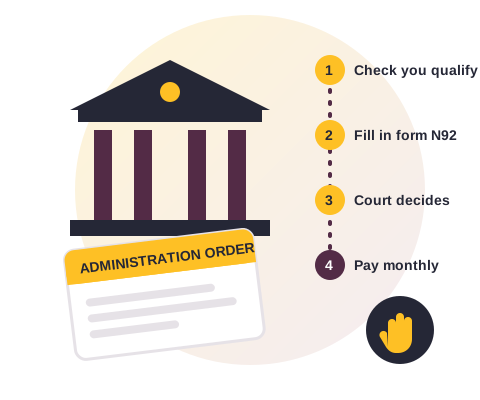
Who can get an Administration Order?
- you live in England or Wales
- your total debts are £5,000 or less, counting every debt you have
- you have two or more debts
- at least one is a County Court Judgment or High Court judgment that you can't pay in full
- you can afford a regular monthly payment, even a small one
Because of the £5,000 limit, which counts mortgages and secured loans, most homeowners won't qualify. The limit hasn't changed for decades. A law passed in 2007 would raise it and remove the need for a judgment, but those changes have never been brought into force.
How does an Administration Order work?
- You make one payment each month to the court, at an amount the court sets based on your budget.
- The court shares it between your creditors in proportion to what each is owed.
- Creditors in the order can't take other action against you or your property, including bailiffs, without the court's permission.
- Interest and charges stop on the debts in the order.
- It ends when you've paid the debts in full, or the amount set by a composition order.
The court runs the order, so there's no company in the middle taking a cut, and you deal with one organisation instead of several creditors.
Can an Administration Order write off part of my debt?
Yes, if the court makes a composition order alongside it. This limits what you pay to a percentage of your debts, or to a set period, often around three years. When you've paid that, the rest is written off. Creditors can object, and the court decides based on what you can realistically afford.
Without a composition order, you keep paying until the debts are cleared in full, which can take a long time if your payments are small. You can ask the court to add a composition order later if your circumstances get worse.
How much does an Administration Order cost?
There's no fee to apply. The court takes a fee from your payments that can't be more than 10% of your total debts. On £5,000 of debt, that's no more than £500, spread across your payments.
How do I apply for an Administration Order?
- Get free advice to check it's the best option for you.
- Fill in form N92. List every creditor, how much you owe each one, your income and your spending. Leaving debts out can cause problems later.
- Send it to the County Court for your area, usually the court handling your judgment. You can ask to be considered for a composition order at the same time.
- A court officer or judge decides how much you'll pay. Your creditors are told and can object. There may be a short hearing if anyone objects or the court needs more information.
- The order is made and you start paying the court.
If you're facing enforcement while you wait, tell the court and your creditors that you've applied, and ask them to hold off. Debt Breathing Space can pause most action for 60 days while you get advice.
What happens after the order is made?
- Pay the court on time every month. Keep records of every payment.
- Tell the court if your income, address or circumstances change. You can ask it to review your payments, up or down.
- Avoid taking on new credit. Lenders will see the order on your credit file, and new debts can make it harder to keep up.
- Keep paying your priority bills, such as rent, council tax and energy, as they fall due.
- If you get a new debt, it won't automatically be included. Ask the court whether it can be added.
What happens if I miss payments?
If you fall behind, the court will usually write to you. If you don't catch up or explain why, it can revoke the order. Your creditors can then take action again, including sending bailiffs for any judgment debts. If you're struggling, contact the court before you miss a payment and ask for your payments to be reduced, or for a composition order.
Does an Administration Order affect my credit file?
Yes. The order is recorded on the public Register of Judgments, Orders and Fines and shows on your credit file. It's usually removed six years after the order is made. If you pay everything off, you can ask for it to be marked as satisfied. You'll probably already have a CCJ on your file, which is needed to qualify.
What are the pros and cons of an Administration Order?
| Pros | Cons |
|---|---|
| One affordable payment to the court | Only for total debts of £5,000 or less |
| Creditors in the order can't use bailiffs or other action without the court's permission | You must already have a County Court or High Court judgment |
| Interest and charges stop | A court fee of up to 10% is taken from your payments |
| No upfront fee, and no company taking a cut | Affects your credit file, and missing payments can end the order |
| Part of the debt may be written off with a composition order | Without a composition order, it can take many years |
How does an Administration Order compare with a DRO or DMP?
| Administration Order | Debt Relief Order | Debt Management Plan | |
|---|---|---|---|
| Debt limit | £5,000 | £50,000 | None |
| Needs a judgment? | Yes | No | No |
| Monthly payment | Yes, to the court | No (spare income of £75 a month or less) | Yes, to the provider |
| Debts written off | Only with a composition order | Yes, after 12 months | No, unless creditors agree |
| Legally binding | Yes | Yes | No |
| Cost | Up to 10%, taken from payments | Free | Free from debt charities |
What are the alternatives?
If you don't qualify, or something else suits you better, look at an informal payment arrangement, an IVA for larger debts, or bankruptcy. If bailiffs are already involved for a judgment debt, you can also ask the court to suspend the warrant with an N245 form. See all your debt options.
Want to compare your options?
Tell us about your debts and a licensed insolvency practitioner will call you back to talk through your options. It's free, with no obligation.
Questions about Administration Orders
What is the debt limit for an Administration Order?
£5,000 in total, counting all your debts, including any secured debts such as a mortgage.
Do I need a CCJ to get an Administration Order?
Yes. You need at least one County Court or High Court judgment that you can't pay in full.
How much does an Administration Order cost?
There's no fee to apply. The court takes up to 10% of your total debts from your payments.
Can an Administration Order stop bailiffs?
Yes, for creditors included in the order. They can't take enforcement action without the court's permission while the order is in place.
Can an Administration Order write off debt?
Only if the court also makes a composition order. You then pay a set percentage or for a set time, and the rest is written off.
Which form do I need for an Administration Order?
Form N92, sent to the County Court for your area.
What happens if I miss Administration Order payments?
The court can revoke the order, and creditors can take action again. Contact the court before you miss a payment and ask for it to be reduced.
How long does an Administration Order stay on my credit file?
Usually six years from the date of the order.
