
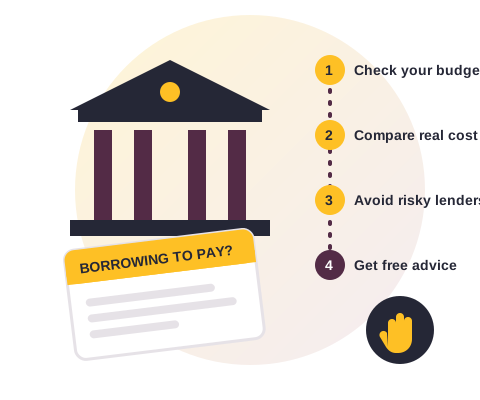
Robbing Peter to pay Paul: how the debt spiral starts
It usually starts small. You use the overdraft to cover the gap before payday, then a credit card to pay the overdraft, then a loan to clear the cards. Each step feels like it's solving the problem, but you're just moving the debt around, and usually paying more interest each time.
This is often called a debt spiral: you spend more than you earn, borrow to fill the gap, and more of your income then goes on repayments, so you borrow again. Eventually most of your money goes on debt, and there's nothing left for bills.
Signs you're borrowing to survive:
- you use one credit card to pay another, or to pay a loan
- you're in your overdraft every month and never get back into credit
- you've used a payday loan or buy now, pay later for food, rent or bills
- you only ever make the minimum payment on your cards
- you're borrowing from family or friends to keep up with repayments
- you're thinking about a loan because a bailiff or creditor is chasing you
Are you in a debt spiral or a debt crisis?
Two quick questions can help. Answering yes to either suggests you may be in debt crisis:
- Are you struggling to pay your basic bills? Such as rent or mortgage, energy, council tax and the minimum payments on your debts.
- Are your debts bigger than a year's take-home pay? Not counting your mortgage.
If you answered no to both but your debts keep growing, you may be in a debt spiral. Acting now, by cutting costs and getting your borrowing cheaper, may be enough. If you answered yes, borrowing more is very unlikely to help, and free debt advice is the right next step.
Why borrowing more usually makes things worse
- It doesn't reduce what you owe. New borrowing only moves the debt, and adds new interest and fees on top.
- You may not get a good rate. If you've missed payments, your credit score is likely to be lower, so you'll be offered higher rates or turned down. The best advertised deals go to people with the best credit scores.
- Longer terms cost more. A lower monthly payment over more years can mean paying much more overall.
- Missing payments on a new loan can be costly. If you fall behind, the lender may demand the whole balance at once.
- You might end up with both. Once your cards are cleared, it's easy to start using them again, leaving you with the new loan and the old debts.
- Lots of applications harm your credit file. Each application leaves a search on your file, which can make the next one harder.
- It can hide the real problem. If your income doesn't cover your outgoings, no loan will fix that.
Types of borrowing: which might help and which to avoid
| Type | Could it help? | Watch out for |
|---|---|---|
| 0% balance transfer card | Possibly, if you're not behind and can clear it in the 0% period | A transfer fee, a high rate when the deal ends, and losing the 0% rate if you miss a payment |
| Unsecured consolidation loan | Possibly, if the rate is lower and you can afford it | A longer term, early repayment charges on old loans, and running up the old cards again |
| Credit union loan | Often cheaper than other lenders | You usually need to be a member, and your savings may be used if you miss payments |
| Budgeting loan or council support | Interest-free help for essentials if you're on certain benefits | Limited funds, and it's repaid from your benefits |
| Secured loan or remortgage | Rarely the right choice for unsecured debts | It turns credit card debt into debt secured on your home, so your home is at risk if you can't pay |
| Guarantor loan | Rarely | Your friend or relative could have to pay the whole balance |
| Payday loans and high-cost credit | No | Very high interest, and easy to fall into a cycle of borrowing again |
| Logbook loans | No | Secured on your car, which can be taken if you fall behind |
| Loan sharks | Never | Illegal lending, with extreme rates and threats. See below. |
When could a consolidation loan make sense?
A debt consolidation loan pays off several debts so you only have one payment. It can be a sensible choice, but only if all of these apply:
- you're up to date with your payments and your bills
- the new loan has a lower interest rate than your current debts, and you've checked the APR and the total cost, not just the monthly payment
- you've included any early repayment charges on the loans you're clearing
- you can comfortably afford the new payment from your budget
- you'll stop using the cleared cards, and ideally ask for the limits to be lowered
- the loan is unsecured, so your home isn't at risk
Deal with the cause first. If you got into debt because your income doesn't cover your spending, a loan won't change that. Consolidating doesn't make you debt-free, it just puts the debt in one place. Unless you change what caused it, there's a real risk of ending up with the new loan and new debts.
Be careful with overdrafts. If you've only been paying interest on an overdraft, moving it into a loan means repaying the balance too, so your monthly payment could go up.
If your credit score has already been affected, read our guide to Debt Consolidation Loans with bad credit, which covers the options, the real costs and the alternatives.
Be wary of companies that advertise debt consolidation heavily on TV or social media, and of any adverts promising to write off most of your debt. Always get independent advice before you sign anything.
If you do consolidate: how to do it safely
- Try 0% options first. If you're not behind, a 0% balance transfer card for card debts, or a 0% money transfer card for an overdraft, can be cheaper than a loan. Set up a fixed direct debit that clears the balance before the 0% period ends, rather than paying the minimum.
- Work out exactly what you owe. Add up your cards, overdraft and other debts. For existing loans, ask for a settlement figure, which includes any early repayment charge.
- Borrow only what you need, and choose the shortest term you can afford. A longer term means lower payments but more interest overall, so compare the total cost.
- Check your chances before applying. Use an eligibility checker that does a "soft search", which doesn't affect your credit file, so you don't collect lots of rejected applications.
- Pay off the old debts straight away. Don't spend the money while it's sitting in your account.
- Close or cut up the cleared cards, or ask for the limits to be cut, so you're not tempted to use them again.
- Pay in full and on time every month. If you ever can't, tell the lender straight away and ask about an affordable plan.
Borrowing from family or friends
It can be cheaper, but it can strain relationships if things go wrong. If you do borrow from someone you know, agree in writing how much you'll repay and when. Make sure they can afford to lose the money, and never ask them to borrow in their own name for you.
What to do instead of borrowing
- Do a budget. List your income and essential costs to see what you can really afford.
- Cut costs and boost income. Cancel unused subscriptions, check you're getting every benefit you're entitled to, and check for a council tax discount or reduction.
- Pay priority debts first. Rent or mortgage, council tax, energy and court fines come before credit cards and loans.
- Talk to your creditors. Many will freeze interest or accept lower payments if you show them an honest budget.
- Get protection if you need it. Debt Breathing Space gives you 60 days' protection from most interest, charges and enforcement, including bailiffs.
- Look at a debt solution. A Debt Management Plan spreads payments without new borrowing. An IVA, Debt Relief Order or bankruptcy can write off what you can't afford.
Being chased by bailiffs? Don't take out a high-cost loan to pay them off. Offer an affordable payment plan instead. See how to stop bailiffs for your options. Compare all the debt solutions on our debt advice page, or get free debt help.
Borrowing to keep up with debts?
Tell us about your debts and a licensed insolvency practitioner will call you back to talk through your options. It's free, with no obligation.
Questions about borrowing to pay off debt
Should I borrow money to pay off debt?
Usually not if you're already behind or struggling to pay your bills. Borrowing only moves the debt and often costs more. It can make sense if you're up to date, can get a lower rate and can afford the new payment, but get independent advice first.
Is a debt consolidation loan a good idea?
It can be, if you're up to date with payments, the total cost is lower than your current debts, you can afford the repayments and you stop using the cleared cards. If you're already missing payments, it usually isn't the answer.
Will a consolidation loan hurt my credit score?
Applying leaves a search on your credit file, and several applications in a short time can make it harder to get credit. Keeping up the payments can help your score over time, but missing them will harm it.
Should I use a credit card to pay another credit card?
Only through a proper balance transfer to a cheaper card, and only if you can clear it before any 0% deal ends. Using one card's credit to make another card's payment is a warning sign of a debt spiral.
Should I remortgage to clear my debts?
Be very careful. It turns unsecured debts like credit cards into debt secured on your home, so you could lose your home if you can't keep up. It can also cost more overall because of the longer term. Get independent advice first.
Should I take out a loan to pay the bailiffs?
Avoid high-cost borrowing to pay bailiffs. Offer an affordable payment plan instead, ask for more time, or get Debt Breathing Space. If bailiff fees are already high, get free advice about your options.
What if I've borrowed from a loan shark?
You're not in trouble. Report them in confidence to the Illegal Money Lending Team on 0300 555 2222 in England, or Stop Loan Sharks Wales on 0300 123 3311.
Is a 0% balance transfer better than a consolidation loan?
It can be cheaper, if you're not behind with payments and can clear the balance before the 0% period ends. Watch for a transfer fee, and set up a fixed monthly payment rather than paying the minimum. If you're not sure you'll stick to it, a loan's fixed payments may be safer.
What should I do instead of borrowing?
Do a budget, cut costs and check your benefits, deal with priority debts first, and talk to your creditors. Free debt advice can help you find a solution, such as a Debt Management Plan, IVA or Debt Relief Order, without borrowing more.
