
What are my rights with bailiffs?
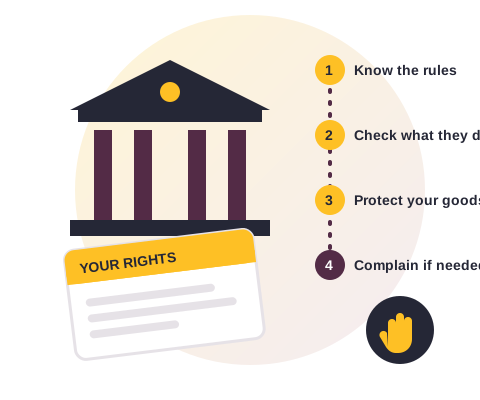
Bailiffs (enforcement agents) have real powers, but they must follow the Taking Control of Goods rules, the government's National Standards and, for most firms, the Enforcement Conduct Board's standards. Here are your main rights:
| Your right | What it means | Read more |
|---|---|---|
| Notice before a visit | At least 14 clear days from a Notice of Enforcement (28 if a debt adviser asks, for most personal debts) | Notice of Enforcement |
| Visiting hours | Only between 6am and 9pm | When bailiffs can visit |
| Peaceful entry only | For most debts they can't force their way in | Can bailiffs force entry? |
| Protected goods | Essentials, work tools up to £1,350 and pets can't be taken | What bailiffs cannot take |
| Other people's things | Only the debtor's goods can be taken | What can bailiffs take? |
| Fixed fees | £79, £247 and £116 stages, plus 7.5% over £1,900 | Bailiff fees |
| Fair treatment | Extra care if you're vulnerable | Extra support |
| The right to complain | To the firm, the creditor, the Enforcement Conduct Board and the courts | How to complain |
Do bailiffs have to give notice?
Yes. Before they can take control of your goods, bailiffs must send a Notice of Enforcement. Since 1 May 2026, it must give you at least 14 clear days, not counting Sundays and bank holidays. For most personal debts, a free debt adviser can get this extended to 28 clear days if they ask before the 14 days run out.
Bailiffs then normally have 12 months to take control of goods. If you've signed a controlled goods agreement and break it, they must give you 2 clear days' notice before coming back.
When can bailiffs visit?
- Between 6am and 9pm only. A visit outside these hours breaks the rules.
- Any day of the week, including weekends.
- The exceptions are where a court has given permission, or for business premises that trade outside those hours.
- A bailiff who has started taking control of goods before 9pm can carry on after 9pm if needed to finish.
Do bailiffs have to show ID?
Yes. If you ask, a bailiff must show you their identification and evidence that they're authorised to act, such as the warrant, writ or liability order details. Most bailiffs must hold a certificate from the County Court. You can check a bailiff's name on the government's Certificated Enforcement Agents Register.
Ask for ID through a window or the letterbox, without opening the door. If someone claims to be a bailiff but can't prove it, don't let them in and don't pay. Debt collectors aren't bailiffs and have no right to enter or take goods: see debt collectors vs bailiffs.
Can bailiffs come into my home?
- You don't have to open the door or let them in. Talk through a window, the letterbox or by phone.
- Peaceful entry only, for most debts. For council tax, parking, County Court debts and most others, bailiffs can only come in through a door that's open or unlocked, or if you let them in. They can't push past you or climb through a window.
- Not if only children or vulnerable people are home. Bailiffs mustn't enter if the only people there are children under 16, or people who appear to be vulnerable.
- Forced entry is only allowed in limited cases, such as unpaid magistrates' court fines, some HMRC debts with a warrant, or after a broken controlled goods agreement. See can bailiffs force entry?
- Other people's homes: bailiffs can't enter someone else's property to look for your goods without a court warrant.
How must bailiffs behave?
The National Standards and the Enforcement Conduct Board's standards say bailiffs must:
- act lawfully, professionally and with courtesy
- not threaten, intimidate or mislead you about their powers
- not discuss your debt with anyone else, such as neighbours
- wear a body-worn camera during visits, if they work for an accredited firm
- give you the paperwork the law requires, such as a notice after entry listing any goods they've taken control of
- consider reasonable payment offers, especially if you're vulnerable
You can also record a visit on your phone. It's your home, and a recording can help if you need to complain.
What are my rights over my belongings?
- Bailiffs can only take goods that belong to the person who owes the debt. See other people's belongings.
- They can't take essentials, children's things, medical items, pets, work tools up to £1,350, a Blue Badge vehicle, or (usually) goods on finance.
- They shouldn't take goods worth much more than the debt and fees, unless there's nothing else.
- They must give you a list of anything they take control of.
- You must be given the chance to sign a controlled goods agreement and pay by instalments, instead of having goods removed.
What are my rights on fees and paperwork?
Bailiff fees are fixed by law. A bailiff can't charge the £247 enforcement fee unless they've actually visited, and can't add fees that aren't in the regulations. You have the right to:
- a breakdown of the debt and every fee added, with dates
- a receipt for every payment
- ask the court to assess the fees if you think you've been overcharged
- your personal data, including body camera footage, through a free subject access request
What are my rights if goods are removed and sold?
- You must get at least 7 clear days' notice before goods are sold, so you can still pay and get them back.
- Goods are usually sold at public auction, and the bailiff must try to get the best price reasonably possible.
- You're entitled to a statement showing what was sold, for how much, and how the money was used.
- Any money left over after the debt and fees are paid must be given back to you.
What are my rights if I'm vulnerable?
Bailiffs must take extra care if you're elderly, disabled, seriously ill, pregnant, recently bereaved, have a mental health condition, don't speak much English, or are struggling in another way. They may pause action, give you more time, or return the case to the creditor.
Tell the bailiff firm and the creditor in writing, using our vulnerability letter, with evidence if you have it. From January 2027, new Enforcement Conduct Board standards will require accredited firms to be better at spotting vulnerability and making sure payment plans are affordable. See extra support.
Can I get enforcement paused?
- Debt Breathing Space legally pauses most enforcement, interest and charges for 60 days while you get advice.
- Ask the creditor to recall the debt if you're vulnerable or the debt is wrong.
- For County Court debts, apply to suspend the warrant using an N245 form.
- A formal debt solution, such as a Debt Relief Order, IVA or bankruptcy, usually stops enforcement for the debts it includes.
What can I do if a bailiff breaks the rules?
- Write down what happened straight away: dates, times, names and what was said. Keep letters, photos and recordings.
- Complain to the bailiff firm and the creditor, and ask for enforcement to be paused.
- Escalate to the Enforcement Conduct Board, or the ombudsman for council debts.
- Go to court for serious breaches: to challenge fees, claim compensation or complain about the bailiff's certificate.
Read our full guide to complaining about bailiffs. If you feel threatened or someone is hurt, call the police.
Bailiffs not following the rules?
Tell us about your debts and a licensed insolvency practitioner will call you back to talk through your options. It's free, with no obligation.
Questions about your rights
What are my rights when a bailiff comes to my house?
You don't have to let them in, they must show ID if asked, they can only visit between 6am and 9pm, they can't take essentials or other people's goods, and they must treat you fairly if you're vulnerable.
Can bailiffs enter if I'm not home?
They can enter peacefully through an unlocked door, but not if the only people there are children under 16 or vulnerable people. For most debts, they can't break in.
Do bailiffs have to give notice before visiting?
Yes. They must send a Notice of Enforcement giving at least 14 clear days before taking control of goods, for cases from 1 May 2026.
Can bailiffs come on a Sunday?
Yes. Bailiffs can visit any day of the week, but only between 6am and 9pm.
Can I film a bailiff?
Yes, you can record a bailiff visit on your phone. Bailiffs from accredited firms should also wear body-worn cameras.
How do I check a bailiff is genuine?
Ask for ID and the warrant or order details, then check their name on the government's Certificated Enforcement Agents Register.
Can bailiffs talk to my neighbours about my debt?
No. Bailiffs shouldn't discuss your debt with anyone who isn't responsible for it.
Who can I complain to about a bailiff?
The bailiff firm and the creditor first, then the Enforcement Conduct Board. For council debts, you can also go to the ombudsman.
Sources
- The Taking Control of Goods Regulations 2013
- The Taking Control of Goods (Miscellaneous Amendments) Regulations 2026
- Tribunals, Courts and Enforcement Act 2007, Schedule 12
- GOV.UK: Bailiff powers when they visit your home
- GOV.UK: Taking Control of Goods: National Standards
- GOV.UK: Certificated Enforcement Agents Register
- Enforcement Conduct Board