What is a Notice of Enforcement?
A Notice of Enforcement is the first formal letter from a bailiff firm (enforcement agents). It tells you that a creditor has passed your debt to bailiffs, and gives you a deadline to pay or agree a plan before a bailiff can visit to take control of your goods.
Bailiffs can't take control of goods without first giving you one. It's used for council tax, parking and traffic fines, magistrates' court fines, County Court Judgments, High Court writs, business rates, some HMRC debts and commercial rent.
The notice itself isn't a court order. It's based on one, though, such as a liability order, warrant or writ, and that's what gives bailiffs their powers.
What must a Notice of Enforcement include?
The notice must be in the official prescribed form. It must show:
- the bailiff firm's name and contact details, including when you can reach them
- the creditor, and the court order, warrant, liability order or other authority, with a reference number
- the amount you owe, including the £79 compliance fee
- the date of the notice and the deadline to pay, at least 14 clear days later
- how to pay
- what happens if you don't pay, including the fees that can be added
- that a debt adviser can ask for more time, where this applies
How is a Notice of Enforcement given?
It can be sent by post, by email or fax, delivered by hand, or left in a sealed envelope at your home or business premises. It must be given to each person named on the order, so if a debt is joint, both of you should get one. Only a certificated enforcement agent, or someone working for them, can give it.
How many days do I get after a Notice of Enforcement?
Since 1 May 2026, the minimum notice period is 14 clear days, up from 7. When counting clear days, leave out:
- the day you're given the notice
- the day the bailiff takes control of goods
- Sundays, bank holidays, Good Friday and Christmas Day
Example: a notice given to you on Monday 2 November 2026 starts the count on Tuesday 3 November. Leaving out Sundays 8 and 15 November, the 14th clear day is Wednesday 18 November, so the earliest a bailiff can take control of goods is Thursday 19 November. A notice sent by post may take a few days to arrive, so check the deadline printed on the notice.
Cases already with bailiffs before 1 May 2026 kept the old 7-day period. A bailiff then has 12 months from the notice to take control of goods. If you agree a payment plan and later break it, the 12 months can run from when the plan broke down.
Can I get more than 14 days?
For most personal debts, such as council tax, parking fines and CCJs, a recognised debt advice provider can ask for the notice period to be extended to 28 clear days. The request must be made before the 14 days run out, so contact a free debt adviser quickly. The extension usually doesn't apply to business debts, such as business rates or commercial rent.
You can also ask the bailiff firm or the creditor for more time yourself, for example while you wait for a benefit decision or wages. They don't have to agree, but many will. Use our free letter to ask for more time.
What fees will I pay?
| Stage | When it's added | Fee |
|---|---|---|
| Compliance | As soon as the bailiff firm gets your case. It's already on the Notice of Enforcement | £79 |
| Enforcement | Only if a bailiff actually visits after the deadline | £247 + 7.5% of the debt over £1,900 |
| Sale | Only if goods are removed for sale | £116 + 7.5% of the debt over £1,900 |
These are the fees for cases passed to bailiffs from 1 May 2026. Paying or agreeing a plan within the notice period keeps the fees to £79. High Court fees are different: see bailiff fees.
How do I check a Notice of Enforcement is genuine and valid?
- Is it really from bailiffs? Debt collection agencies sometimes send letters that look official but give no power to take goods. A real notice names a court order, warrant or liability order and comes from a firm of certificated enforcement agents.
- Is the debt yours, and is the amount right? Check against your own records, and ask for a breakdown if you're unsure.
- Is the deadline at least 14 clear days after you got it?
- Is it addressed to you, at your address?
- Has the order been dealt with? For example, a parking fine you'd challenged, or a council tax bill you'd already paid.
If something looks wrong, contact the bailiff firm and the creditor straight away, ask them to put things on hold, and see disputing a bailiff debt.
What should I do after getting a Notice of Enforcement?
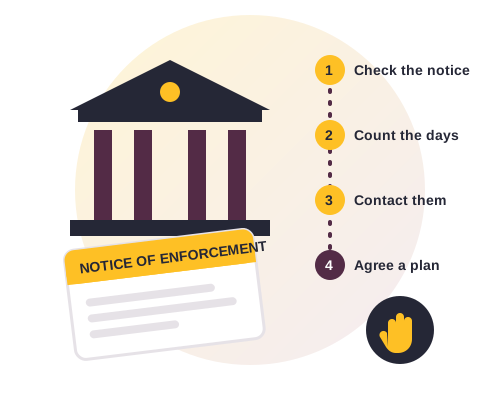
- Don't ignore it. Put the deadline in your diary.
- Work out what you can afford, after rent, energy and food.
- Contact the bailiff firm before the deadline. Pay in full if you can, or offer an affordable payment plan. Get anything agreed in writing.
- Tell them if you're vulnerable, for example because of illness, disability, a recent bereavement or young children. Use our vulnerability letter.
- Contact a free debt adviser, who can ask for 28 days and help with the plan. Debt Breathing Space pauses most enforcement for 60 days.
- Keep valuables and vehicles safe and don't let a bailiff in if one calls early. They can't take control of goods before the deadline.
What other bailiff notices might I get?
| Notice | When you get it | What it means |
|---|---|---|
| Notice of Enforcement | First | At least 14 clear days to pay before a visit |
| Notice after entry or taking control | After a bailiff has been inside, or clamped a vehicle | Lists goods taken into control. See controlled goods agreements |
| Notice of intention to re-enter | After a controlled goods agreement is broken | At least 2 clear days before the bailiff comes back, and may force entry. See can bailiffs force entry |
| Notice of sale | After goods are removed | At least 7 clear days before they're sold |
What happens if I ignore a Notice of Enforcement?
After the deadline, a bailiff can visit, add the £247 enforcement fee and try to take control of your goods, usually by listing them on a controlled goods agreement or clamping a vehicle. For most debts you don't have to let them in, but they can take control of vehicles parked on the road or your drive. Read what bailiffs can take and how to stop bailiffs.
What if I never got the Notice of Enforcement?
Bailiffs can't take control of goods without giving a valid notice. If you didn't get one, for example because it went to an old address, tell the bailiff firm and the creditor straight away, ask for proof of when and how it was sent, and ask for the case to be paused. If fees were added because of a notice you never received, you can challenge them: see complaining about bailiffs.
Received a Notice of Enforcement?
Tell us about your debts and a licensed insolvency practitioner will call you back to talk through your options. It's free, with no obligation.
Questions about Notices of Enforcement
How long after a Notice of Enforcement will bailiffs visit?
Not before the deadline in the notice. Since 1 May 2026, that's at least 14 clear days, not counting Sundays and bank holidays.
Can I get 28 days instead of 14?
For most personal debts, a recognised debt adviser can ask for 28 clear days, if they ask before the 14 days run out. It usually doesn't apply to business debts.
Is a Notice of Enforcement a court order?
No. It's a letter from the bailiff firm, but it's based on a court order, warrant or liability order that gives bailiffs their powers.
How much is the fee on a Notice of Enforcement?
£79 for cases passed to bailiffs from 1 May 2026. If you pay or agree a plan before the deadline, no further fees are added.
Can I pay the creditor instead of the bailiffs?
Once your debt is with bailiffs, the creditor will usually tell you to pay the bailiffs. You can ask the creditor to take the case back, but it doesn't have to.
What if I never received the Notice of Enforcement?
Bailiffs can't take control of goods without giving a valid notice. Tell the bailiff firm and the creditor, and ask for the case to be paused while it's checked.
How long is a Notice of Enforcement valid for?
A bailiff normally has 12 months from the notice to take control of goods.
Can a bailiff visit before the deadline?
They can contact you, but they can't take control of your goods until the notice period has ended.