
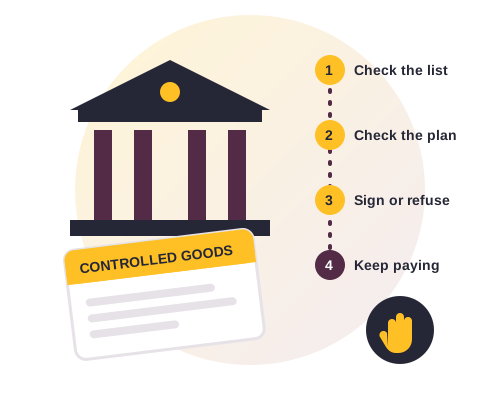
What is a controlled goods agreement?
When a bailiff (enforcement agent) visits, they can "take control" of your goods. Instead of taking them away, they usually ask you to sign a controlled goods agreement. You may hear it called a walking possession agreement. It means:
- you keep and use the listed goods
- you agree to pay the debt and fees by a set plan
- you mustn't sell, move or give away the listed goods while it lasts
- the bailiff can come back and remove the goods if you don't pay
It's a legal step in the enforcement process, not just a payment plan. Signing one gives the bailiff powers they didn't have before, so read it carefully.
When will I be asked to sign one?
- At your door or inside your home, after the bailiff has listed goods.
- On the highway, after clamping a vehicle you own. The agreement covers the vehicle.
- By phone or letter, without a visit. This is sometimes called a "virtual" or non-entry agreement, which lists goods you've described. Take advice before agreeing to one.
A bailiff can only do this after the deadline on your Notice of Enforcement has passed.
Should I sign a controlled goods agreement?
| Reasons to sign | Reasons to be careful |
|---|---|
| Stops goods or your car being removed that day | If you break it, the bailiff can force entry to your home to take the listed goods |
| Gives you time to pay by instalments | The payments asked for may be more than you can afford |
| Avoids the sale fee and auction costs | The list may include goods that should be protected or aren't yours |
- Only agree to payments you can keep up. Pay rent, energy, food and council tax first, and offer what's left.
- Check the list before you sign. Point out anything that's protected or belongs to someone else, and ask for it to be removed.
- Ask for time to get advice, if you can. A free debt adviser can help you negotiate the payments.
What happens if I don't sign?
You don't have to sign. But if the bailiff has already taken control of goods, they can:
- remove the goods straight away to sell them, which adds the £116 sale fee (plus 7.5% of a debt over £1,900) and storage and auction costs
- secure goods where they are, for example in a locked room or, in some cases, a whole business premises
- leave a vehicle clamped and tow it away, usually after at least two hours if it's on the road
If the bailiff hasn't been inside and hasn't clamped anything, you can refuse entry for most debts. Offer a payment plan through the door or by phone instead. See can bailiffs force entry.
Who can sign a controlled goods agreement?
You, the person who owes the debt, or someone the bailiff reasonably believes you've authorised to sign for you. A bailiff shouldn't ask a child, or someone who clearly doesn't understand what they're signing, to sign. If someone signed without your permission, or a vulnerable person was pressured into signing, complain and get advice.
What can and can't be listed?
Bailiffs can list goods that belong to the person who owes the debt and aren't protected, such as a TV, games console, jewellery, a second car or a car you own outright. They can't list:
- basic household items your household needs, like a cooker, fridge, washing machine, beds, bedding and a table and chairs
- tools, equipment and vehicles you need for work, up to £1,350 in total (this protection doesn't apply to business rates)
- pets, guide dogs and assistance dogs
- vehicles with a valid Blue Badge, or used to carry a disabled person
- goods owned only by someone else, such as a partner, child, lodger or landlord
Goods you own jointly can be listed, but the bailiff can only claim your share. Goods on hire purchase or conditional sale are a grey area: tell the bailiff and show the agreement. See what bailiffs cannot take and things on finance.
What must the agreement say?
A controlled goods agreement must be in writing and signed by you (or your authorised representative) and the bailiff. You must get a copy. It should show:
- the goods taken into control, described clearly enough to identify them
- the total debt and fees
- the payment plan: amounts, dates and how to pay
- that you mustn't remove or dispose of the goods
- what happens if you miss a payment
The bailiff must also leave a notice after entry, or after clamping a vehicle, listing what's been taken into control.
What happens after I sign?
- Keep paying on time, and get receipts or keep bank records of every payment.
- Don't sell, move or give away the listed goods. Doing so can be a criminal offence.
- If your circumstances change, write to the bailiff firm straight away, explain what's changed and offer a new amount you can afford, with your income and outgoings. If they won't agree to a reasonable offer, ask the creditor to step in.
What happens if I miss a payment?
- Notice of re-entry. The bailiff must give you at least 2 clear days' notice before coming back to inspect or remove the goods.
- Re-entry. They can come back in, using reasonable force if needed, to remove the listed goods. This applies even for debts where they couldn't force entry before.
- Removal and sale fee. The £116 sale fee (plus 7.5% of a debt over £1,900) is added. High Court cases have a second enforcement fee.
- Notice of sale. You must get at least 7 clear days' notice before the goods are sold, usually at auction.
Contact the bailiff before a payment is due if you can't make it, and ask to change the plan. If you get a re-entry notice, get advice straight away.
What if I was pressured to sign, or the list is wrong?
If you were pressured into agreeing payments you can't afford, or the list includes protected goods or someone else's property, write to the bailiff firm and the creditor. Ask for the plan to be reviewed and the goods removed from the list, and put enforcement on hold. If that doesn't work, complain about the bailiff. The owner of goods wrongly listed can also apply to the court using an N244 form.
When does a controlled goods agreement end?
It ends when the debt and fees are paid in full, or if the debt is returned to the creditor or cancelled. The listed goods are then released. Ask the bailiff firm for written confirmation, and keep it.
Struggling to keep up bailiff payments?
Tell us about your debts and a licensed insolvency practitioner will call you back to talk through your options. It's free, with no obligation.
Questions about controlled goods agreements
Do I have to sign a controlled goods agreement?
No. But if the bailiff has already taken control of goods, they may remove them straight away. Only sign if you can afford the payments.
Can a bailiff force entry after I sign a controlled goods agreement?
Yes, if you break the agreement. They must give you at least 2 clear days' notice, and can then re-enter, using reasonable force if necessary, to remove the listed goods.
Can a bailiff list my car on a controlled goods agreement?
Yes, if you own it and it isn't protected. A car with a valid Blue Badge, or needed for work up to £1,350, is protected for most debts.
Can my partner sign a controlled goods agreement for me?
Only if the bailiff reasonably believes you've authorised them. Your partner's own goods shouldn't be listed for your debt.
Can I sign a controlled goods agreement over the phone?
Some bailiff firms offer a “virtual” agreement by phone or letter, without a visit. Get advice first, as breaking it has the same consequences.
Can I change the payments on a controlled goods agreement?
Yes, ask the bailiff firm in writing with your budget. If they refuse a reasonable offer, ask the creditor to step in.
Can I sell something listed on a controlled goods agreement?
No. Selling, moving or giving away listed goods can be a criminal offence.
What happens when I've paid off a controlled goods agreement?
The agreement ends and the goods are released. Ask for written confirmation.
