
Why searching for terrible credit loans online is a warning sign: it's not going to get better
If you've reached the point of searching for loans for terrible credit, mainstream lenders have probably already said no. That usually means one or more of these:
- you've missed payments, or have defaults or a County Court judgment
- you're already using most of your available credit
- your income doesn't comfortably cover your bills and debt repayments
Lenders turning you down is often a sign that more borrowing isn't affordable. The loans still available to you will be the most expensive and the riskiest, and they're least likely to solve the problem. If it's a consolidation loan you're after, that's even more true: a high-cost loan to clear cheaper debts usually leaves you paying more.
What "terrible credit" loans usually are
| Type | What to watch out for |
|---|---|
| Payday and short-term instalment loans | Very high interest. Easy to fall into borrowing again to repay the last loan. |
| Doorstep and home credit loans | Weekly payments that look small but carry a high total cost |
| Guarantor loans | Your friend or relative could have to pay everything you owe |
| Logbook loans | Secured on your car, which can be taken if you fall behind |
| Secured or homeowner loans | Your home is at risk if you can't keep up |
| Rent-to-own | You don't own the goods until you finish paying, and the total price is high |
| "Loans" from unlicensed lenders | Illegal. Loan sharks often use threats and take your bank card. See below. |
The real cost of high-cost short-term loans
Payday loans and other high-cost short-term credit are covered by a price cap set by the Financial Conduct Authority:
- interest and fees can't be more than 0.8% a day of the amount borrowed
- default fees are capped at £15
- you'll never pay back more than double what you borrowed, in total
That still makes them very expensive. Borrowing £100 for 30 days can cost up to £24 in interest, and the costs build up quickly if you can't repay on time. Using one to pay off other debts is almost always a bad idea.
A perfect credit loan vs a terrible credit loan: what £20,000 really costs
Your credit history makes a huge difference to what you pay. Here's how the same £20,000 loan over 5 years compares.
| APR | Monthly payment | Total interest | Total repaid |
|---|---|---|---|
| 5.9% | £384 | £3,058 | £23,058 |
| 7% | £394 | £3,640 | £23,640 |
| 15% | £466 | £7,958 | £27,958 |
| 20% | £512 | £10,715 | £30,715 |
| 25% | £558 | £13,501 | £33,501 |
| 29.9% | £604 | £16,247 | £36,247 |
Illustrative figures: £20,000 borrowed, fixed APR, 60 monthly repayments, no fees. Rounded to the nearest pound. Real quotes vary by lender and applicant.
That's about £7,650 more for the same £20,000, and around £128 a month extra. At 29.9%, the extra cost is over £13,000.
- A poor credit history means much higher rates. The advertised "representative" rate only has to be offered to just over half of the people accepted.
- Many people with serious credit problems won't get an unsecured loan of this size at all, and may only be offered secured or guarantor borrowing.
- Borrowing more isn't always the answer. Paying an extra £7,000 to £13,000 in interest to clear debts you're already struggling with can make the problem worse.
Compare that with the options below. A Debt Management Plan adds no new interest and often gets existing interest frozen, while an IVA or Debt Relief Order can write off what you can't afford.
Red flags: when a "loan" could be a scam
- "Guaranteed approval" or "no credit checks". Legitimate lenders must check that you can afford to repay.
- An upfront fee before you get the money. This is a common scam, known as loan fee fraud.
- Pressure to decide quickly, or contact out of the blue by text, social media or phone.
- Brokers who charge you to "find" a loan. Check what you'll pay before giving any details.
- A lender that isn't on the FCA register. Always check before you apply.
- Someone asking for your bank card, PIN or ID documents as "security". That's a sign of a loan shark.
If you've borrowed from a loan shark, you're not in trouble. Report them in confidence to the Illegal Money Lending Team on 0300 555 2222 in England, or Stop Loan Sharks Wales on 0300 123 3311.
Your other options at a glance
None of these involve borrowing more, and none need a good credit score.
Debt Management Plan (DMP)
One affordable monthly payment for your non-priority debts. Free from debt charities, and there's no credit check.
See DMP details ↓ Write off debtIVA
Pay what you can afford for 5 to 6 years, then the rest of the debts included are written off.
See IVA details ↓ Write off debtDebt Relief Order
Free, for debts under £50,000 with a low income. The debts are written off after 12 months.
See DRO details ↓ Short-term protectionDebt Breathing Space
60 days' protection from interest, charges and enforcement, including bailiffs, while you get advice.
Read the guide → Fresh startBankruptcy
Most debts written off, usually after a year, if there's no realistic way to repay.
Read the guide →Option 1: a Debt Management Plan (DMP)
A Debt Management Plan is the closest thing to a consolidation loan, without the loan. Instead of borrowing to clear your debts, you make one affordable monthly payment to a DMP provider, who shares it between your creditors.
| What it is | An informal agreement to repay your non-priority debts at a rate you can afford |
|---|---|
| Credit check? | No. It isn't new borrowing. |
| Debts it covers | Credit cards, loans, overdrafts, catalogues, payday loans and buy now, pay later. Not priority debts like council tax or rent. |
| Cost | Free from debt charities such as StepChange and PayPlan. Some companies charge fees. |
| How long | Until your debts are repaid in full |
| Interest | Your provider asks creditors to freeze interest and charges. Many do, but they don't have to. |
| Flexibility | You can change, pause or stop it at any time |
- Good for: people who can afford a regular payment and want to repay in full, but can't keep up with the full contractual payments.
- Watch out for: nothing is written off, it isn't legally binding so creditors can still take action, and your credit file will usually show arrears or defaults.
Read our full Debt Management Plan guide.
Option 2: an IVA (Individual Voluntary Arrangement)
If your debts are too big to repay in a reasonable time, an IVA lets you pay what you can afford for a fixed period, after which the rest of the debts included are written off. It's a formal, legally binding agreement set up by a licensed insolvency practitioner.
| What it is | A formal agreement with your creditors to pay part of what you owe |
|---|---|
| Credit check? | No. It isn't new borrowing. |
| Who it suits | Usually people owing several thousand pounds to two or more creditors, with a regular income |
| How long | Usually 5 to 6 years |
| Approval | Creditors owed 75% of the debt must agree. It then binds all of them. |
| Protection | Interest is frozen, and creditors in the IVA can't take further action, including bailiffs |
| Cost | Fees are taken from your monthly payments, not paid upfront |
| Your home | Under the IVA Protocol, your family home is no longer part of the IVA |
- Good for: people with larger unsecured debts they can't repay in full, who have a steady income and want to avoid bankruptcy.
- Watch out for: it's a long commitment, there are fees, it's on a public register and your credit file for 6 years, and it can fail if you can't keep up. If you qualify for a free Debt Relief Order, that's usually the better option.
How much is written off depends on your circumstances, and no one can promise a percentage in advance. Read our full IVA guide.
Option 3: a Debt Relief Order (DRO)
If you have a low income and few assets, a Debt Relief Order could clear your debts completely, and it's free. For 12 months you don't pay the debts in the DRO, and if your situation hasn't improved by the end, they're written off.
| What it is | A formal way to write off debts if you can't afford to pay them |
|---|---|
| Credit check? | No. It isn't new borrowing. |
| Who qualifies | Debts under £50,000, less than £75 a month spare income, assets under £2,000 (plus a vehicle under £4,000), and you don't own your home |
| Cost | Free. There's no fee. |
| How long | 12 months |
| How to apply | Through an approved debt adviser at a free advice service. You can't apply on your own. |
| Protection | Creditors in the DRO can't chase you, including bailiffs for debts like council tax arrears |
| Debts it can't include | Magistrates' court fines, student loans, child maintenance and Social Fund loans |
- Good for: people on a low income, including many on benefits, with modest debts and little or nothing to spare each month.
- Watch out for: it's on a public register and your credit file for 6 years, you can't borrow over £500 without saying you have a DRO, and it can be cancelled if your income or assets go up during the 12 months.
If you qualify for a DRO, it's usually better than an IVA, because it's free and much shorter. Read our full Debt Relief Order guide.
Next steps: what to do instead of a terrible credit loan
Before you apply for one more loan, look at options that don't involve new high-cost borrowing:
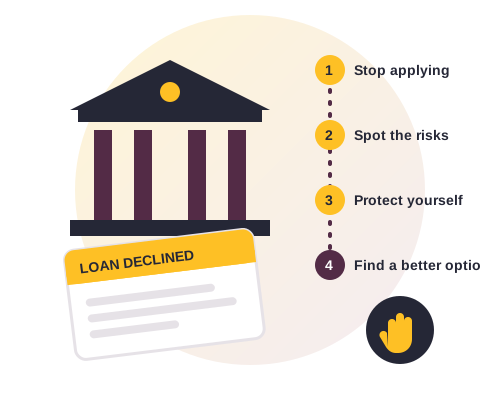
- Stop applying. Every rejected application leaves a search on your credit file, which makes the next one even harder.
- Get some breathing room. Debt Breathing Space gives you 60 days' protection from interest, charges and enforcement, including bailiffs, while you get advice.
- Check for cheaper or free help. Credit unions often lend to people with poor credit at capped rates. If you're on certain benefits, you may be able to get an interest-free Budgeting Loan or Budgeting Advance, or help from your council's local welfare scheme.
- Talk to your creditors. Many will freeze interest or accept lower payments if you show them a realistic budget.
- Consolidate without a loan. A Debt Management Plan combines your debts into one affordable payment, with no credit check and no new borrowing.
- Look at writing off what you can't afford. An IVA, Debt Relief Order or bankruptcy may suit you if you can't repay in full.
Still thinking about consolidating? Read our guide to Debt Consolidation Loans with bad credit, and our post should I try to borrow my way out of debt?
Need money because bailiffs are at the door? Don't take a high-cost loan to pay them. Offer an affordable payment plan, and see how to stop bailiffs.
Turned down for credit again?
Tell us about your debts and a licensed insolvency practitioner will call you back to talk through your options. It's free, with no obligation.
Questions about terrible credit loans
Can I get a loan with terrible credit?
Possibly, but usually only from high-cost lenders, or with security or a guarantor. If mainstream lenders keep saying no, it's often a sign that more borrowing isn't affordable, and other options may be safer.
Are 'guaranteed approval' loans real?
No legitimate lender can guarantee approval, because they must check you can afford to repay. 'Guaranteed' or 'no credit check' offers are a red flag for scams or illegal lenders.
How much can a payday loan cost?
Under the FCA price cap, interest and fees can't be more than 0.8% a day of the amount borrowed, default fees are capped at £15, and you'll never repay more than double what you borrowed. That's still very expensive.
Can I get a consolidation loan with terrible credit?
It's unlikely to be at a rate that helps. A high-cost loan to clear cheaper debts usually leaves you paying more. A Debt Management Plan can combine your payments without a credit check or new borrowing.
Should I pay a fee to get a loan?
No. Never pay an upfront fee before receiving a loan. It's a common scam. Check any lender or broker is authorised on the FCA register.
Will applying for more loans hurt my credit?
Yes. Each full application leaves a search on your credit file, and several in a short time can make lenders more likely to say no.
What is a Debt Management Plan?
A Debt Management Plan is an informal agreement to repay your non-priority debts with one affordable monthly payment, shared between your creditors. There's no credit check, and free DMPs are available from debt charities. You repay what you owe in full.
What is an IVA?
An IVA is a formal agreement to pay what you can afford towards your debts, usually for 5 to 6 years, through a licensed insolvency practitioner. Interest is frozen, creditors in the IVA can't take action, and the rest of the debts included are written off at the end.
What is a Debt Relief Order?
A Debt Relief Order is a free way to write off debts if you owe less than £50,000, have less than £75 a month spare income and few assets, and don't own your home. It lasts 12 months, then the debts included are written off. You apply through an approved debt adviser.
Is a DMP, IVA or DRO better than a bad credit loan?
For most people who can't get mainstream credit, yes. None of them involve new borrowing or a credit check. A DMP repays your debts in full at an affordable rate, while an IVA or DRO writes off what you can't afford. Free advice can help you choose.
How much more does a loan cost with bad credit?
A lot more. As an illustration, £20,000 over 5 years costs about £23,060 in total at 5.9% APR, but about £30,700 at 20% APR. That's around £7,650 more for the same loan, and over £13,000 more at 29.9%.
Where can I get money in an emergency with bad credit?
Try a credit union, an interest-free Budgeting Loan or Budgeting Advance if you're on certain benefits, or your council's local welfare scheme. Free debt advice can also help you find support you may be missing.
